
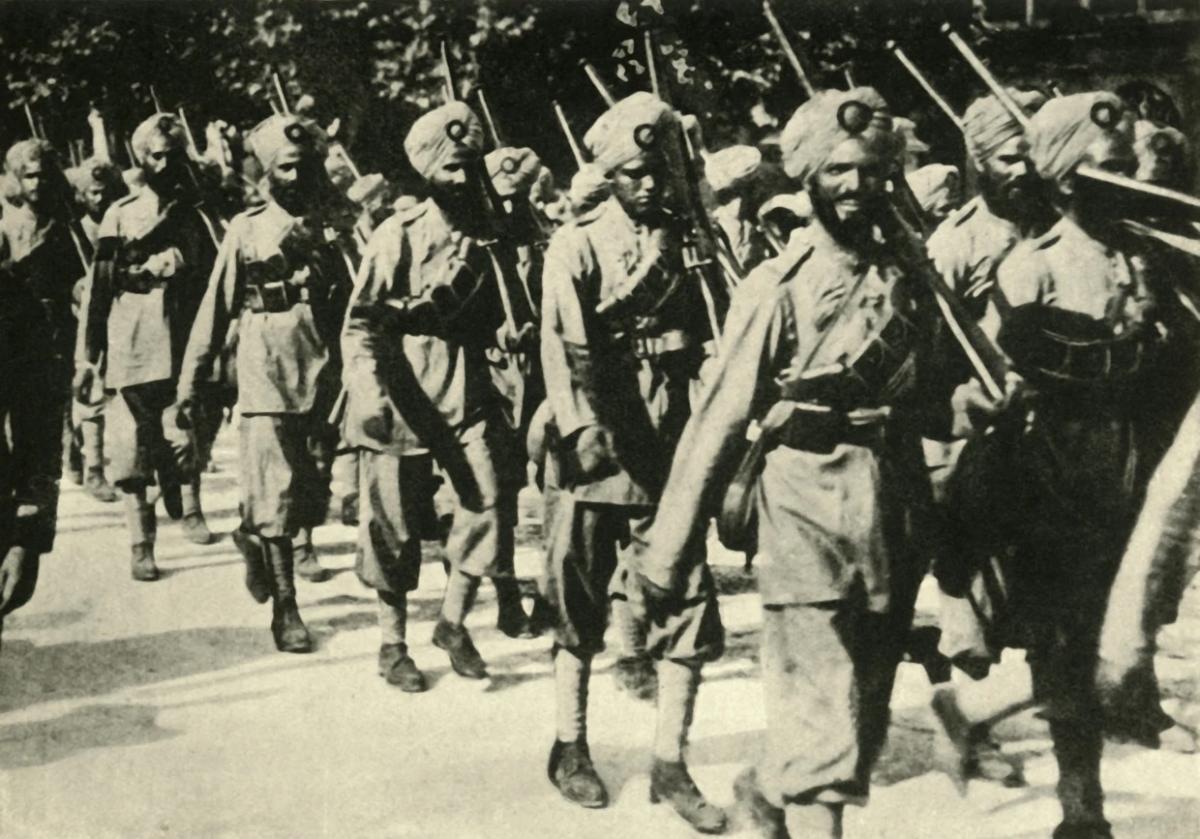
Over the course of World War I, over one million Indian soldiers fought in Europe on the side of Britain. The Indian soldiers primarily fought in the Western Front against German forces. The Indian Army was an all volunteer army. The promise of improving one’s caste standing by joining a more respectable profession incentivized many men to enlist. In 1914, the army had a total of 214,000 men. Throughout the course of the war, over 800,000 men volunteered to serve in the army. However, despite the large number of troops, the British government did not properly supply them with the proper equipment, food rations, medical supplies, and other necessities for the war effort. What’s more, World War I saw the introduction of new weapons technology that the Indian forces were not trained for. This made fighting not only inefficient, but also substantially more dangerous, as Indian soldiers were often sent to the front lines. Ultimately, over 60,000 Indian soldiers died in World War I. Interestingly, there are few memorials to the Indian soldiers. Potentially, this is due to the rising nationalist and anti-British sentiments of the period. India’s participation in the war served as a reminder of British colonialism, which likely would not have been popular in the twentieth century political climate in India.
While World War I is not explicitly discussed in Haimabati Sen’s work, a connection does appear in the caption of a picture of her son, Atmajyoti Sen. The caption reads, “Atmajyoti Sen (1895-1970), Haimabati's second son who joined the Indian Medical Service and served as a captain in Mesopotamia in World War I. Taken c. 1918” (205). When listing the professions of her children, for Atmajyoti she writes, “The second son is a doctor and practices medicine” (236) and makes no mention of his time spent in the military during the war. The conspicuous absence of World War I despite Sen’s direct connection to it and the value she places in her son as a doctor may reflect the shifting attitudes towards the British Empire. Either it was not acceptable to honor his service at this time, or Sen herself did not deem it worthy of mention. Regardless, the absence of World War I from the text is a striking omission that may point to changing attitudes in twentieth-century India.
Citations:
“Why the Indian Soldiers of WW1 Were Forgotten.” BBC News, 2 July 2015, www.bbc.com/news/magazine-33317368.
Jarboe, Andrew T. “Introduction.” Indian Soldiers in World War I: Race and Representation in an Imperial War, University of Nebraska Press, 2021, pp. 1–26. JSTOR, https://doi.org/10.2307/j.ctv1mjqprg.5.
Bostanci, Anne. “How Was India Involved in the First World War? | British Council.” Www.britishcouncil.org, 30 Oct. 2014, https://www.britishcouncil.org/voices-magazine/how-was-india-involved-first-world-war