
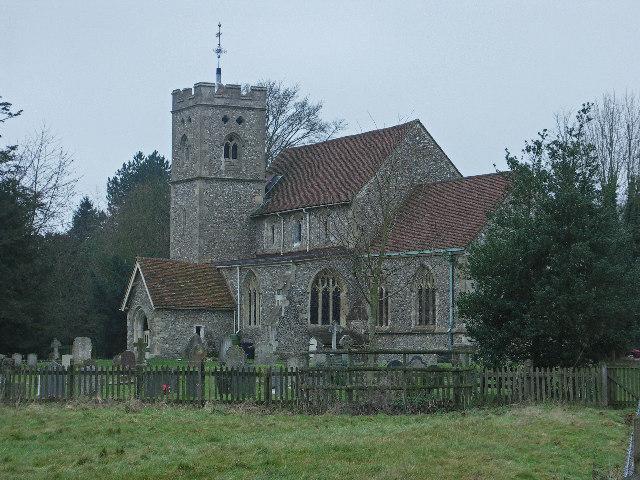
(at St. Mary Magdalene church)
Victor mentions visiting the "tomb of the illustrious [John] Hampden" on his tour with Clerval as he procrastinates on his promise to make the monster a bride. It appears alongside a moment in which Victor, inspired by "the divine ideals of liberty and self-sacrifice," gains a moment of clarity (or further obscurity, depending) and seems briefly energized before returning to his despair.
John Hampden was a famous Parliamentarian who died during the English Civil War in 1643. He was buried here in the parish church. The "field on which that patriot fell" is Chalgrove Field near Thame. His great-grandson later built a monument in 1743 to honor him. These "divine ideals" that inspired Victor came from Hampden's opposition in Parliament to the king's ship tax. Interestingly, his mortal wound may have been caused by the malfunction of his own gun. He appeared to be a well-respected, outspken political in opposition to the king.
This location is where one of Victor's many mood swings takes place. He becomes temporarily enlightened by some intellectual or natural stimulus, only to soon fall back into self-pity. It is ironic that Victor explicitly notes self-sacrifice as one of the Hampden's virtues he admires, as all his loved ones are sacrificed to the monster's vengeance except for him. Both the continual self-pity and this semantic choice are examples of Victor's victim mentality that dooms his loved ones and, eventually, himself.
Ellis, David. “Church of St Mary Magdalene, Great Hampden,” Geograph, 4 Jan. 2006, www.geograph.org.uk/photo/102265.
“BCW Project.” Bcw-Project.org.uk, 2026, www.bcw-project.org.uk/biography/john-hampden.