
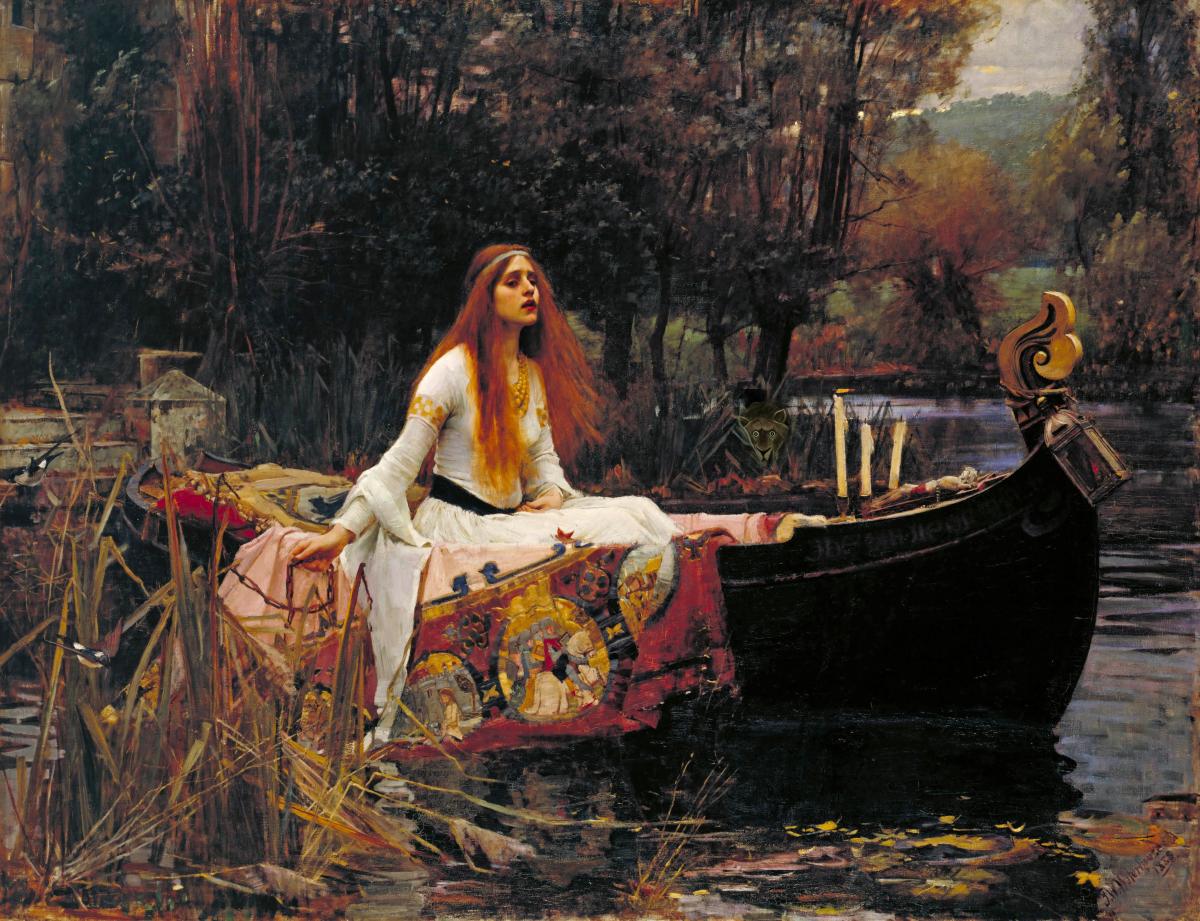

The painting entitled The Lady of Shalott was done by John Waterhouse in the year 1888. It is based on a poem by Alfred Lord Tennyson. The poem is about a river that people sail on their way to Camelot. There are disagreements over what the painting and poem’s overall message is. However, there seems to be a universal consensus that it highlights the connection between life and art. The painting itself is based specifically on the fourth section of the poem. This particular section follows a woman travelling on a boat. Like other travelers on the river, she is on her way to Camelot. During her journey, she frequently makes “chanting” noises, which the author calls her “deathsong”. Unfortunately, she dies before her boat reaches Camelot.
The painting depicts a woman in a white dress floating on a boat. She is sitting on a red blanket, and there are three candles sitting on the front edge of the boat. She is floating away from what appears to be a set of spiral stairs leading into a forest. The woods are a combination of dark green and brown shades. The lily pads in the water share this same set of coloring as well. On the front of the boat, there is a golden and black sculpture in the shape of a flame. In the distance, there are tall mountains overlooked by a somber and cloudy sky. She is wearing a white dress that is looser at the sleeves. There are gold rings on the higher points of the sleeves near her shoulders. She is wearing a gold necklace with three rows. She has a navy-blue waistband since the dress gets looser towards the bottom. She wears a thin grey headband to keep her hair out of her face. Her fashion is inconsistent with what Victorian women typically wore during the 1880’s. During this era, women were wearing high-dresses that covered the neck area. As seen in the painting, Waterhouse paints the dress to reveal her neck. She is also not wearing a waist corset, which was a typical element of female dress during this era. It was also typical to wear a “half-coat” and she isn’t sporting this either. This was by design, as Waterhouse didn’t want her to appear in “modern attire”. Since the poem is about a river to Camelot, Waterhouse would have wanted the woman to look more Arthurian (medieval) rather than Victorian. Her emotional expression is one of the most unique aspects about the painting. As she looks off into the distance, she appears to be crying. Her eyes are red, and her mouth is open, which suggests she can’t breathe through her nose. The painting’s brighter colors are confined to her and the boat. The darker shades make up her surroundings. It is as if she represents a bright light travelling into the dark unknown world. The red blanket that she is sitting on has a distinct pattern on it. There is a picture of a horse and a castle on one of the squares. This design is another indicator of Waterhouse’s goals when it comes to this painting. He wants the audience to see her as a medieval woman. Unlike Victorian women, her hair isn’t tied up, or hidden under a hat. It has substantial length, and it is separated from her forehead. Her physique appears realistic, and lacks unnatural refinement. Each one of these aspects helps contribute to Waterhouse’s message. I believe that both he and Tennyson are trying to shed light on the historical oppression of women. During my discussion of the Matrimonial Causes Act of 1878, I learned that a form of abuse women suffered from during the Victorian era was abandonment. In the painting, the woman is sad, and she is floating off alone into the dark unknown. There isn’t even anyone at the steps to see her off. I believe that Waterhouse and Tennyson are symbolizing the frequent abandonment that women have faced throughout history. The poem by Tennyson confirms this scenario as well. Before the woman arrives in Camelot, she dies. Since she was alone on her journey, she had no one to help her. During the Victorian era, women had little to no legal protection. Therefore, women had no financial or legal help once they were abandoned. This helpless scenario is similar to that of the woman on the boat.
Tennyson, Alfred Tennyson, and Geneviève Côté. The Lady of Shalott. KCP Poetry, 2009.
Wright, Jane. “A Reflection on Fiction and Art in ‘The Lady of Shalott.’” Victorian Poetry, vol. 41, no. 2, 2003, pp. 287–290., doi:10.1353/vp.2003.0026.
Seddon , Keith, and Jocelyn Almond . The Lady of Shalott .