
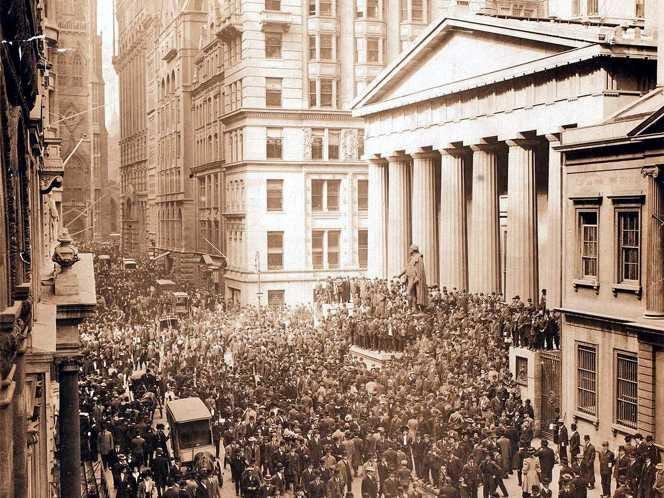

During the Panic of 1907, shadow banks, specifically New York trust companies, played a big role in the onset of it. Shadow banks act as financial intermediaries that have similar qualities to commercial banks but are not formally established as one. Some examples include mortgage lenders, trust companies, investment banks, etc., but in the case of the Panic, trust companies happened to be the source of contempt and disaster at the time. One of the primary causes of the Panic began with runs on shadow banks which rose exponentially when nonfinancial corporations began to withdraw their money from their trusts to which these companies were unable to support this mass withdrawal.
This “panic” rose from the instability one of the main trust companies of New York, Knickerbocker, suffered. The president of Knickerbocker, Charles W. Morse, along with mining entrepreneur Augustus Heinze were involved in acquiring shares of United Copper Company and other smaller banks a part of NYCH (New York Cross Harbor Railroad), but this ended up falling through. This was due to a run on the Mercantile National, one of the banks that Morse was heavily involved with. The Mercantile National received public support from NYCH, and many knew that this was associated with Morse and his considerable investment. As a result, NYCH requested that all the members of the Mercantile board of directors be dismissed because of the disaster that had begun to strike.
The events that followed included the eventual dismissal of Morse from Knickerbocker Trust in which Knickerbocker had to publicly prove their stability so their depositors would not withdraw. However, they no longer had the National Bank of Commerce as their clearing agent which sent the public, nonfinancial corporations into a frenzy and soon after led to the perpetual panic. Knickerbocker specifically paid out $8 million in a matter of three hours on October 21. A domino effect took place where multiple surrounding banks were experiencing the same mass withdrawals as they caught word of the scandal that involved Morse and wanted nothing to do with anything he was associated with. Knickerbocker was soon forced to close as well as other trust companies. Trust in these banks that held people’s life savings had dissipated which did not bode well for the economy.
J.P. Morgan as well as the US Treasury offered emergency assistance to these other suffering trust companies except for Knickerbocker as the large sum of money lent played a substantial part in pulling them out of the crisis. Knickerbocker acted as one of the primary catalysts in the Panic of 1907 which resulted in soaring interest rates and considerable financial losses for the public depositors. It only took a handful of powerful men to make poor investment decisions and a scandal to send the country, namely New York, into a now historically significant crisis.
The economic effects were felt by many as the Knickerbocker Trust was one of the main turning points that plunged the US into a major recession, preluding the Great Depression. Inflation and interest rates did not allow for people already financially suffering to sustain their lifestyles, and the ones who were not were still significantly impacted.
Works Cited
Frydman, Carola, Hilt, Eric, Zhou, Lily. "Economic Effects of Runs on Early 'Shadow Banks': Trust Companies and the Impact of 1907." The Journal of Political Economy, vol. 123, no. 4, pp. 902-940, 2015. Purdue Libraries. https://web-s-ebscohost-com.ezproxy.lib.purdue.edu/ehost/detail/detail?vid=0&sid=614dbe5a-f1f7-4fd4-9202-75af55da09bf%40redis&bdata=JnNpdGU9ZWhvc3QtbGl2ZQ%3d%3d#AN=108825128&db=bth
Moen, John & Tallman, Ellis. "Panic of 1907." The New Palgrave Dictionary of Economics, pp. 10007-10008, 2018. Purdue Libraries. https://link-springer-com.ezproxy.lib.purdue.edu/referenceworkentry/10.1057%2F978-1-349-95189-5_1971
Rodgers, M.T. & Wilson, B.K. "Systemic risk, missing gold flows and the panic of 1907." The Quarterly Journal of Austrian Economics, vol. 14, no. 2, pp. 158+, 2011. Purdue Libraries. https://go.gale.com/ps/i.do?p=AONE&u=purdue_main&id=GALE%7CA267519028&v=2.1&it=r