
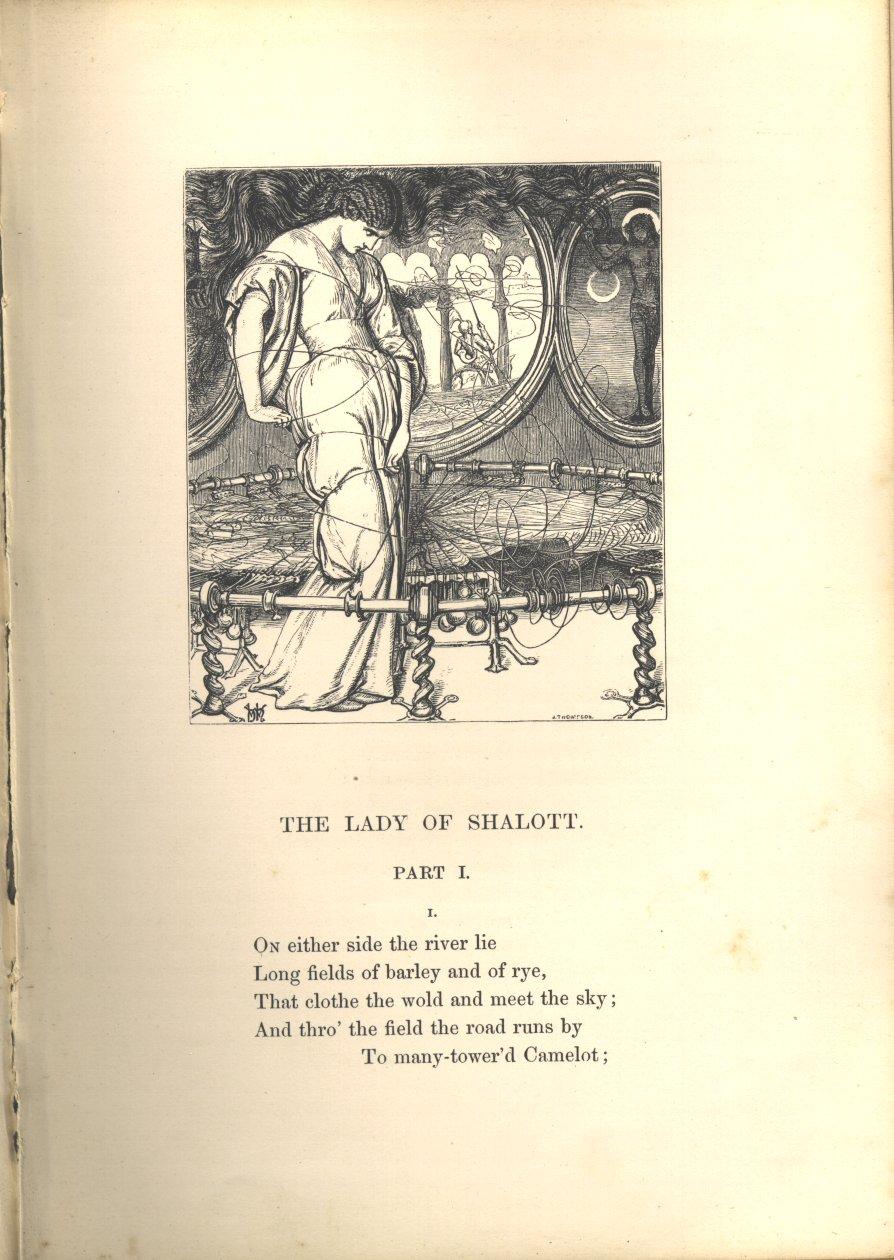
“The Lady of Shalott” is an inset illustration by William Holman Hunt, and engraved by the Dalziels in 1857. It is a 4.2 x 3.6 inches wood engraving that is found within The Moxon Tennyson. Hunt’s illustration depicts the titular Lady of Shallot at a moment where she begins to go mad in her isolation. This unfurling of her mental state is powerfully signified by her unruly hair, and the threads of her weaving tangling all over the picture. Notably, Hunt’s illustration is proleptically placed before the text of the poem, establishing a menacing tone that contrasts the opening stanza of the poem. Tennyson famously disliked Hunt’s interpretation of his text, claiming that Hunt’s depiction of the Lady of Shallot was not based in the text. Tennyson’s poem, however, had been in the minds of the public readership for decades since its original publishing in 1832, and Hunt’s interpretation was no doubt influenced by his own time spent with the text over 25 years as well as public and critical reception.
Culturally, the illustration depicts the societal tensions surrounding women’s rights in the 1850s. The Victorian period was notoriously restrictive for women, who were expected to remain in the domestic sphere and adhere to strict gender roles of passivity, domesticity, and purity. At the same time, this decade saw several changes at the policy level to women’s rights, including a presentation to the House of Lords for Women’s Suffrage, and an 1852 ruling that said a man may not force his wife to live with him. Tennyson’s “The Lady of Shalott” deals with these themes of the domestic isolation of women, and the negative consequence it has on their psyches. Hunt’s illustration interprets these themes in cultural context, and visibly represents the societal constraints women of this time experienced through illustrating the Lady of Shallot as being tangled up in the threads of her weaving. This entanglement symbolizes the ways in which Victorian women were trapped by their domestic duties, the same way the Lady of Shallot is trapped in her tower by a curse and is driven mad by isolation as a result.
Sources:
http://www.branchcollective.org/?ps_articles=lorraine-janzen-kooistra-t…
http://www.victorianweb.org/history/wmhisttl.html
https://www.bl.uk/romantics-and-victorians/articles/an-introduction-to-the-lady-of-shalott
http://www.victorianweb.org/authors/tennyson/losillus1.html
Submitted by Kyle Sarjeant, Faye Hamidavi, Anali Jaikarran, Selina Lafarciola and Marina Arnone