

Display Explanation:
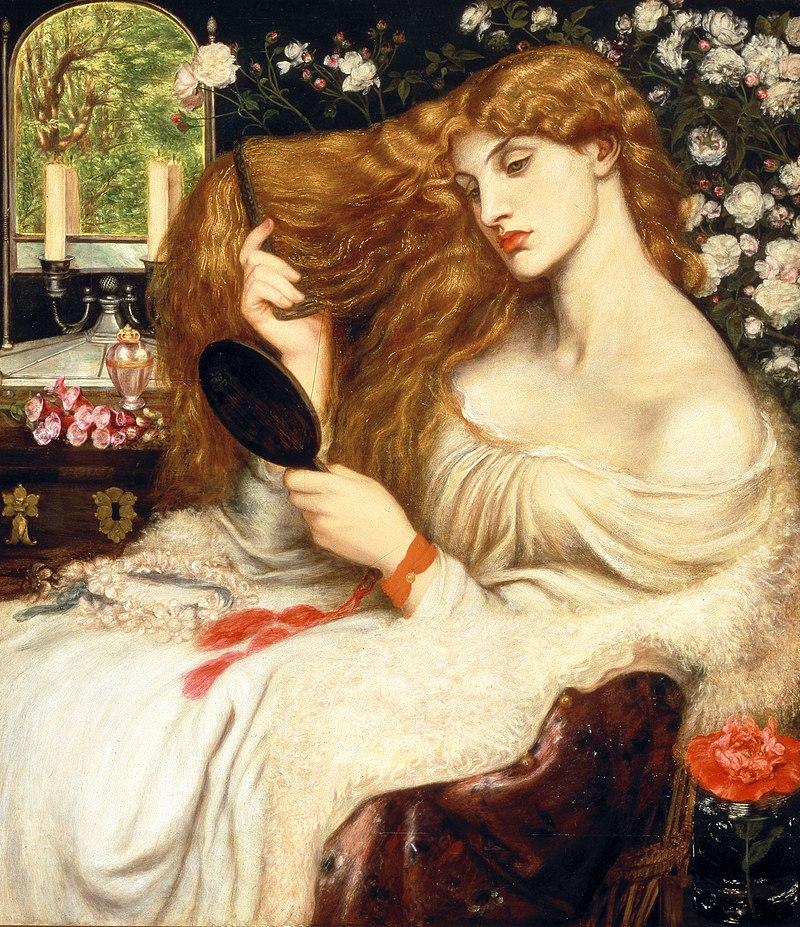
My installation will be located in a fifteen feet (wide) by 30 feet (long) display room. It will also consist of a ten feet high ceiling, allowing the paintings to come alive within the viewer’s imagination. There will be no door to enter this standalone display room, however the indicator that you’ve entered will be the shift of color from brown to black within the floor. The room will present the viewer with an eerie feeling upon entrance, as most of it will be very dark. The floor remains black throughout the entire room, and it also remains black upon the ceiling. However, the left and right walls upon entering the room will be a dark shade of red, such as mahogany. This is in correlation to the paintings that I’ll be placing upon those walls, which are Lady Lilith and Lamia. The dimensions of those two paintings are 96.5 cm x 85.1 cm (38 in x 33.5in) for Lady Lilith and 183 cm x 230cm (71 in x 91 in) for Lamia. Everyone will be starting along the left side of the room, and will make their way to each painting, but without access to skip the intended order as guards will be in place. Also, within the middle of the room, there will be a single four and a half feet high stand, with a bouquet of flowers placed on it. Those will consist of different shades of red and pink flowers as they are featured in two of the paintings included in my installation. To start the viewer’s experience, they will be greeted by Lady Lilith, which also happens to be the smallest of the three paintings. I chose to start with Lady Lilith due to the positioning of her body within the painting, as her face is pointed toward the viewers as they are walking in the room. It was also the painting that was created first, which was in 1867. There will be candles, which are fake, placed beside the bottom corners of the painting to represent the room that Lilith was painted in. Each image will be placed front and center upon each wall they are assigned to, leaving plenty of room in between them and for accessories to propel their appearance. The next painting within the room is Lady Godiva, and she is placed upon the lone white wall. Although you’ll learn more about it in my installation note, Godiva represents the light placed between the dark, as although she used her body to obtain what she wanted, it was in good faith. Lady Godiva is 142.2cm x 183 cm (55.9in x 72 in) in size, making it the second largest image within the room, and displaying the increase that is prevalent as you progress throughout the paintings. I chose not to include accessories within the Godiva display as she was able to help other people through riding a horse naked, so the painting deserves a “naked” background to support it. After viewing Lady Godiva, the viewer will continue to walk until they reach the final and largest painting, Lamia. As the painting will be placed upon another mahogany wall, it will also be accompanied by a knight’s sword and helmet. They will resemble the armor of the knight that she presumably murdered, and the sword will be mounted to the left of the painting, and the helmet will be placed upon a stand to the right of the painting. After viewing Lamia, the viewer must exit the room and re-enter from the original starting point if they wish to view the display room again.
Installation Note:
Each woman depicted within the paintings used their body to their own advantage, displaying a high level of power. The display room cycles through each woman, and displays their unique ways of accomplishing that goal. Although the other two reach that level of dominance in an evil manner, Lady Godiva was able to gain power using her body in a positive manner. That is why I chose to have Lady Godiva be the second and middle image within the installation, as she displays the selflessness between them.
In Lady Godiva, the composition of the image elicits stateliness. The horse is dressed elegantly, and Collier chose to have it moving parallel to the image’s viewpoint, only showing Lady Godiva from one side. The viewer will notice that she is naked but can also be distracted by the long red dress-like object covering the horse, the finely detailed saddle that she is riding on, and the fact that she is attempting to cover herself up. Lady Godiva chose to ride naked through the streets to reduce oppressive taxes assigned by her husband to his tenants, and she only had her stunning red hair to cover her body. Red hair often symbolized seductiveness, ferocity, and sensuality but that wasn’t the reasoning for Collier’s usage in the painting. Her hair was the only thing maintaining her modesty throughout an embarrassing act. Her nakedness symbolized the effects of oppression, showing how humiliating and dehumanizing it can be. The painting is portrayed in such a colorful and formal way, which is a direct contrast of the moral behind the painting. Lady Godiva holds a high level of power behind the image and original story explaining it, as she used her body to gain something she had wanted. Her desire was something much different from what a woman would use her body to acquire, however, as it was for social justice.
Lady Lilith faces the same direction as Lady Godiva, with their eyes not being directed at the image. This is done differently in both images, as Lady Godiva is ashamed within the painting and Lady Lilith is inviting the viewer to stare at her. Lilith also has shades of red placed subtlety upon her, with a red wristband and red makeup to catch the eye of the viewer. The backgrounds of each image contrast the meaning of the images. In Lady Lilith, a variety of flowers are seen within the background, and she is portrayed as a harmless woman brushing her hair in her room. However, the writing that coincides with the painting describes Lilith as a witch, and she is said to seduce those men that she tricks and eventually strangles them with her red hair. A difference between Lady Godiva and Lady Lilith is that Godiva’s use of her hair is to maintain her dignity and Lilith’s use is to seduce men and kill them. In Lady Lilith, the reaction imposed is that of seduction, as Lilith is asking the viewer (or man) to stare at her and eventually fall into her trap. In Lady Godiva, the reaction imposed is that of compassion, as although Godiva is naked, it is to achieve something for the greater good and she isn’t comfortable with what she had to do.
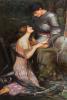
Lamia is the final piece of my installation, and she is facing the right side of the room where the exit is. There are several traces of red included throughout the painting just like the other two paintings, including several flowers and a waistband wrapping around the man. A similarity between Lady Lilith and Lamia is the use of their body for an evil act, as she most likely murdered the man within the painting. She is shown kneeling before him, and covered in a snake-skin patterned article of clothing. The poem that inspired this piece explained that this man fell in love with the most beautiful girl, but he is unaware of what she really is. Lamia is a half-serpent monster, and it shapeshifts into a young woman in order to prey on men. She symbolizes a woman that is portrayed as attractive or desirable but is ultimately destructive.
Collier, John. Lady Godiva. 1898. Herbert Art Gallery & Museum.

Accessed 15 Feb. 2022.
Rossetti, Dante Gabriel. Lady Lilith. 1866. Delaware Art Museum.
https://en.wikipedia.org/wiki/Dante_Gabriel_Rossetti#/media/File:Lady-Li....
Accessed 15 Feb. 2023.
Waterhouse, John William, Lamia, 1916, Auckland Art Gallery
Accessed 21 Feb. 2023 https://joyofmuseums.com/artists-index/john-william-waterhouse/lamia/