
Disclaimer
In this passage, I will be using language such as “acquired” and “acquisition” in order to maintain a neutral stance on the matter of Lord Elgin and the collection of marbles he acquired from the Parthenon. The debate about the ethics of taking artifacts from their homeland and people is a very complicated one. I highly encourage you to read up on the subject and reach your own conclusion about how the acquisition of the Elgin Marbles falls on this debate. I highly recommend watching Chip Colwell’s TED Talk as a starting point to launch your journey into the ethics of possession and repossession within museums: Museums have a dark past, but we can fix that | Chip Colwell | TEDxMileHigh
The Art
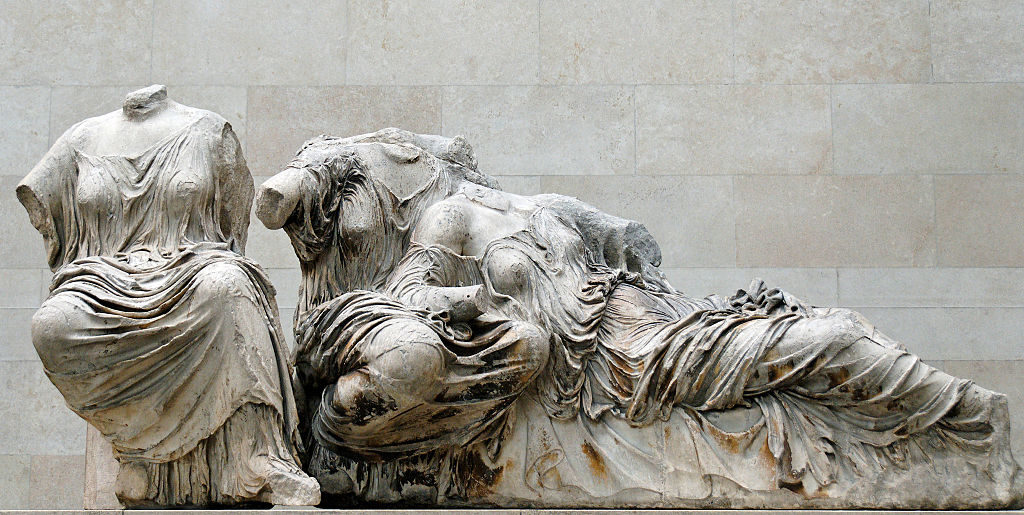
The Parthenon has stood in Athens, Greece since its construction in the fifth century BCE. The famous marble sculptures within the temple were most likely produced between the years 447BCE and 432BCE, roughly two thousand four hundred and fifty-two years ago. These sculptures depict the triumphs of Greece’s great heroes and gods. The British Museum’s collection includes fifteen of flat, two-dimensional wall reliefs called metopes and seventeen figures and sculptures in varying degrees of intactness.
The Man
Thomas Bruce, the seventh earl of Elgin, served as the English Ambassador to the Ottoman Empire from 1799-1803. He spends the first ten years of the nineteenth century removing and shipping Ancient Greek sculptures and art to London. He describes his pillages as necessary to advance and refine English aesthetic and art. It is no secret that the modern Western world reveres and romanticizes Ancient Greek society, art, and academia—the new British Museum’s exterior is based on Grecian architecture, after all. In 1801, Elgin received permission from the current Ottoman authorities in place during the Ottoman occupation of Greece (or claimed that he receives permission, more information on that to come), and so began his excavation and removal of over half the intact sculptures found at the Parthenon. He and his team also removed art from surrounding sites of historical significance, such as the Acropolis. He exhibited these expeditionary trophies as part of his own private collection until the Marbles were bought by the British government. The display of the Parthenon Marbles debuted in 1816, and with the exception of construction in the middle of the nineteenth century, these marbles have been on display in the museum ever since. These sculptures were the inspiration for poet John Keats’s 1816 sonnet “On Seeing the Elgin Marbles for the First Time,” in which he describes the awe-inspiring experience with an emotional depth I’m sure has graced visitors for the last two hundred and six years— “Such dim-conceived glories of the brain/ Bring round the heart an undescribable feud;/ So do these wonders a most dizzy pain,”
The Debate
It remains unclear to historians whether or not the actions of Lord Elgin were entirely legal. According to the British Museum’s official trustee statement concerning the matter, they claim before the museum acquired the sculptures in 1816, an extensive investigation on the earl’s actions was conducted to ensure that his legal standing was cleared. Parliament’s vote decided his innocent in any shifty actions. No English investigations have been done since. Though Elgin may have had the permission of Greek and Turkish authorities, some historians worry that the vague language of any diplomatic agreements made between the earl and Ottoman authorities may not clear Elgin’s name after all. On July 6, 1801, Selim III, the sultan who ruled the land upon which the Parthenon stood issued a firman, or royal decree, stating that the Ottoman government would have no problem if Elgin and his expeditioners, “take away some pieces of stone with old inscriptions and figures...” While that was permission enough for Elgin and his crew, some historians interpret this phrasing to mean that the sultan meant for certain sculptures and inscriptions to be taking away only temporarily by the Englishmen so that replications could be produced. Some even argue with the merits of this firman. This is because that the Ottoman authorities occupying Greece at the time never communicated directly with the British government at the time to confirm this agreement. It was Elgin who claimed that the document existed, and Reverend Phillip Hunt, a young clergyman who was a part of Elgin’s excavation team claimed that he had a hard copy of the document but had conveniently left it at home when being interrogated by Parliament. The only physical documents Parliament was ever offered as evidence were copies translated to English, which very easily could have been faked. The actual firman itself, if the document existed at all, has since been lost to history. The current director of the Acropolis Museum Dimitrios Pandermalis claiming that the document issued between the sultan and the earl was not an official firman but more of an administrative letter. The research conducted by the Acropolis Musuem has found that this permit was not even issued to Elgin himself— the document was meant to give Ottoman authorities permission to excavate around the Parthenon. Since Elgin’s artistic treasures first hit English sources, they have been the cause of much debate. However, in recent years, the call that these priceless artifacts be returned to their homeland has increased. Greek authorities and museum professionals continue to seek compromises and agreements with the British Museum, and while this Museum claims it is open to making compromises and listen to requests, they hold that there is nothing inherently wrong with their possession of the Marbles.
This is an important debate to have, as a disturbing number of artifacts in museums all across the Western world have been pillaged, stolen, or cheated out of their homelands. The British Museum itself has an extensive collection of Ancient Greek and Egyptian art— all acquired by the museum during this time when having a hard copy of an issued firman was not of any concern to Parliament. All across the world, objects of religious, spiritual, cultural, historical, and ancestral significance have been taken from the people to whom they are significant. This question, with no right answer, has been plaguing museum professionals for the last twenty years or so—who is the rightful caretaker of an artifact: a museum, where it can be carefully preserved for people to look at it for years to come, or the people who created and revere the object?
Content sourced from:
https://www.britannica.com/biography/Thomas-Bruce-7th-earl-of-Elgin
https://www.artnews.com/art-news/news/parthenon-marbles-british-museum-restitution-1234605904/
https://www.greece-is.com/news/ottoman-archives-reveal-elgin-took-marbles-illegally-expert-claims/
https://www.newworldencyclopedia.org/entry/Elgin_Marbles#Acquisition
https://www.poetryfoundation.org/poems/52305/on-seeing-the-elgin-marbles