
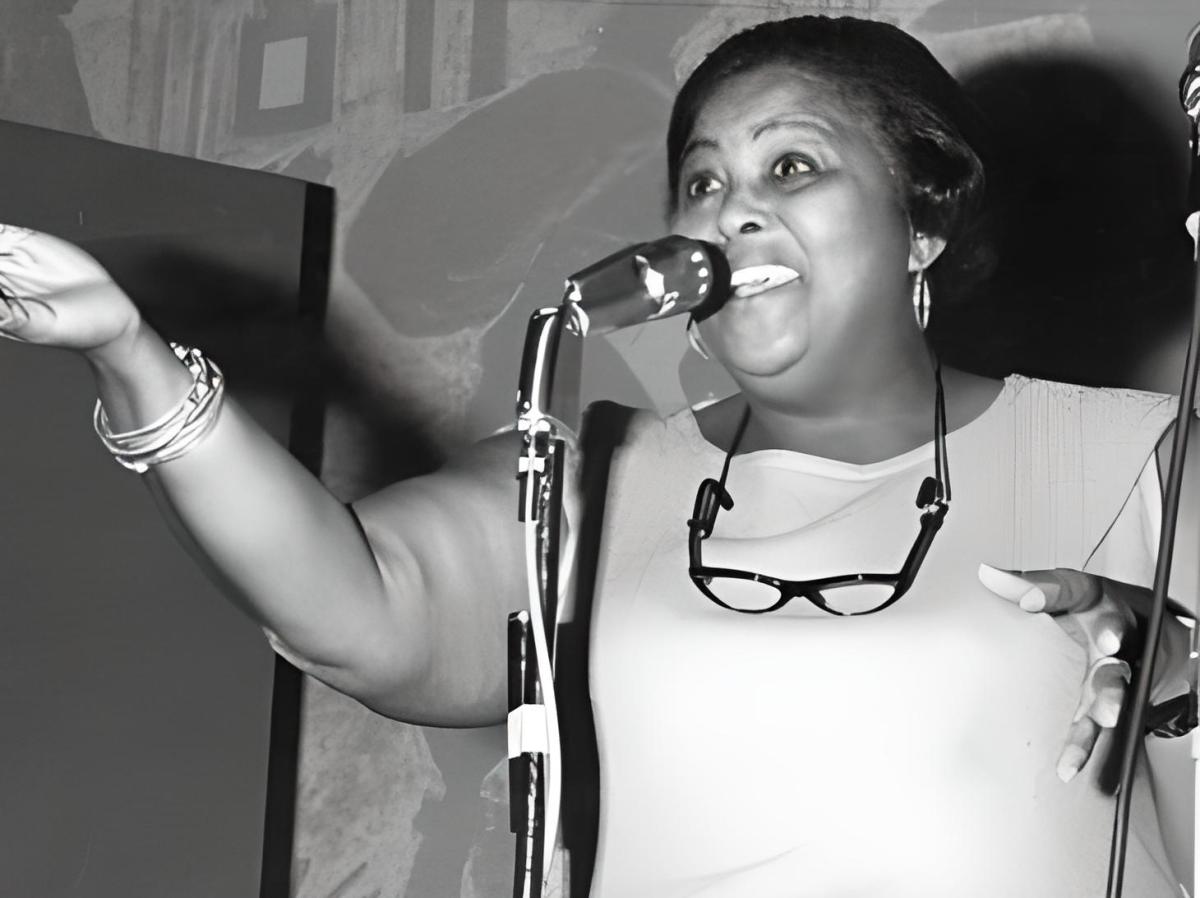

“Colonization in Reverse” is a satirical poem that explores the experiences of Jamaican immigrants in England post World War 2. Coverley implements her own personal touch, using humor, irony, and Jamaican dialect. Ultimately, Coverley’s goal in the piece is to expose the prejudice she and her people experienced at the hands of the English locals.
1 Wat a joyful news, Miss Mattie,dat suit her dignity
2 I feel like me heart gwine burs
3 Jamaica people colonizin
4 Englan in Revers
5 Be the hundred, be de tousan
6 Fro country and from town,
7 By de ship-load, be the plane load
8 Jamaica is Englan boun.
9 Dem pour out a Jamaica,
10 Everybody future plan
11 Is fe get a big-time job
12 An settle in de mother lan.
13 What an islan! What a people!
14 Man an woman, old an young
15 Jus a pack dem bag an baggage
16 An turn history upside dung!
17 Some people doan like travel,
18 But fe show dem loyalty
19 Dem all a open up cheap-fare-
20 To-England agency.
21 An week by week dem shipping off
22 Dem countryman like fire,
23 Fe immigrate an populate
24 De seat a de Empire.
25 Oonoo see how life is funny,
26 Oonoo see da turnabout?
27 Jamaica live fe box bread
28 Out a English people mout’.
29 For wen dem ketch a Englan,
30 An start play dem different role,
31 Some will settle down to work
32 An some will settle fe de dole.
33 Jane says de dole is not too bad
34 Because dey paying she
35 Two pounds a week fe seek a job
36 me say Jane will never fine work
37 At de rate how she dah look,
38 For all day she stay popn Aunt Fan couch
39 An read love-story book.
40 Wat a devilment a Englan!
41 Dem face war an brave de worse,
42 But me wondering how dem gwine stan
43 Colonizin in reverse.
The poem's title, "Colonization in Reverse," suggests a reversal of power dynamics. Rather than the English colonizing Jamaica, Jamaicans are now colonizing England. However, as the poem shows, the reality is far from empowering. The Jamaicans are still subject to discrimination and exploitation.
The poem begins by describing the excitement and anticipation of Jamaican immigrants as they leave their homeland for England, where they hope to find a better life. The English are initially quite welcoming towards the immigrants. However, their excitement soon fades as the Jamaicans encounter discrimination and hardship in the wake of prejudice and indifference.
Bennett uses humor to illustrate the indignities suffered by the immigrants. She writes that the Englishmen "blow dem nose and scrub dem ear" when they are around the Jamaicans, implying that they consider them dirty and uncivilized.
The poem moves on to highlight the challenges faced by the Jamaicans in England, such as difficulty finding housing, employment, and overall daily struggles. Despite these challenges, the Jamaicans continue to work hard and contribute to British society, leaving behind "treasures" to help sustain their homeland.
Bennett's use of Jamaican dialect in the poem is also significant to her own identity and of the Jamaican people, as a whole. The dialect is a direct form of resistance to colonialism and asserts the cultural identity of the Jamaican people as unchanging. Through the use of dialect, Bennett emphasizes the uniqueness and value of Jamaican culture and language in wake of finding themselves in a foreign country.
In the context of modernism, the poem can be seen as a critique on the idea of progress, portraying it as negative in the connotations surrounding one's culture. In addition, the poem highlights the cultural significance of migration and how it shapes identities and communities. This is a key theme in modernist literature, which has often explored the relationship between the individual and their cultural identity as the world continues to change and societies gradually evolve.
Works Cited
“Colonization in Reverse.” Best Poems, Sept. 2017, www.best-poems.net/louise-bennett-coverley/colonization-in-reverse.html. Accessed April 25, 2023
“Rt. Hon. Dr. Louise Bennett Coverley (1919 – 2006).” The National Library of Jamaica, 26 Feb. 2017, nlj.gov.jm/project/rt-hon-dr-louise-bennett-coverley-1919-2006.
Poetry by Heart. www.poetrybyheart.org.uk/poems/colonization-in-reverse.
Morris, Mervyn. “Remembering Miss Lou.” Caribbean Beat Magazine, June 2020, www.caribbean-beat.com/issue-82/remembering-miss-lou#axzz4HJsXjDMy.
Wikipedia contributors. “Louise Bennett-Coverley.” Wikipedia, Feb. 2023, en.wikipedia.org/wiki/Louise_Bennett-Coverley.