
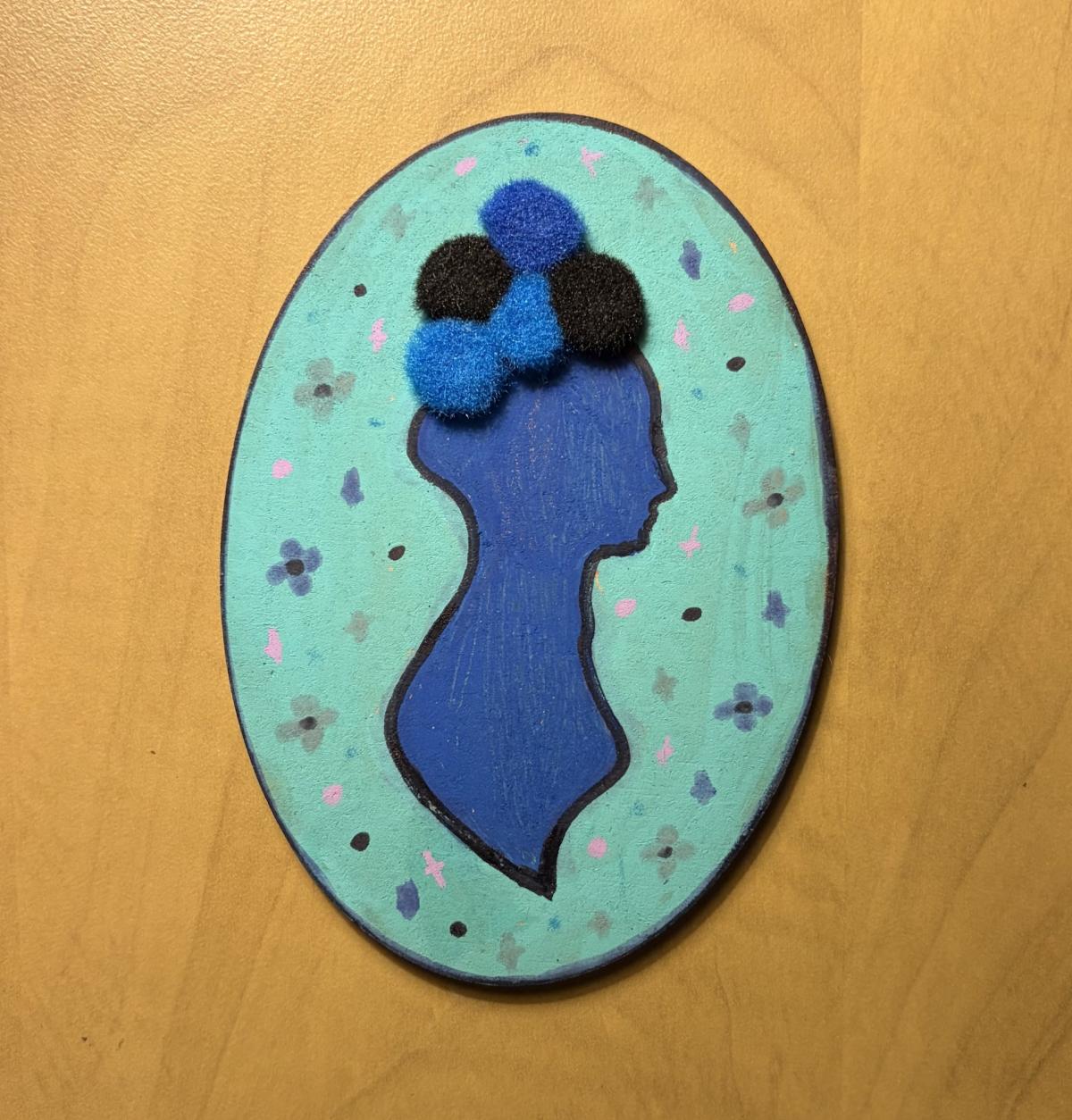




In the Regency era, silhouettes served as tokens of affection or gifts, illustrating a thoughtful representation of a loved one to commemorate their likeness. My silhouette of Jane Austen seeks to highlight the relationship between Austen's identity and her characters through an exchange of material objects in their respective realities. Jane Austen includes objects from her reality--such as letters, portrait miniatures, rings, and pianos--as narrative vehicles in her novels. These objects establish the social and cultural conventions of the Regency era and build a world that feels similar to Austen's reality, influenced by objects of importance to her. In Austen's Emma, the character of Emma Woodhouse occupies a different social world than Austen herself did. I used the fancy hat as an object from Emma's world that Jane wouldn't have possessed in her own life. This contrast emphasizes the ways in which Austen's perspective and experiences come through in the worlds she builds as well as the differences between Austen and the characters she writes.
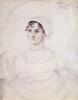
Silhouette of Jane Austen, Created by Lily Mackay, 2025. When I was considering whose silhouette to craft, I recalled Cassandra Austen's sketch of Jane and how it's the only reason we know what her face looked like. I'm no artist like Cassandra was, but I liked the idea of depicting Jane as an obscure silhouette to convey how her appearance would have been a mystery to us without her sister. Cassandra's sketch of her sister also conveys how much love and admiration she had for Jane through the detailed representation of her features. It is important to commemorate people's likenesses as a way to carry on their legacies, especially those who might otherwise be lost to history.
Crafting Process of Jane Austen's Silhouette, Photograph by Catherine J. Golden, 2025. I chose a medium-sized wooden oval for my silhouette. I wanted to draw directly on the wood rather than attach a paper cut-out to it. I find coloring fun and relaxing, so I was excited to pick out some cool colors for the background and the silhouette itself. I went with shades of blue since the color reminded me of the Regency era. I found a photo of an artist's Jane Austen silhouette and used it as a reference to draw a silhouette on the wood in blue marker. I chose a shade of teal blue to color around the silhouette. I wanted the silhouette to stand out from the background, so I colored the shape in with a darker shade of blue. Then, I outlined the silhouette again in black marker to define the lines. I decided to give Jane a fancy hat that a wealthy young lady like Emma Woodhouse might wear. I glued pom-poms into a hat-like shape, traced the outline of the wooden oval with black marker, and added some small flowers and colorful dots to the background. I tried gluing feathers to the sides of the wood, but the hot glue gun was not working in my favor.
Sketch of Jane Austen by Cassandra Austen, ca. 1810, Wikipedia. My silhouette of Jane Austen was inspired by Cassandra's sketch of her sister. Drawing someone you love is such a thoughtful and caring act, which goes to show how close Cassandra and Jane were. Whether or not Cassandra knew at the time, her portrait of Jane's face would help preserve her sister's literary legacy and make her feel more like a real person to the fans of her work. Cassandra's sketch of Jane emphasizes the social significance of visibility, particularly for female artists, when interpreting the themes of Jane Austen's novels with her personal perspective in mind.
Jane Austen's Writing Desk, British Library, BBC (2024). Objects that were significant to Austen, like pianos and letters, are key features in the worlds she builds in her writing. They illustrate the ways in which people from the period could communicate without speaking, such as writing letters or gifting locks of hair. One of the most significant objects in Jane Austen's life was the writing desk gifted to her by her father. Jane's desk symbolizes her method of creation, showing the material object that Jane used to write about objects from her world, and even objects she didn't possess in her own life, to further build plots and characters.
Film Poster of Emma (2020) featuring Anya Taylor-Joy as Emma Woodhouse, 2020. I wanted to tie in a character from one of Austen's novels, and Emma stood out because of her wealth and social status. While Austen was genteel, she wasn't wealthy as her character Emma Woodhouse is. In fact, Emma is the wealthiest of Austen's female protagonists, providing a unique perspective on marriage and social class as a financially independent young woman. Emma's wealth allows her to reject the pressure to get married, a privilege that Austen's other heroines do not have. Emma's social class is conveyed not only through her behavior but her appearance, as well. Particularly in the 2020 film adaptation of Emma, Anya Taylor-Joy as Emma wears fancy dresses, hats, and accessories. The object of the fancy hat from Emma's world contrasts with the the world of the less wealthy Jane Austen, who likely did not dress as fashionably as Emma. I thought it would be fun to give Jane a bit of Emma's flair in the form of a fancy hat of pom-poms, inspired by the big hats with feathers and ruffles that Anya Taylor-Joy wears in the film. This placement of the Emma-esque hat on Jane Austen's silhouette reflects the larger significance of objects as social representations in her novels and how the objects depicted both differ from and connect to objects of Austen's world.