
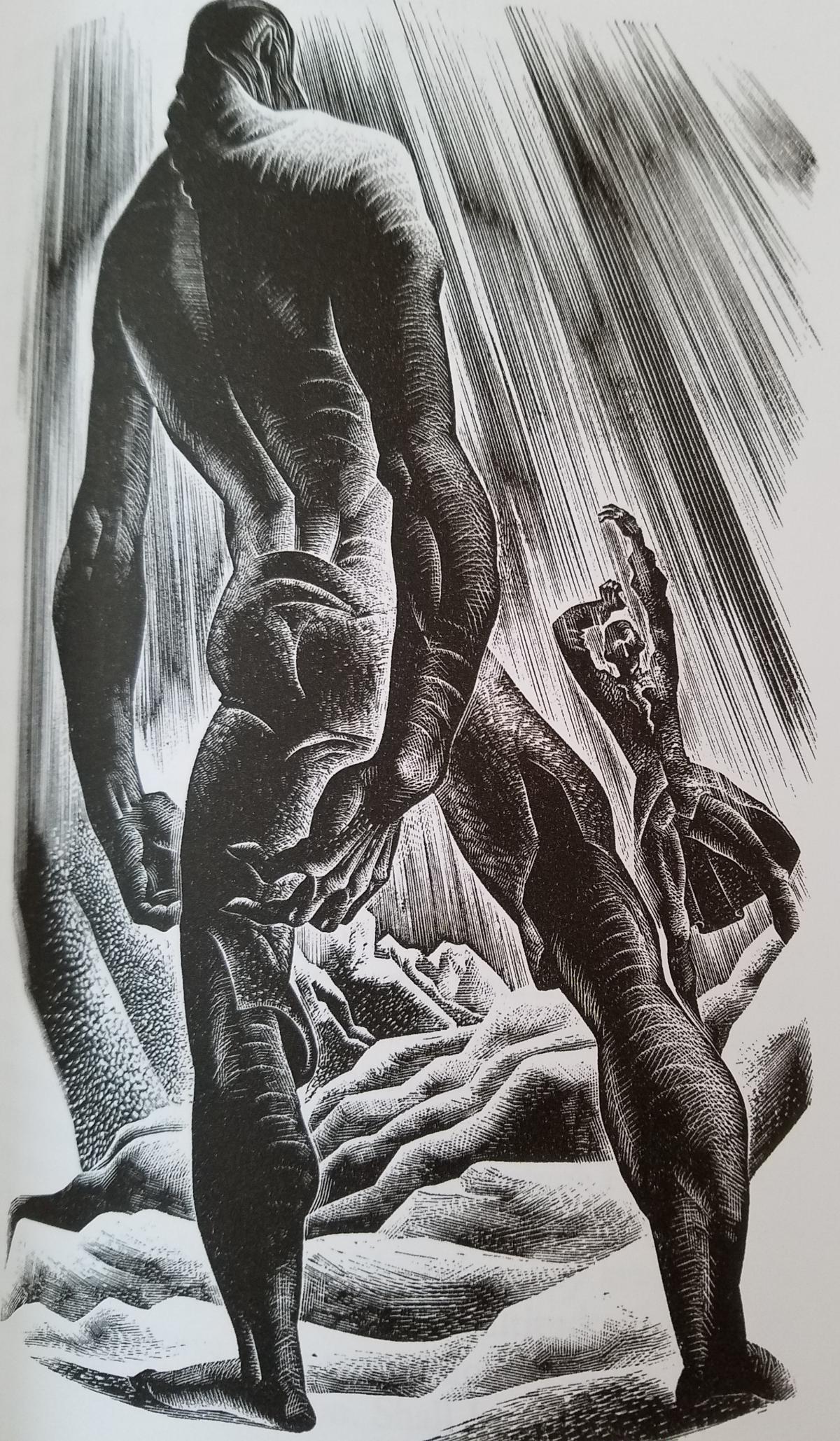
This illustration conveys the scene in Volume II, chapter 10 when the monster confronts Victor Frankenstein after William's death. In this chapter, Victor sets out to the summit of Montanvert while it storms. He then notices the monster at the top, but he doesn't recognize the monster yet. He sends threats to the monster out of suspense. Victor then realizes that it is his creation waiting for him. This is the first time Victor bears witness to his creation after killing his brother. The monster then starts to confront Victor about his murder victim. The creature explains," You accuse me of murder, and yet you would, with a satisfied conscience, destroy your creature" (Shelley 71). Here the monster tends to become angry but respectively forceful when telling Victor that he is guilty. Victor realizes he is culpable for the murder and creation of his nightmare. The atmosphere continues to be quite intense because of Victor's actions and the creature's ability to destroy. Although the creature has a lot of strength, it isn't used against Victor in this scene. The creature is unknown to himself; therefore, he is unaware of his power. This resulted in the death of William, and now Victor pays for that. In this scene, the creature is a prime example of "the monstrous" because he is unpredictable and unknowing. Therefore, Victor is guilty of the innocence of the animal. Throughout the scene, the monster continues to confront Victor without physical destruction about his abandonment and William's murder.
Ward chose to give us the creator's backside and close up to demonstrate how abnormal and monster-like the creature's body looks. He also wanted to illustrate how these two characters act towards each other. Victor is upset, and his hands' frailing signifies he is not happy to see his creation. The creature's body language seems civil, considering he just wanted Victor to hear his story after abandonment. Ward decided to leave the face unseen to create that suspension and mystery of the unknown. Ward highlights the monster's physique and overall body structure compared to Victor. It is clear that the monster is much larger than his creator and is oddly shaped. His un proportional body parts extort that he was not made with or given the same body parts from one carcass, making him look off-balanced. It is also displayed that his limbs are sewed on in different directions. The way his right hand is behind his back does not match his left. There are also lines all over the creature's body, which we can assume it's stitching or markings from where the scientist cut the body parts and sewed them. The monster is dressed in rags compared to Victor, fully dressed appropriately for the weather and location. This picture demonstrates the difference between Victor and the monster; however, it also demonstrates fully how this creature was put together by different body parts and wasn't perfectly proportional to fit with the body. Victor tried to make a perfect creature and took the best body parts without understanding the disadvantage he gave the creature. It is also unnerving looking at the monster from the back and seeing his body parts point in opposite ways like he is an animal and points out that he is not human. As the viewer sees the creatures back, we can only imagine what he looks like, but the main focus is that Victor is ashamed and upset. Overall, throwing his hands in the air almost as if he's being punished and in pain when he brought this amongst himself.
The confrontation between the creature and Victor is not a happy one since they both show hatred. In the image, one can read Victor's facial expressions and how angered he sees his creation standing in front of him. Victor's face is clear, pointing up to the sky almost as if he is screaming because of this interaction. His arms in the air pointing up to the sky in anger, asking why he had to come across his creation. In Monsters in America, Frankenstein is "The story of a 'monster' that rebelled against its master," since the creature no longer accepts Victor (Poole 60). Ward conveys rebellion through the physical positioning of the creature and Victor. It appears that the creature is furiously coming towards Victor, and Victor can do nothing but accept that his creature wants to end him. The relationship between the two is very hostile and can be seen in the dark colors, representing the anger between them. Victor wants to escape his creation, and the creature wants to get revenge for his existence. Ward may be on the creature's side since it is the primary source of attention and is the most significant part of the image. Since he is also placed at the bottom of the picture, it shows significance since, in art forms, more attention is intended to be brought to the bottom of the work based on positioning.
Mary Shelley sets the scene of the environment in Frankenstein. Victor had decided to venture out to Mount Montanvert in search to clear his thoughts and be alone. Victor was walking alone in freezing temperatures, "While the rain poured from the dark sky, and added to the melancholy impression [he] received from the objects around [him]," through the rocky paths shown in the image (Shelley 68). The lines in the painting represent the rain falling, and more of the color black is used to show darkness. Ward chose to implement rain and shadows to represent the dark, gothic idea Mary Shelley shows. The talk of darkness in the environment meant something was about to happen. Victor had made it up to the peak only for a large-sized figure to appear from afar, "that it was the wretch whom [he] had created. [He] trembled with rage and horror, resolving to wait for his approach, and then close with him in mortal combat' (Shelley 70). Victor was not happy with coming upon the creature as he looks so doomed in the image. The scene is set in very dark colors, making the impression of a terrible interaction. Victor is throwing his arms up in anger that he saw the "Devil" he created (Shelley 70). Mary Shelley had been using weather as a signal of something big happening throughout the readings. The very descriptive opening scene of the environment conveys the idea of the confrontation between the two as an unpleasant situation, using dark gothic effects to emphasize the fact of conflict.
References
Poole, W. Scott. Monsters in America: Our Historical Obsession with the Hideous and the Haunting. Baylor University Press, 2011.
Shelley, Mary Wollstonecraft, 1797-1851. Frankenstein, Or, The Modern Prometheus: the 1818 Text. Oxford; New York: Oxford University Press, 1998.