
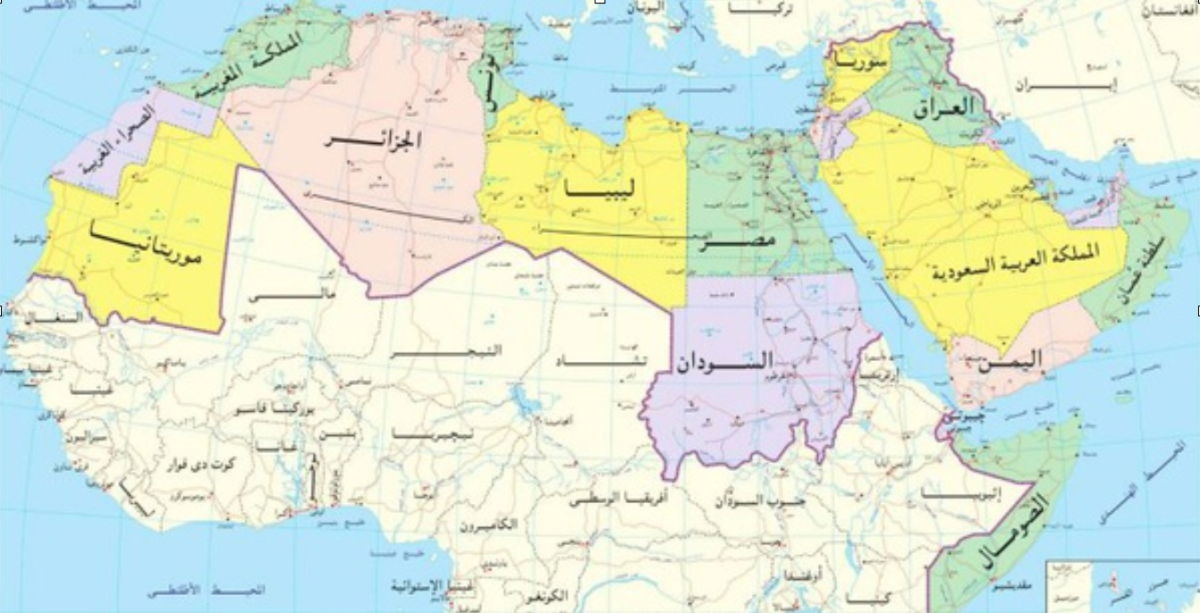
What is Pan-Arabism? Pan-Arabism is the concept of uniting the Arab world into a single Arab state based on bringing together the Arab race. In Arabic (الوحيدة العربية) it literally translates to “one Arabia” or “the only Arabia.” If attained, the state would reach from Morocco in the west, along the top of Africa, east to Saudi Arabia, and north as far as Syria. It arose in the nineteenth century, and while it lacks a concrete point death, Pan-Arabism has certainly dwindled by now. The concept of Pan-Arabism introduces a crucial question: who is an Arab?
There are many points of connection between the peoples of the Middle East and North Africa. The first, and one of the most important, is language. Not only is Arabic the official and dominant language of this part of the world, but “the Arabic language, in the broad sense of the term, has never been destroyed and continues to be considered as one of the strongest ties of national unity in the Arab world today” (Fallatah 21). In a more specific sense, there are of course thousands of accents, dialects and other languages spoken. Even so, Arabic is not only a form of communication to Arabs, it’s their expression, their heritage, and inseparable from their main religion, Islam.
This brings us to the second point. While every Arab is certainly not a Muslim, the majority in the Middle East and North Africa are followers of Islam, making Islam a common connection point. Not only is it a belief, but a way of life, a lens by which nearly everything else is shaped, and brings in a common history and legacy. Islam also promotes unity and equality between believers, and in fact “[o]ne of its basic aims is to unite the Arab world into one great community, the community of Islam” (Fallatah 22). However, what many in the west do not understand is that in reality, Islam is very diverse, and its believers even more so. It creates a very complex spectrum of people who are not always unified by belief in the same way that the concept Islam promotes it.
The third notable point is common culture. “As with all cultures, the Arab culture consists of the customs, traditions, music, literature and language that have been transmitted from generation to generation over the centuries” (Fallatah 24). A great deal of the Middle East and North Africa shares many core aspects of Arab culture. For example, most societies are patriarchal, and family/community centered, a stark difference from the individualized west. And as stated, there are many more specific connections. Each of these similarities builds on the shared worldview of an Arab, along with the points of language and religion. In regards to Pan-Arabism, “it follows that without the accomplishment of cultural unity, there would not be a chance for the nation to fulfill its political unity” (24). But on the other hand, each people group is unique by nature and lives by their own special set of cultural practices and traditions, leaving Arabs a greatly diversified people.
And this is the main problem with Pan-Arabism: all of the aforementioned connections, while they are highly significant and valid, are also extremely complicated and diversified. In a broad sense, the political state created by Pan-Arabism makes perfect sense. But the closer one looks, the more nuance and diversity there is. It works in theory, but it never came to be in reality. However, “no matter how the term “Arabism” is understood today… one cannot deny that there are common linguistic, religious and cultural features which constitute the bonds of Arab unity throughout the Arab world” (Fallatah 18). For all their wonderfully unique and complex differences, Arabs are still deeply connected, and will likely always be.
Works Cited
Fallatah, Mohammed A. S. The Emergence Of Pan-arabism And Its Impact On Egyptian Foreign Policy: 1945-1981 (Egypt), University of Idaho, Ann Arbor, 1986. ProQuest, https://www.proquest.com/dissertations-theses/emergence-pan-arabism-imp….
Abou-El-Fadl, Reem. “Early Pan-Arabism in Egypt's July Revolution: The Free Officers' Political Formation and Policy-Making, 1946-54.” Nations and Nationalism, vol. 21, no. 2, 2015, pp. 289–308., https://doi.org/10.1111/nana.12122. Accessed 12 Nov. 2021.
Kramer, Martin. “Arab Nationalism: Mistaken Identity.” Arab Awakening and Islamic Revival, 2017, pp. 19–52., https://doi.org/10.4324/9781315082172-3. Accessed 12 Nov. 2021.