
Representations of Black women in Victorian England were varied, and cultural attitudes surrounding race and colonialism were complex. With slavery officially abolished in England decades before the American Civil War began and literary works like Uncle Tom’s Cabin popular among English progressives, England was in many ways ahead of America in terms of combating systemic racism. During the early nineteenth century, black activists would travel to England in order to advocate for abolition safely, and the country was known by some as “the land of appeals” (Dickerson 58). However, British colonialism complicated this narrative, as the second half of the century saw an increased fascination among the British public with “the dark continent of Africa” and lack of interest in civil rights activism in the United States post-Civil War (59). Representations of Black women in art from the period varied widely from images of what Shirley Carlson refers to as the “Black Victoria” to highly exoticized colonial photographs taken in Africa.
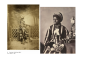
A popular representation of Black women during the Victorian era was a trope referred to by Carlson as the “Black Victoria,” a model of Black womanhood which had much in common with ideologies of the cult of domesticity in England more broadly. These women were committed to remaining in the home and being mothers, (Carlson 61) and dressed in typical modest Victorian attire. Some Black women who were photographed by British photographers during this era embody this ideal outside the strictly domestic sphere. A Zulu woman (pictured to the right) photographed at some point in 1879 (Royal Collection Trust), seems to embody a form of this ideal in the religious realm. According to the image description (Royal Collection Trust) she worked as a missionary, and her clothing as well as the framing of the photo align with the “Black Victoria” trope. This photo is also emblematic of British colonialism, as the woman in the picture has been assimilated into Western culture as exemplified by her dress. She is wearing a fitted buttoned bodice with long, looser sleeves, a fashionable Victorian gown for the late 1870s (Shrimpton 20). The “Black Victoria,” in that sense, represents a kind of Black womanhood which was acceptable to white British audiences only so far as the subject adhered to British ideals of womanhood. The Zulu Kingdom was a colony of Britain, and this unnamed woman’s portrait is a symbol of the “Black Victoria” more generally as well as the ideals of Western womanhood which were forced upon colonized women during the period.
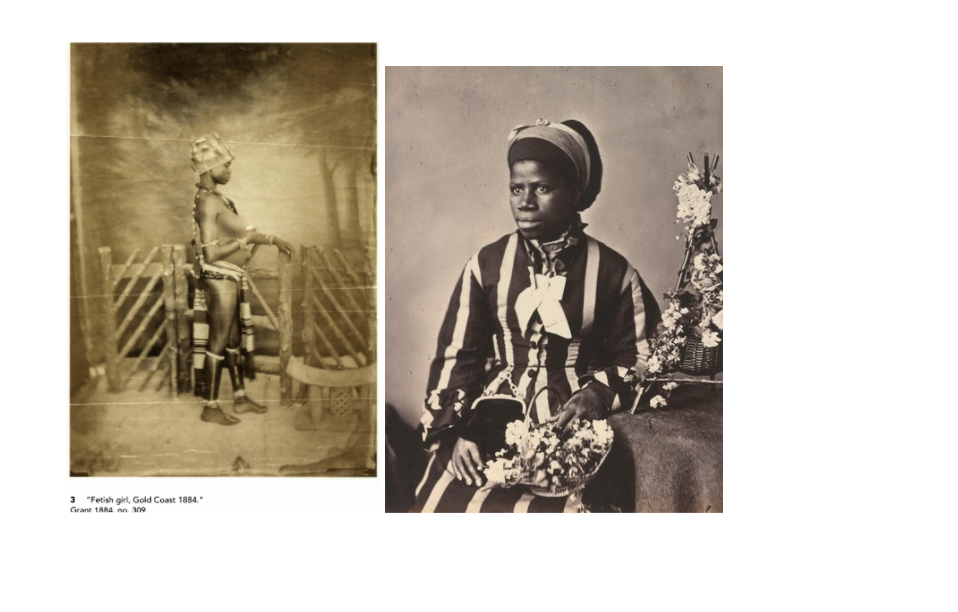
Black women in the colonies were often exoticized and sexualized by British photographers, forming a group known as “Fetish Girls" (pictured to the left). Colonial photography was an influential form of imperialist propaganda during the Victorian era, as many viewed the photos as genuine candid images of an “authentic” Africa (Ama Asaa Engmann 46). Despite the general British public viewing the photos as unbiased, scientific observation, modern scholars argue that they were intentionally crafted pieces of propaganda that “needed to define and maintain hegemonic constructions of difference between those in the colony and the metropole, in order to justify colonialism and capitalist expansion” (46). The photos taken of African women were intended to highlight the differences between British culture and the people they colonized and established an us versus them dichotomy. The pictures were also often sexualized, with emphasis placed on the women’s bodies, reinforcing racist stereotypes about African sexuality as “primitive” and “animalistic” (54). The invasive photos encouraged white British audiences to objectify and exoticize Black women.
British colonialism during the Victorian era, as well as the Civil War and abolition in the United States, factored heavily into artistic representations of Black women by British artists. Photography was particularly influential as it could be easily read as an objective representation of reality, such as with the “Fetish Girls” of Africa. The jarring contrast between the seemingly sympathetic response by white British people to abolitionist movements and the fetishistic, exoticized images British photographers took of Black women in Africa, highlights the complexity of representations of Black women in the Victorian era and the implicit biases directed towards women who were not considered to be ‘civilized.’ The “Black Victoria” trope, on the other hand, represented an ‘acceptable’ form of womanhood for Black women, while also reinforcing assimilation and colonialism during the era.
Works Cited:
Ama Asaa Engmann, Rachel. “Under Imperial Eyes, Black Bodies, Buttocks, and Breasts: British Colonial Photography and Asante ‘Fetish Girls.’” African Arts, vol. 45, no. 2, 2012, pp. 46–57.
“Black and Asian History and Victorian Britain.” Royal Collection Trust, https://www.rct.uk/collection/themes/trails/black-and-asian-history-and….
Carlson, Shirley J. “Black Ideals of Womanhood in the Late Victorian Era.” The Journal of Negro History, vol. 77, no. 2, 1992, pp. 61-73.
Dickerson, Vanessa D. Dark Victorians. U of I Press, 2008.
Photos:
Left: via “Under Imperial Eyes, Black Bodies, Buttocks, and Breasts: British Colonial Photography and Asante ‘Fetish Girls.’” Grant, 1884.
Right: via Royal Collection Trust. Photographer unknown.