
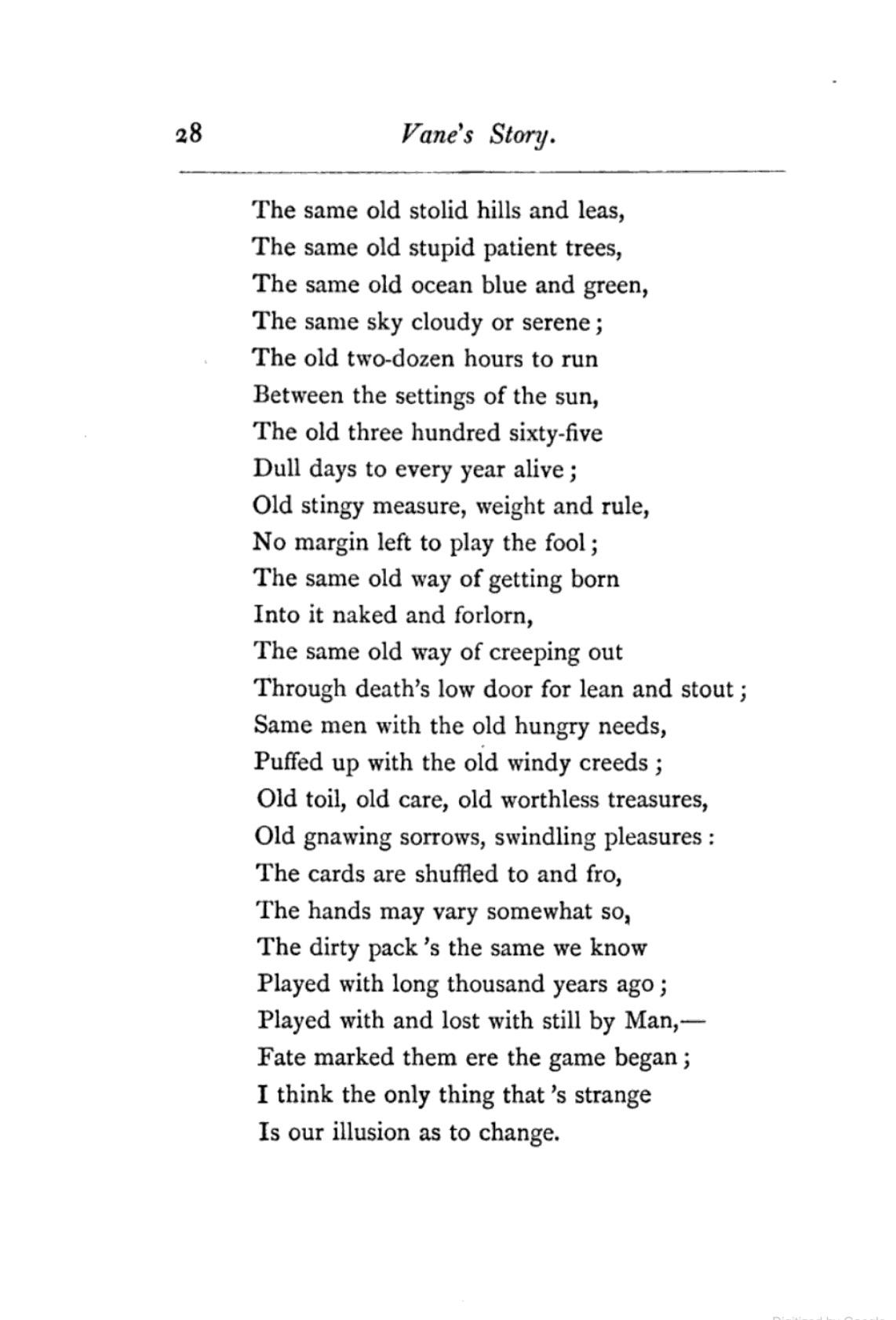
In times of heartbreak, I rather enjoy James Thompson’s work and the way he captures the faults within the human condition. Life is simply left to chance, and women do not hold any of the cards. It is up to men to pursue women, success, and self-fulfillment. It has been this way since the dawn of humanity. Women have been expected to stay put and mind the home. I am left to wait. I must wait to be pursued; however, when I pursue anything for myself, I am scoffed at. My supposed friends tell me I am working myself to death, but they have never tried to support themselves. They do not understand the plights of the working women. If I write anything pessimistic like Mr. Thompson’s work, it will not be published. I am required to wear a smile and pretend I do not see the sorrows and swindling pleasures. I can not write about the truths that are so evident to women. I can merely tell half-truths and pretty lies. Only men are allowed to reveal the ugly truth and receive credit for it. The vast majority of men do not understand what it is like to be at the mercy of the pursuer, so they can not tell the whole truth. They do not know what it is like to play the game of life without cards. They can only reveal the truth that men experience. I am now left to clip the gloomy poems written by men to my door, to remind myself of the fate women have been doomed with.
Editorial Commentary: This woman appears to be unhappy with the gender-related social construct of the Victorian era. Mary Erle asserts that while she is experiencing heartbreak, she deeply relates to this cynical poem by James Thompson. According to the first two lines, life is dull and full of “toil,” “care,” and “useless treasures.” If Mary relates to this portion of the poem, it suggests that she believes the Victorian society sees the values of life in the wrong places relating to gender norms and expectations. She directly notes that she is not allowed to bring attention to the “sorrows” and “swindling pleasures” that she experiences. These “swindling pleasures” likely relate to her love life. Pairing the word “swindling” with “pleasures” to describe love highlights that these relationships were deceiving and less honorable than they were made out to be. Mary highlights that she is frustrated because she can not reveal why she is upset with these relationships and the ways Victorians carried out courtship. She states that she is “left to wait” for males to reach out to her, which appears to be her main grievance with Victorian society. Mary testifies that women were not expected to do anything for themselves and that men did not understand the negative aspects of this arrangement. This demonstrates that women of this time felt censored and were “required to wear a smile” even though they were suffering as a result of societal expectations. It also reflects the pressure she feels to fulfill the Victorian stereotype of an angelic woman. Mary brought a lot of attention to the metaphor of life being a card game and to the fact that women held none of the cards. James Thompson may have intended for his use of the word “man” to reference all of man-kind, but Mary interpreted it as men holding all the power and cards within the game of life. Mary’s account provides a window into the minds of working women and the issues they dealt with within the male-dominated Victorian society.
[Citation: “Vane's Story.” Google Books, Google, www.google.com/books/edition/Vane_s_Story/U1Y2AAAAMAAJ?hl=en.]