
Introduction
Mary Wollstonecraft’s excerpt Vindication of the Rights of Women explores major topics during her period. She captures what it is like to be a woman, while simultaneously arguing that women want a sense of purpose. She argues that women have a desire for education and want a role outside of domestic house duties. In contrast, Patmore created a poem The Angel in the House to put women inside a box essentially. He affirms traditional Victorian values by placing women on a pedestal and allowing men to know what they should expect of women. Patmore denotes women’s purpose as objects to be gazed upon and nurturers to their children and husbands. This exhibit focuses on women’s purpose through the male and female gaze by orchestrating how women view their intellectual, working, and motherly abilities, compared to what men believe women’s purpose is such as domestic duties and beauty.
R.M. Janes discusses the history behind the Vindication of the Rights of Women and how society during the 18th century responded to Wollstonecraft in her article: “On the Reception of Mary Wollstonecraft’s: A Vindication of the Rights of Woman”, arguing that social change was hard to conform to when society already has a certain outlook on how things should be done: “The principle difference between the pro- and anti-feminist position at the end of the eighteenth century and the beginning of the nineteenth century was less their attitude for change than their attitude towards past formulations” (Janes 296). Creating a sense of inferiority, Janes argues, is the only way to keep women feeling subordinate. How do women demonstrate social resistance and rise against patriarchy?
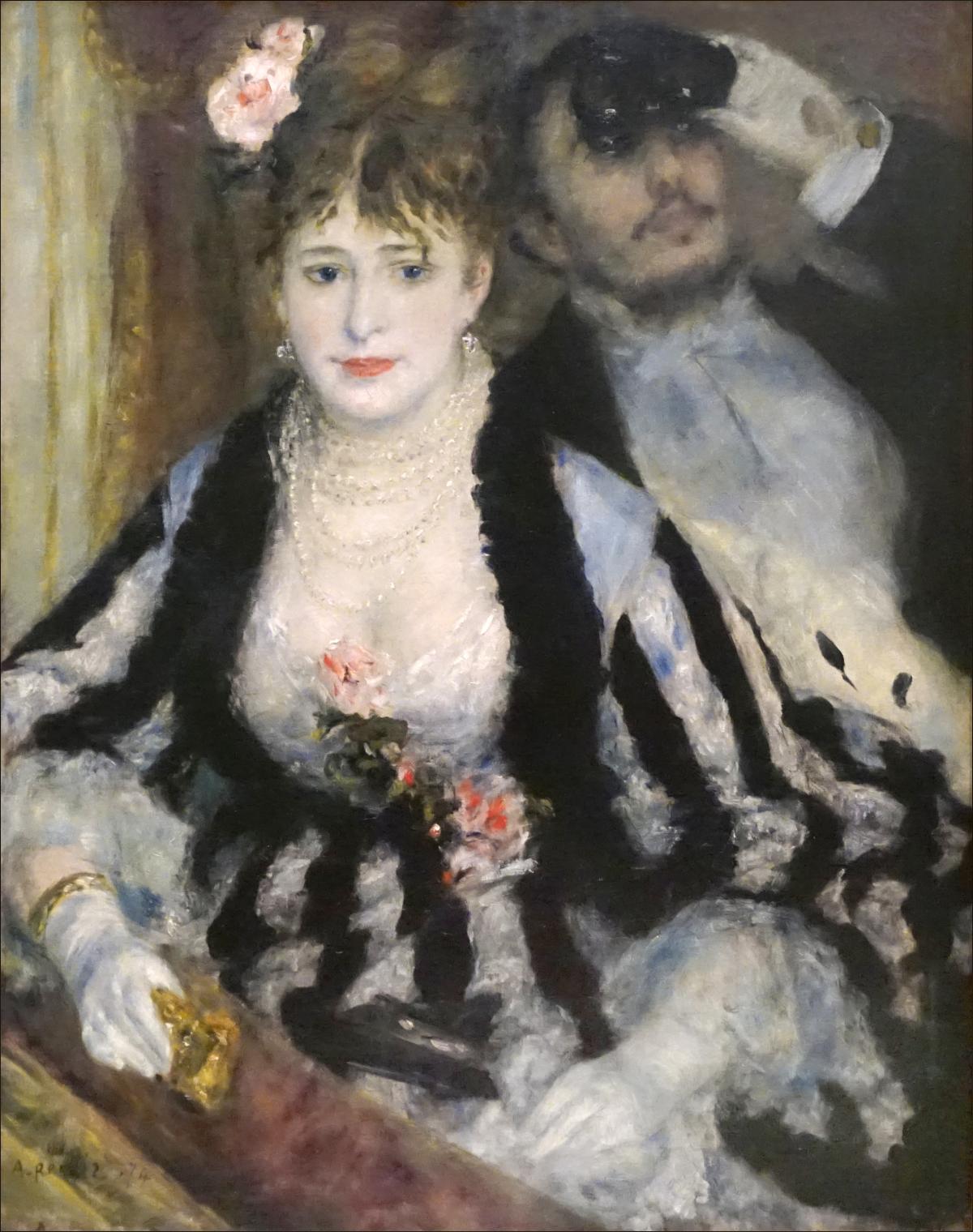
The supporting images will be investigating that question. The next four images include different depictions of women’s roles and how men view women within those roles. Spanning the 19th century, we will begin with August Renoir’s painting “The Loge” and end with Emily Mary Osborne’s painting “Nameless and Friendless” depicting how women find their purpose by resisting a patriarchal society.
Work Cited
Janes, R. M. “On the Reception of Mary Wollstonecraft’s: A Vindication of the Rights of Woman.” Journal of the History of Ideas, vol. 39, no. 2, 1978, pp. 293–302. JSTOR, https://doi.org/10.2307/2708781. Accessed 3 Mar. 2024.
Images in the Series
Fig 1. Renoir, August: “Renoir at the Theater: Looking at La Loge” 1874. Web,
https://courtauld.ac.uk/gallery/exhibitions/renoir-at-the-theatre-looking-at-la-loge/
Auguste Renoir was an impressionist painter who created a controversial piece that depicts a beautiful woman and man sitting in an opera. It is a useful visualization of how men regarded women during the 19th century as someone to be gazed upon. Patmore essentially places women on a pedestal in his prologue “Angel in the House”, which represents this idea: “You, sweet, his mistress, wife, and muse, were you for mortal woman meant? Your praises give a hundred clues to mythological intent!” (Patmore 57-60) he acknowledges women as beautiful creatures that were meant to be admired, which coincides with Wollstonecraft’s concerns in the Vindication of the Rights of Women: “Can she consent to be occupied merely to please him; merely to adorn the earth, when her soul is capable of rising to thee”. Women’s purpose according to male views is to sit still and enjoy the attention that they receive, but Wollstonecraft argues that women want greater passions. Renoir deliberately opens the women up in the painting to be admired, while showing the male companion focused on watching other surroundings in the opera that are open to interpretation such as admiring other women, which can be seen in the way he showcases the elegant lady in the painting. The way that the painting is illustrated has gained retaliation from other painters such as Mary Cassette.
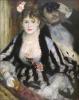
Fig 2. Cassette, Mary “In the Loge” 1878
Web, https://artsandculture.google.com/asset/in-the-loge/tgF6xIFz0Qjp1w?hl=en
Mary Cassette’s direct response to Renoir’s “Looking at La Loge” showcases women’s desire for purposes outside of being admired. In the background, a man is observing a woman in black watching the opera. Cassette’s assertion that women can be independent, reflects women not merely as objects, but as intellectual beings that desire freedom and liberation from their male counterparts. The woman in black is resisting her “role” as a woman in Victorian society. Wollstonecraft addresses this explicitly in her excerpt by stating: “To carry the remark still further, if I fear in girls instead of being cherished, perhaps, created, were treated in the same manner as cowardice in boys, we should quickly see women with more dignified aspects”. Witnessing women wanting independence and intellectual stability demonstrates the ways in which men have categorized women in specific roles. Women have resisted these roles by declaring their desire for social freedom and not being restricted to beings that are only admired by males and instead wanting to be seen as equals in all aspects.
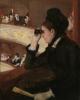
Fig 3. The Cult of True Womanhood
Web, https://www.newyorkalmanack.com/2014/03/george-bryjak-the-cult-of-true-womanhood/
This image is used to depict the domestic roles that women were placed into by representing a mother surrounded by her three children, while the males linger in the background pointing and criticizing dressed in suits and standing tall to demonstrate authority. Men viewed women as the caretakers who taught the children how to be moral upstanding humans. True womanhood according to patriarchal society is characterized by having motherly and nurturing qualities. Patmore highlights these qualities by commenting on women’s wonderful ability to be nurturers: “Those are our children’s songs that come with bells and bleating’s of the sheep; and there, in yonder English home, we thrive on food and sleep” (69-72). Making the father figure happy is of the utmost importance. Men determined woman’s purpose to be that women are to be wed and have children. Wollstonecraft urgently comments on this view by opposing traditional roles: “If children are to be educated to understand the true principle of patriotism, their mother must be a patriot; and the love of mankind, from which an orderly train of virtues spring, can only be produced by considering the moral and civil interest of mankind; but the education and situation of woman, at present, shuts her out from such investigations” (Wollstonecraft). She argues that women can have both knowledge and nurturing abilities and they may be better mothers if they have the tools to learn how to be virtuous citizens that men claim that they are. This illustrates resistance to patriarchal society by questioning the roles that women were placed in by men.
Fig 4. Osborne, Emily “Nameless and Friendless: The Rich Man’s Wealth in his Strong City” 1857
Opposing traditional gender roles, Osborne highlights the feminine urge to provide value and purpose in a male-dominated world by working. Osborne was a genre painter who depicted feminine distress in her work. Her painting demonstrates a woman trying to make a profit off a painting she created. There are several inferences that the woman looks to be uncomfortable with her downcast eyes and inability to stand still, i.e... holding the string. Notably, in the background, numerous men are judging and objectifying her. This painting demonstrates the female desire to make something of oneself with the talents that you are provided with. This goes to show that she does not feel like she belongs in this world even though she is self-motivated and feels as though this is what she was called to do. Wollstonecraft makes the argument that many talented women are wasting their potential because of how men view them: “The conduct and manners of women, in fact, evidently prove, that their minds are not in a healthy state; for, like the flowers that are planted in too rich a soil, strength and usefulness are sacrificed to beauty; (Wollstonecraft). Women often give up pursuing their interests and goals because their intellectual abilities have never been nurtured. This painting illustrates resistance to patriarchy by rejecting societal norms for a woman and showing a single woman looking to find a career in a field that she is passionate about.