
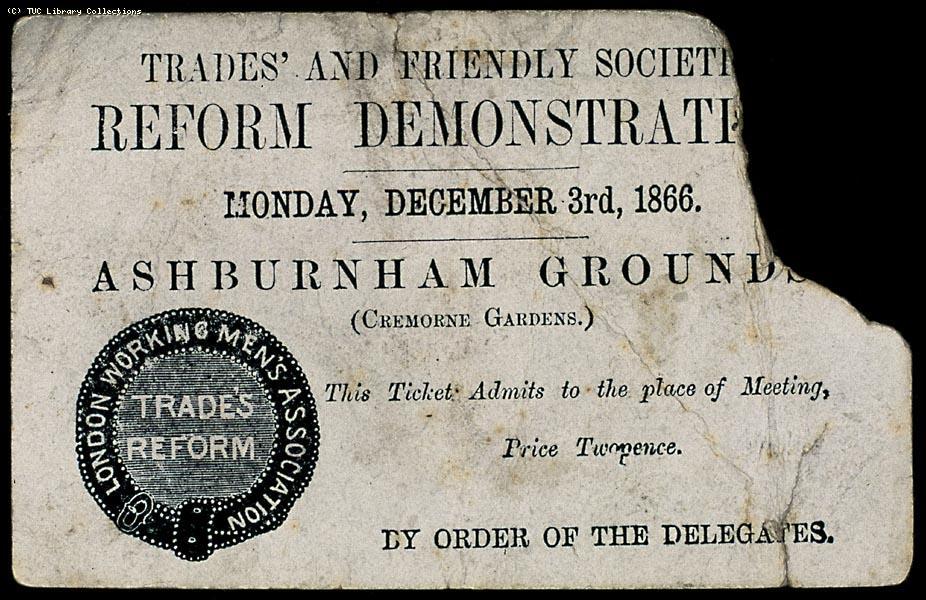
While the 1832 Reform Bill increased the right to vote for more middle-class voters, the working class was still excluded, and many of the issues surrounding corruption, representation, and working conditions were still unaddressed. It is estimated that the bill only enfranchised 700,000 people with the right to vote. What’s more, the 1834 Poor Law Amendment Act was received negatively by the working-class as it cut aid to the poor through the creation of workhouses, which had purposefully worse conditions. In 1864, the National Reform Union united middle and working class citizens to campaign for three essential points: a secret ballot (ie. privacy when voting), equal distribution of seats in Parliament, and votes for all taxpayers. A second group called the Reform League with similar beliefs also formed, which held protests in support of these issues. This pressure ultimately culminated in Parliament revisiting the voting rights. The 1867 Reform Bill was passed, allowing householders and renters who paid more than 10 pounds a year to vote. The bill also allowed farmers and other agricultural landowners to vote by reducing the property amount needed to do so. It is estimated that this increased the voting population from one to two million people.
John Stuart Mill devotes a section of his autobiography to his years in Parliament. Mill was cautious of the idea to grant full voting rights to all members of the working class. In 1859, he had proposed “that the privilege of a plurality of votes should be annexed to education, not to property, and even so, had approved of it only on the supposition of universal suffrage.” Mill does not explicitly state that he supported Gladstone’s efforts. He writes only that, “When I had gained the ear of the House, which I did by a successful speech on Mr. Gladstone's Reform Bill, the idea I proceeded on was that when anything was likely to be as well done, or sufficiently well done, by other people, there was no necessity for me to meddle with it.” Mill took the bill as a way to campaign for women’s suffrage. Mill saw it as a “moral and social duty” and despite its failure to be included, “a personal success.” Thus, for Mill, the causes he advocated for and their progress are what he deemed his most important achievements of his time in Parliament.
Citations:
“Second Reform Act, 1867 - Pressure for Democratic Reform up to 1884 - National 5 History Revision.” BBC Bitesize, www.bbc.co.uk/bitesize/guides/z6c6cqt/revision/8.
UK Parliament . “Second Reform Act 1867.” UK Parliament, 2019, www.parliament.uk/about/living-heritage/evolutionofparliament/houseofcom....
“John Stuart Mill Amendment.” UK Parliament, www.parliament.uk/about/living-heritage/evolutionofparliament/houseofcom/reformacts/from-the-parliamentary-collections/collections-reform-acts/great-reform-act112/