
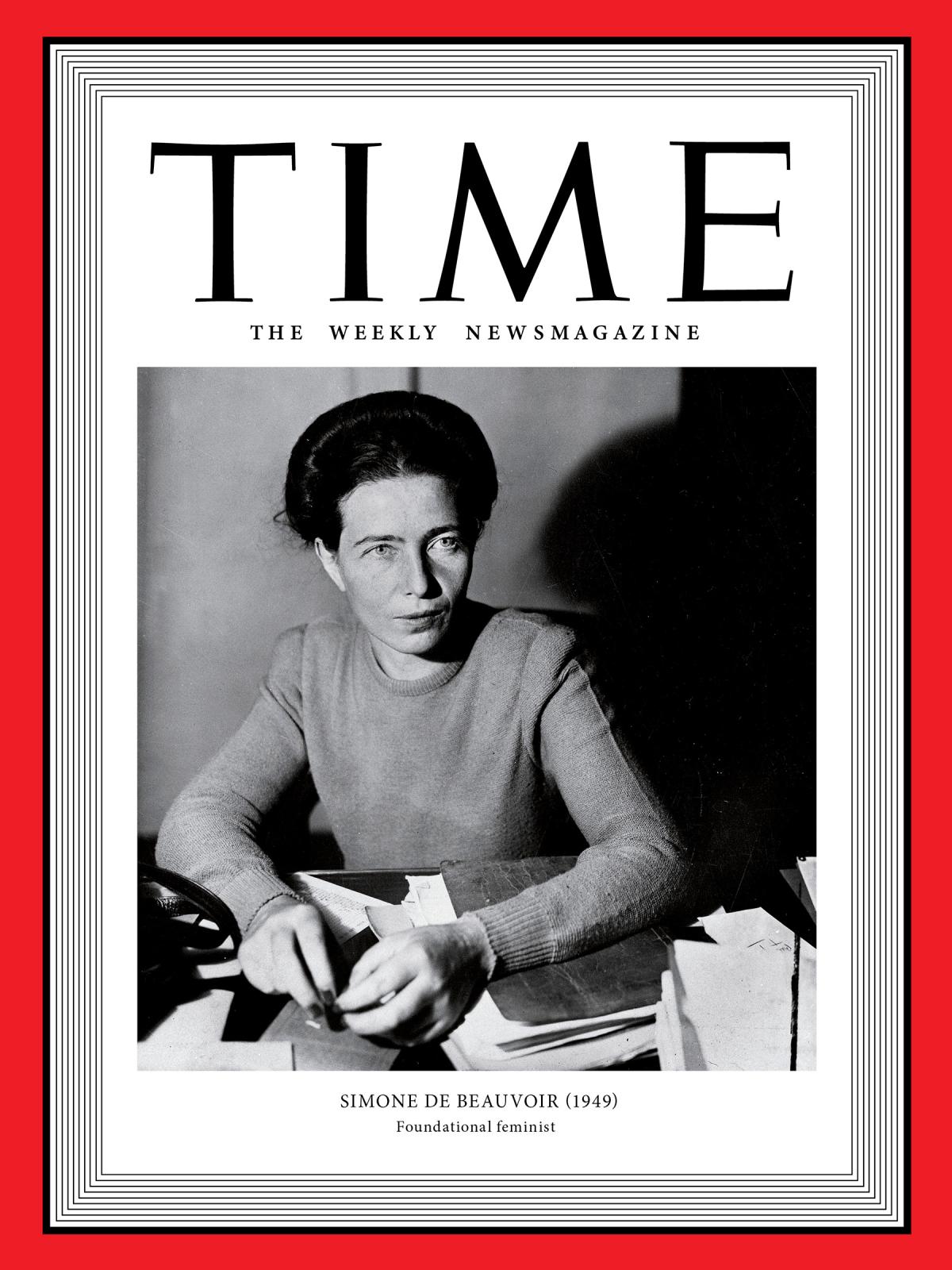
Simone de Beauvoir published the book "The Second Sex" in 1949 which was originally published in France and then in the United States in 1953. This was between the first and second wave of feminism and set the tone for the next wave of women's right activism. Jules Laforgue was one of the most individual of French poets but also the most entertaining with speech-rhythms and heterogenous diction. Beauvoir’s allusions to Jules Laforgue, in her founding text from post- war French. She read his poems quite often and reexamining the poet’s writing on women and the relationship between the different sexes, with his focus on women and the liberation, is then reflected into the foundational ideals of “The Second Sex”.
In this academic journal written by Claire White discusses “It suggests that Laforgue's reflections on sexual politics are underwritten by more radical ideals than it might appear, not least his call for fraternal relations between the sexes — symbolized by a handshake — which was to capture Beauvoir's imagination.” They both felt marriage was looming and inevitable. What Laforgue described was the difficulty on reconciling philosophy with life of emotions. She expressed this life of emotional into one of the inequalities during that time that she was facing regarding women oppression. In “The Second Sex”, she wrote about the history of being treated as second to men with underlying structure of sexual objectification. This book offers an important contribution to the feminist phenomenology of temporality. She questioned "What is a woman?" in which she ultimately determined “One is not born, but rather becomes, a woman” ([1953] 1989: 267)
Works Cited
Burke, Megan M. “Gender as Lived Time: Reading The Second Sex for a Feminist Phenomenology of Temporality.” Hypatia: A Journal of Feminist Philosophy, vol. 33, no. 1, 2018, pp. 111–127. EBSCOhost, doi:10.1111/hypa.12386.
Marcus, Sharon. “Simone de Beauvoir, The Second Sex (1949; Trans. 1953).” Public Culture, vol. 32, no. 2 [91], May 2020, pp. 375–383. EBSCOhost, doi:10.1215/08992363-8090131.
White, Claire. “Laforgue, Beauvoir, and the Second Sex.” Dix-Neuf, vol. 20, no. 1, Apr. 2016, pp. 110–124. EBSCOhost, search.ebscohost.com/login.aspx?direct=true&db=mzh&AN=2016640191&site=ehost-live.