

Sidney Paget (1860-1908) is most widely known for his brilliant illustrations that accompany the Sherlock Holmes stories of Sir Arthur Conan Doyle. Over the course of his collaboration with Doyle, Paget completed 356 illustrations for The Adventures of Sherlock Holmes. His drawings played a considerable role in the popularity of the literary work and exemplify the importance of illustration in the Victorian era. Paget harbored a profound understanding of Holmes as a character, which provided the artist with a means of depicting the famous detective in a unique and compelling manner. Holmes consistently bears a wise expression and wears a distinctive uniform of deerstalker cap and Inverness cape, all of which are prominent characteristics of modern-day adaptations of Doyle's work. Paget's innovative portrayal of the detective, which oftentimes differs slightly from the text in terms of detail, add a vital dimension toThe Adventures of Sherlock Holmes, which would have been lost if not for illustration.
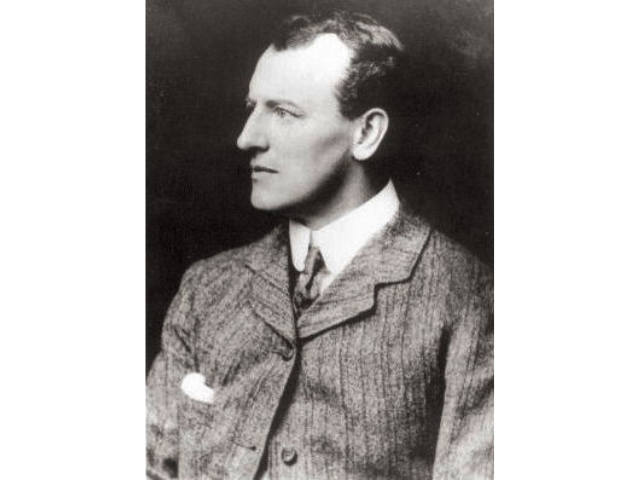
Photograph of "Mr. Sidney Paget," from The Arthur Conan Doyle Encyclopedia, c. 1890. Sidney Edward Paget was born to a family in the heart of London in 1860. Prior to attending the Heatherley School of Fine Art, he studied for two years at the British Museum. Paget went on to enter the Royal Academy Schools in 1881. His two brothers, Walter Paget and Henry M. Paget, also become successful illustrators and portraitists. Sidney Paget is most well known for his illustrations of the Sherlock Holmes stories. It was as a black-and-white artist that he greatly assisted to popularize the works that he illustrated. Paget's drawings were extremely well received in America as well as in the United Kingdom.
Sidney Paget, "The Boscombe Valley Mystery," from The Adventures of Sherlock Holmes, by Arthur Conan Doyle, 1892, The Arthur Conan Doyle Encyclopedia. Signey Paget collaborated closely with Sir Arthur Conan Doyle to create over 350 illustrations for The Adventures of Sherlock Holmes. Paget's iconic depiction of Holmes first appeared in The Strand Magazine and played a large role in generating great popularity for the detective story. In terms of physical appearance, Paget's drawings differ from the descriptions of Sherlock Holmes that Doyle provides throughout the novel. His general depiction of Holmes is far more handsome than that of Doyle's imagination, and it is said that Paget likely based Holmes's appearance off of his younger brother. Paget also presents the character with a distinct appearance that still resonates within the realm of popular culture. He added various features to the detective's appearance. One such addition is Holmes's close-fitting deerstalker cap. This was an artistic decision of the part of Paget as Doyle never mentions Holmes wearing a deerstalker. At the time, this sort of attire was most often worn by hunters in rural areas. As a result, it is reasonable to assume that the cap held some sort of symbolic meaning for Paget. Sherlock's Inverness cape is another trademark accessory for the detective that reappears throughout The Adventures of Sherlock Holmes. The Inverness cape is another moment of artistic liberty on the part of the illustrator. Although Doyle only ever described the detective wearing an Ulster, Paget is responsible for altering this narrative to develop today's iconic image of Holmes.
Sidney Paget, "We Had The Compartment To Ourselves" from The Boscome Valley Mystery, by Arthur Conan Doyle, 1891, The Victorian Web. For all of Arthur Conan Doyle's genius of intellect in producing one of the most popular works of the Victorian Age, the compelling nature of the detective story depends on the visual components that Paget brilliantly supplies. The illustrator had a talent for depicting distinct facial expressions which provided the audience with a means of understanding the personalities of the characters. As is visible in Figure 3, Paget is a master of a traditional style of illustration. His drawing is extremely detailed and presents a contemplative and intelligent Sherlock. Paget is intentional in his portrayal of Sherlock's physical characteristics. The detective's striking facial structure and pronounced nose are integral to the formulation of Sherlock as a character. Paget provides the ideal visuals of a dispassionate protagist of unwavering intellect who champions the ideal picture of the human race. Paget's imagination was cinematic and inspired later filmmakers to transport Sherlock from the page and onto the screen.
Benedict Cumberbatch, "Sherlock Holmes and The Case of Copyright," from Independent, 2014, independent.co.uk. Sherlock aired as a BBC television series from 2010 to 2017. Inspired by The Adventures of Sherlock Holmes, the show is immensely popularity as a modern interpretation of Doyle's detective stories. Athough Sherlock takes place in modern-day London, the protaginist adheres to Paget's classic depiction of Holmes. Sherlock's long trench coat bears a strong resemblance to the Inverness cape, which he pairs with the iconic deerstalker cap. BBC's Sherlock is representative of Paget's lasting influence on the modern media.
Sidney Paget, "The Death of Sherlock Holmes," from The Adventure of the Final Problem, by Arthur Conan Doyle, 1892, The Victorian Web. Paget is extremely skillful in his portrayal of action-packed scenes which make a massive contribution to the entertainment value of the stories. Figure Four is something of a "pregnant moment' for Doyle's work as the reader-viewer is invited to inquire as to what will occur next. The term "pregnant moment," originally formulated by Gotthold Ephraim-Lessing, describes an image that encapsulates tne past, present, and future. The illustration is likely to stick in the mind of any reader-viewer for a prolonged period of time and provides a point of reverence in that respect. The drawing freezes a dynamic movement--what will happen next to Sherlock Holmes?--and conveys a modern feel characterized by conflict and adventure.
Henzell, Tania. “Cloak and Swagger: The History behind Sherlock Holmes’ Iconic Look.” Sherlock Holmes Tartan, Sherlock Holmes Tartan, 8 Dec. 2023, www.sherlockholmestartan.com/blog/cloak-and-swagger-the-history-behind-….
“Sherlock Holmes and the Case of Copyright.” The Independent, Independent Digital News and Media, 7 Jan. 2014, www.independent.co.uk/arts-entertainment/books/features/sherlock-holmes….
“Sidney Paget’s Illustrations.” Sherlockian, 3 Oct. 2017, www.sherlockian.net/investigating/paget/.