
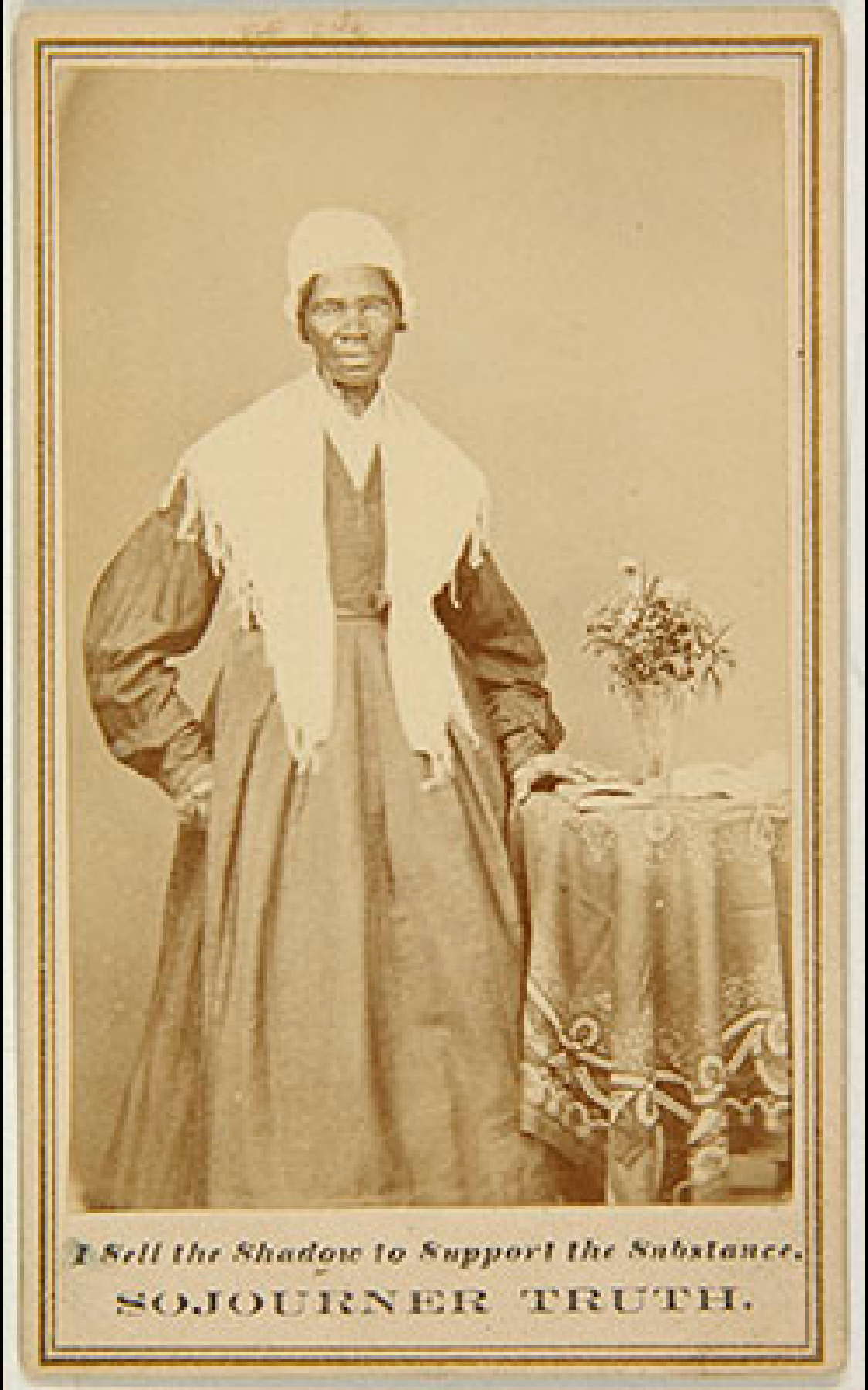
In 2016, the Berkeley Art Museum and Pacific Film Archive opened an exhibition including “cartes de visite” from Sojourner Truth, among other paper content, stamps, letters, banknotes, etc. from the Civil War. The image is of one of Truth’s “cartes de visite” from 1863 and reads “I Sell the Shadow to Support the Substance” with her name below it.
The carte de visite was a “a new mode of mass communication in the 1850s that quickly became relatively inexpensive collectibles” (BAMPFA) that Sojourner Truth took advantage of as an abolitionist and feminist. French photographer André-Adolphe-Eugéne Disdéri’s invention of “cartes de visite” created an accessible and inexpensive medium for lower-class people to make portraits of themselves and to spread their messages quickly. Truth used profits from the cards to help fund her efforts to abolish slavery and continue in her activism for women’s rights.
Truth’s caption on the carte manifests ideas of double marginalization and intersectionality, as she claims her agency as an autonomous self with the use of the words “I sell.” She uses the idea of selling in a new light, independent of her history as a slave, as she is now in charge of transactions and is no longer an objectified property. Truth also takes an economic stance here, as she compares an image of herself on paper to currency because it is of monetary value. A beautiful irony also exists in Truth’s use of words in her “cartes de visite” at all, as she was illiterate. Unable to read or write, Truth still creates a profitable material using powerful written word.
Truth also includes her chosen name “Sojourner Truth” to brand herself as someone independent of the name she went by in her days as a slave, “Isabella Bomfree.” The image itself provides Truth with agency and independence, as well, as the camera captures her at a gripping eye-level, enabling her to command the photo and the viewer’s attention. Both Truth’s diction and stance indicate her strength in her identity as a black woman.
In another one of Truth’s cartes de visite, she is holding knitting in her hands, which has been interpreted to symbolize Truth’s class status. Truth saw knitting as a useful skill that should be taught to newly emancipated slaves as they make their transition into industry as autonomous beings.
With all of these elements, Truth uses her “cartes de visite” to advocate for the rights and equality of women and black people.
Joel Bahr, “Shadows on Display: Sojourner Truth at BAMPFA.” Berkeley News, 28 July 2016, www.news.berkeley.edu/2016/07/25/shadows-on-display-sojourner-truth-at-….
“Sojourner Truth, Photography, and The Fight Against Slavery.” BAMPFA. www.bampfa.org/program/sojourner-truth-photography-and-fight-against-sl….