
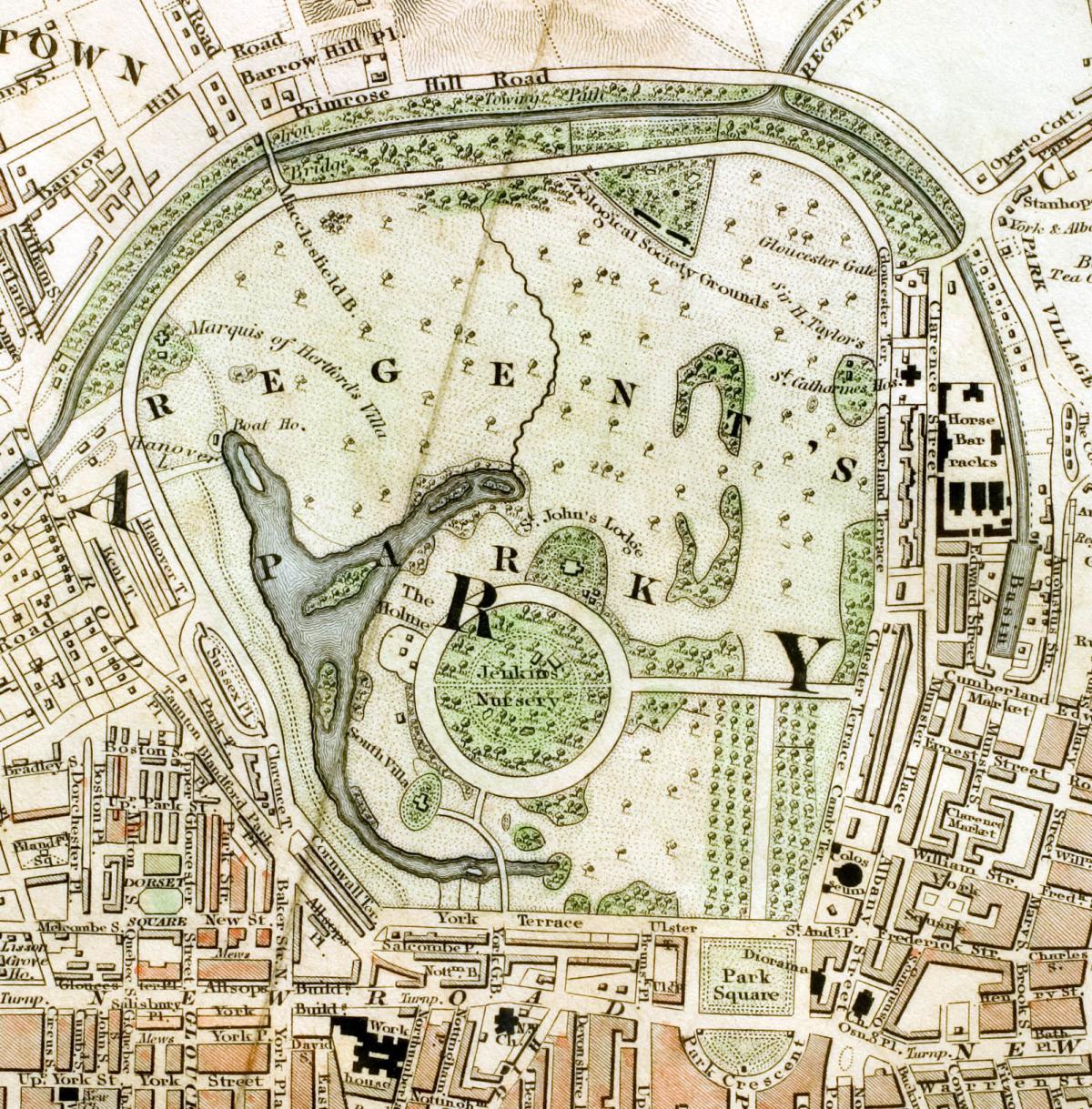
Regent’s Park is one of the eight royal parks of London, partially in the Borough of Camden and partially in the City of Westminster. The Park, before being declared available for the public in 1841, was strictly property to the crown. Originally, Prince Regent at the time, who is now known as King George IV, wanted to make a summer place in the area and restrict it from outside use. However, the palace was never created and landscapers John Nash, close friend of King George IV, and James and Decimus Burton, who financially supported the project themselves, schemed out the layout of the park, bringing it to fruition. It was designed in the early 1820s as an area for members of high society and the royal family to enjoy. Even after it was released, it took decades for Regent’s Park to fully be available to the public ("Landscape History"). For quite a while, Regent’s Park was associated with people of high ranking and importance in society as they would often meet others of their social class there.
As mentioned in chapter 5 of The Romance of a Shop, the Lorimers speak of Lord Watergate, someone of high social status and with a considerable amount of wealth. While speaking of his wife who had passed away, one of the girls states, "I rather fancy so; I know he lives in Regent's Park" (Levy). In chapter 18, Phyllis also mentions that she had "met [Mr. Darrell] at Regent’s Park the other day" (Levy). He is another wealthy and respectable man of notable achievements and standing, and both lines imply Regent's Park to be a well-off and preferable place to live. The few lines mentioning the park all illustrate interactions between the girls and aristocrats, as the death of their father rids them of their way of a comfortable life and drops their social ranking significantly enough to turn them into working women.
It’s no wonder Regent’s Park is associated with London’s finest, given as it is often called “the jewel in the crown.” As Clement Scott describes Regent’s Park in the poem Rus in Urbe in the late 19th century, “we’ve flowers by day and have scents at dark, / The limes are in leaf in the cockney garden, / And lilacs blossom in Regent’s Park” (Lines 14-16). There are numerous references to the park in literature and in cinema, from as old as The Secret Adversary published in 1922 by Agatha Christie, to the London Zoo being shown in Harry Potter and the Philosopher’s Stone in 1997, as well as the later released film taking footage from the actual park ("Regent's Park - In Literature").
To this day, Regent’s Park is still not fully available for the public. There are private organizations such as the London Zoo and Regent’s University that reside in Regent’s Park. Although the areas of Camden and Westminster have high rates of homelessness, many of them are unable to use or are unwelcome to reside in the park due to the public image of the park and the private institutions taking up parts of the 410 acres of land the park takes up (Shukla et al).
Works Cited:
“Regent’s Park - In Literature.” Wikipedia, 23 Sept. 2022, https://en.wikipedia.org/wiki/Regent%27s_Park#In_literature
“Landscape History.” The Royal Parks. The Royal Parks Guild, 2017, https://www.royalparks.org.uk/parks/the-regents-park/about-regents-park…. Accessed September 2022.
Scott, Clement. “Rus in Urbe.” Bartleby, https://www.bartleby.com/360/5/16.html.
Shukla, Gaurav, et al. “Regent’s Park.” Encyclopedia Britannica, https://www.britannica.com/place/Regents-Park.
Schmollinger, William. Improved map of London for 1833, from Actual Survey. 1833. Wikipedia, https://en.wikipedia.org/wiki/Regent%27s_Park#/media/File:Regent's_Park…. Accessed September 2022.

Westall, William. London from Greenwich Park. 1830. The British Museum, London. The British Museum, https://www.britishmuseum.org/collection/object/P_1880-1113-5544. Accessed September 2022.
“Garden Improvements in Regent’s Park.” Illustrated London News, 1 August 1863, p. 121. https://victorianweb.org/art/parks/regentspark/1.html.
Levy, Amy. The Romance of a Shop. 1888.