
Nineteenth-century Britons recognized three major epochs of history—the classical period, the middle ages (reaching into the fifteenth or even sixteenth centuries), and the “modern” period, their own age. As the industrial revolution, population growth, and urbanization brought vast changes to their landscape and culture, many Victorians were drawn to uncover and preserve the remains of Britain’s medieval past. This interest prompted the translation, publication, or republication of medieval poetic epics (such as Beowulf), legends (such as Thomas Malory’s Le Morte D’Arthur), and histories (such as Jean Froissart’s Chronicles of the Hundred Years War).
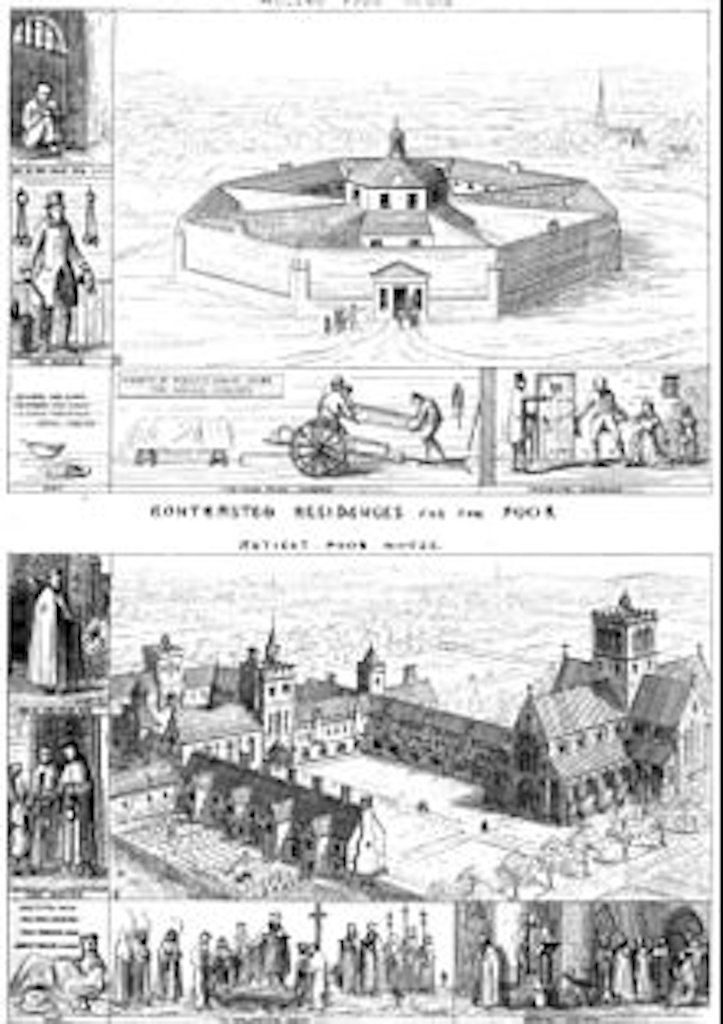
The attitude of Victorians toward their medieval past varied widely; the medieval period could be disdained as a primitive predecessor to their own allegedly more progressive age, romanticized as a simpler world of clear feudal and religious allegiances, or valued for its alleged superiority as a kinder, gentler world than their own. The latter view was well represented in Augustus W. N. Pugin’s Contrasts, which juxtaposed a series of images of 19th century Britain’s industrial squalor with idealized drawings of respectful peasants receiving bounty from church dignitaries and feudal lords.
Morris was influenced by several strands of Victorian medievalism: he visited medieval churches and ruins, admired plainsong and other forms of traditional music, read long, detailed histories of the Middle Ages, and apprenticed for a year in the architectural firm of G. B. Street, a noted medieval restorationist of his day. Most important, however, was his immersion in the medievalist poetry of the two most distinguished poets of his day, Tennyson, who in 1856 had published an early, shorter version of what would become his Idylls of the King, and Browning, who in his 1855 Men and Women had represented artists and rulers from fifteenth-century Italy.
Morris’s poems set during the late Middle Ages show some traces of the prevailing romantization of medieval chivalry, with his knightly protagonists dedicated to worthy causes. However his Defence poems are also quite modern in dramatizing the stress and precarity which a violent and stratified society inflicts on its inhabitants.