
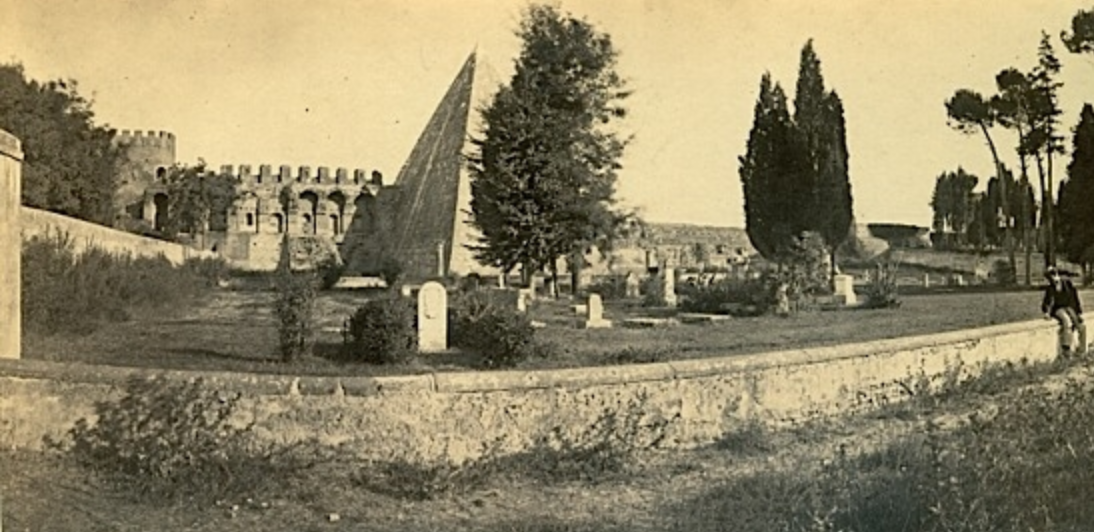
Monte (Mount) Testaccio—from the Latin testa and the Italian cocci, both translating to, “potsherd”—is a 150-foot high mountain of discarded amphoras that had been used for shipping oil from the Roman provinces from the late Republic (2nd c. BCE) onward. After its access to the port was sealed off in the late decades of the 3rd century CE, its usefulness as a dump ceased. During the Middle Ages and the Renaissance the site was a gathering place for religious festivals, jousting tournaments, and public spectacles. Prior to its re-evaluation and investigation as a location of archeological importance and historical significance in the late 19th century, it was a popular picnicking, hunting, and wine storage cite. (The cellars cut into the side of the mountain proved ideally and naturally cool for housing wine.) Reputedly, in 1849, Giuseppe Garibaldi used it as an armory during the attempted revolution in support of Italian unification. At the time of Claude’s 1849 visit to it in Arthur Hugh Clough's Amours de Voyage, it would have been considered—even by the most enthusiastic and discerning of travelers—as little more than a trash heap. However, nestled between the foothill of Monte Testaccio and the 1st century BCE Pyramid of Gaius Cestius, the “Non-Catholic Cemetery for Foreigners in Testaccio”/“Protestant Cemetery” was a popular pilgrimage site throughout most of the 19th century. As the final resting place of both John Keats and Percy Bysshe Shelley—who in the preface to Adonais, wrote, "It might make one in love with death, to think that one should be buried in so sweet a place.”—it was on every author’s list of things-to-see, if not on the ‘official’ Grand Tour itinerary.