
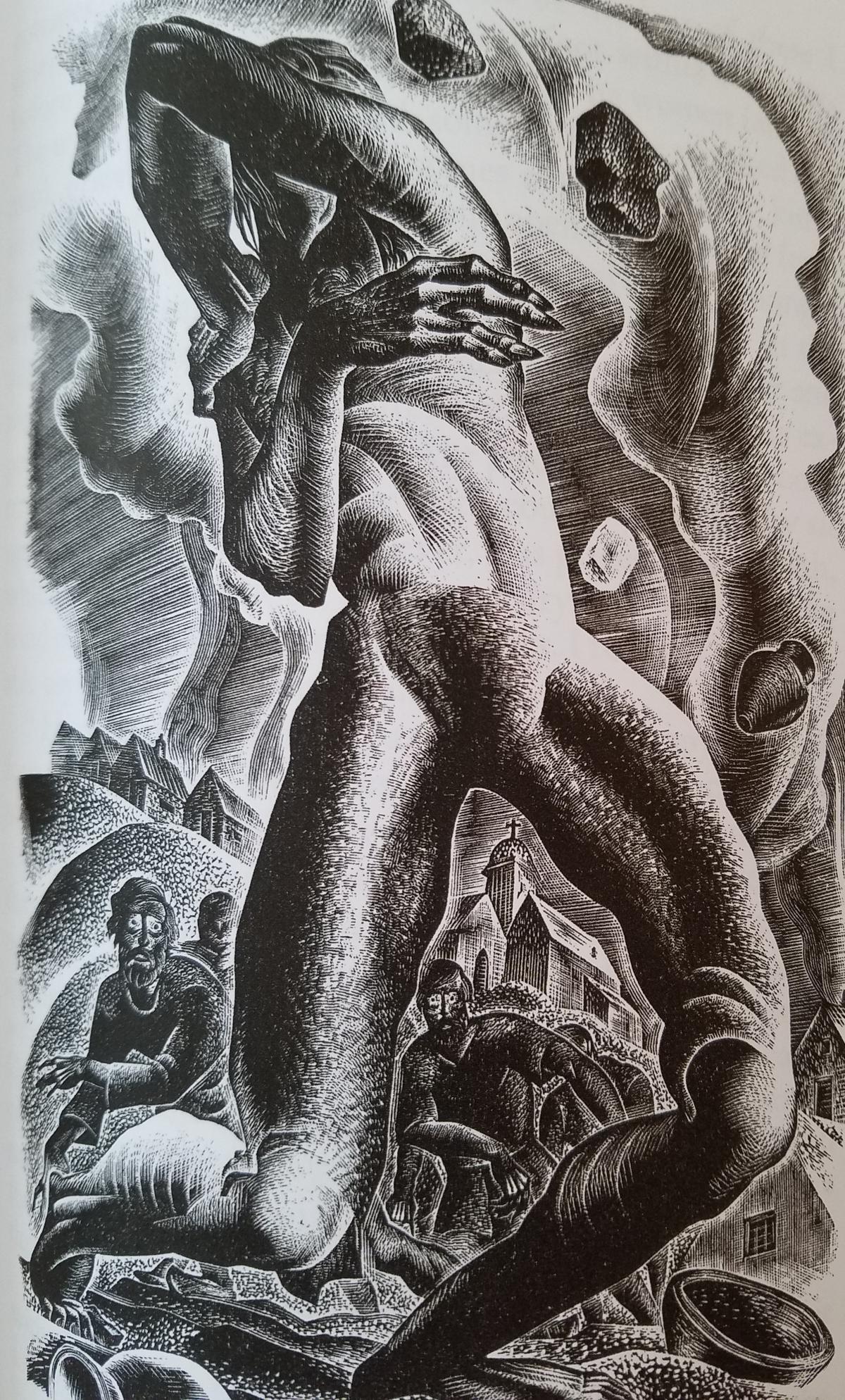
This illustration appears as a heading for volume II, chapter III, when the villagers stone the monster. In the beginning of this chapter, the creature is on his journey through the woods. The creature is on his own and starts to experience what it's like to feel thirsty, hungry, tired, and cold. He also starts to figure out how darkness is night and light is day. One day, the creature wakes up around noon and starts his travels again for the day. On this day, the Creature stumbles upon a village and is confused on how “miraculous” the village appeared (Shelley 75). From a distance the Creature sees “vegetables in the gardens, milk and cheese placed at the windows” making the Creature hungry (75). So, out of curiosity and hunger, the creature steps into the village and frightens everyone instantly. The entire village was “...roused; some fled, some attacked me, until, grievously bruised by stones and many other kinds of missile weapons” (76). From the image we see that the men are stoning and throwing things at the Creature to get out. The creature does not expect this from “a cottage of neat and pleasant appearance” and doesn’t want to enter ever again (76). The Creature escapes the villagers and “fearfully takes refuge in a low hovel” (76). The Creature goes into the village for some food, shelter, and human interaction but leaves full of bruises and fear. .
The illustration shows that the creature is completely unarmed, defenseless, and is being terrorized and attacked by the villagers. The creature is significantly bigger and built differently than the rest of society. Naturally, society is rejecting someone or something that is unfamiliar. The creature’s face is not visible in the illustration, as if he is hiding in fear or embarrassment.The lack of view of the creature’s face is most likely to hide the human side of him and the hurt emotions he is feeling in this situation. This prevents the audience from feeling sympathy. The villager’s faces are visible however, and they are angry. The depiction of the creature takes up a majority of this illustration, as to be a reminder of how large in size this creature is compared to the villagers. It also appears that the creature is falling, or fleeing from the scene, and is trying to escape. The creature seems to be straining his arms to protect his face as his only defense mechanism. If the creature’s face was visible, we would likely see the fear and sadness in his face. The creature is depicted to be lean and muscular in the illustration, and his legs appear as if they are fighting back from letting the creature fall down in defeat. The background of the scene depicted in the image looks as if the village or the grounds surrounding the attack are in flames, and the villagers are throwing several different things at the creature, such as stones, vases and plateware.
Poole says, “Dr. Frankenstein and his monster became perhaps the central metaphor of the last two centuries for anxieties over scientific modernity and the threat it posed to the human experience” (85). It is quite obvious that the creature is a creation of science, and some may even say he’s a dangerous creation of science. Especially with the villagers shown in the background, his unnatural qualities are emphasized. The audience is given a clear depiction between the differences of human qualities and the creature’s qualities. His limbs and strength are much more drastic and, because the villagers are not that far behind the creature, their heads compare to the girth of his thigh. Due to how strong the creature is, his “unnatural power” can be seen as a threat. This is why the villagers stone him. Stones, bowls, and vases can be seen flying every which way, so not only were they extremely desperate to hurl whatever they could, the stones and ceramic can be a symbol of prehistoric times; No weapons or modern technologies are used to hurt the monster, which emphasizes the natural versus unnatural. The villagers in the image represent something very natural, while the creature does not.
Works Cited
Poole, W. Scott. Monsters in America: Our Historical Obsession with the Hideous and the Haunting. Baylor University Press, 2018.
Shelley, Mary. Frankenstein. 1818 Text ed., Oxford World's Classics, 2019.
Ward, Lynd. Villagers Stone the Monster. paganpressbooks.com/jpl/LW115.HTM.