
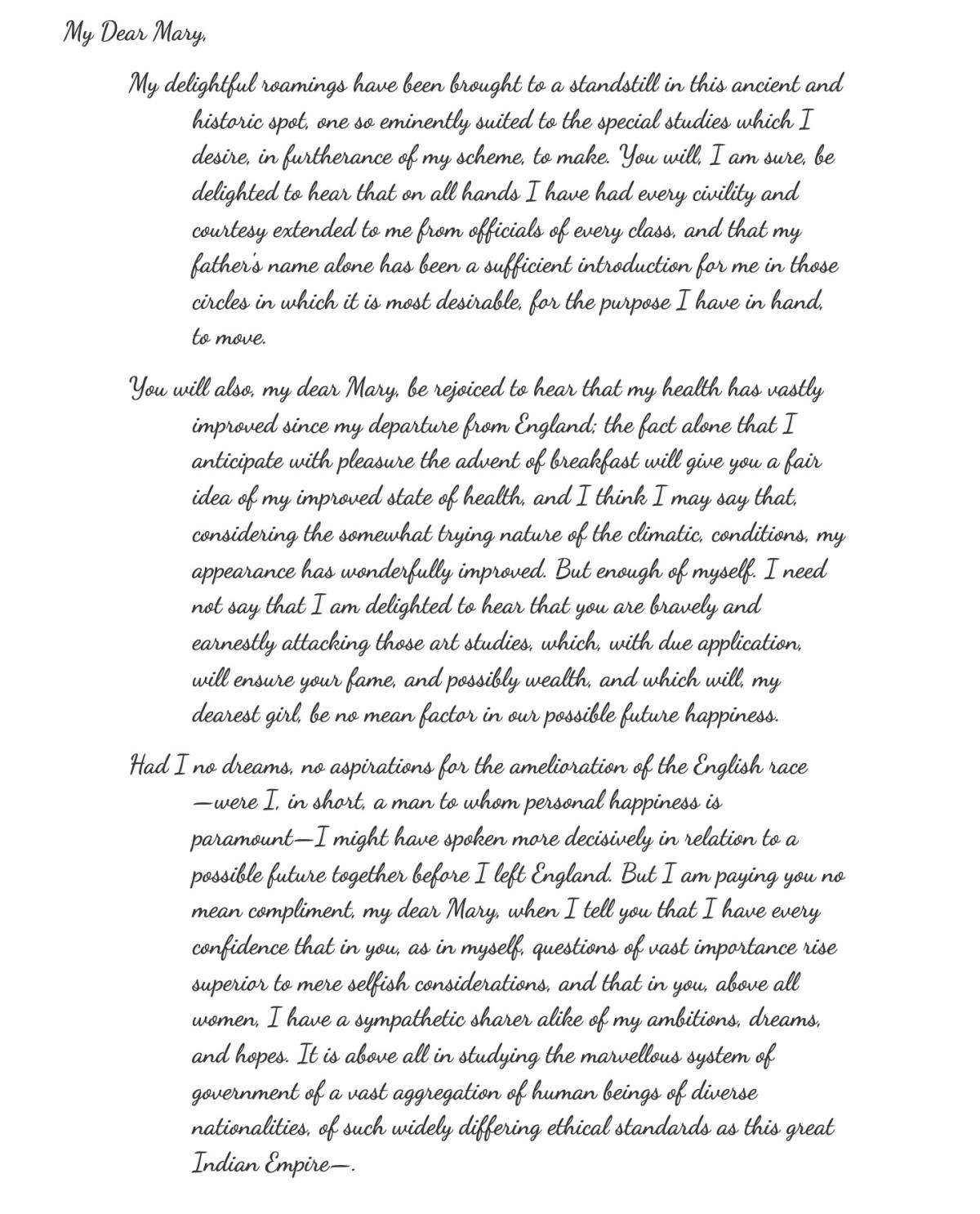
I wait and wait for letters from Vincent, but even when they come it brings me little satisfaction. I am glad his health has improved and that his voyage is going well, but my whole being wishes he had never set out on this voyage in the first place. It concerns me that he had to emphasize that we have a possible future together, rather than just a future. This makes me question his intentions. Does he truly care about me the way I care for him? I am glad he made it clear that his desire to work in Government comes first. He attempted to soften this blow by calling his devotion to me selfish. How could he waste all his talents swagger on marriage? Vincent also seems to believe that because he means to make changes within the Government that I support, it justifies putting our “possible” future together on hold. If only I could embark on a long and perilous journey after telling a man I loved him. I would prefer not to make my lover anxious if I could help it. Most men, Vincent included, do not seem ready to extend this courtesy. This must be because they do not understand what it is like to be kept waiting. With all of his progressive talk, surely Vincent should understand this dilemma if I explained it to him. Unfortunately, it would not be my place to tell him. All I can do is respond to his letter and wait on him some more.
Editorial Commentary: In this clipping, Mary Erle is writing about how a letter from her lover made her feel concerned. Vincent begins the letter by telling Mary how “delighted” she will be to hear about how well he is feeling and looking. Throughout this section of the passage, he comes off as somewhat self-centered. He then proceeds to write, “but enough of myself,” and compliments Mary on her art studies. The way he phrases this portion of the letter appears condescending, especially when he ensures Mary of her “possible wealth” and their “possible future.”He uses the word “possible” to emphasize the fact that their courtship is not a settled matter, and Mary notices this. Vincent then announces that he can not completely commit to a relationship with Mary because it would be “selfish” when considering his future aspirations. He clearly expresses that his career is more important to him than a relationship with Mary is. In modern-day terms, this letter is full of red flags. This would be especially concerning for a woman of the Victorian era like Mary because of the strict societal expectations that follow Victorian courtships. If a woman engages in sexual relations with a man before marriage, she is considered fallen, and it is difficult to find a husband in the future. This made women cautious when it came to relationships. Mary recognizes Vincent’s shortcomings, but women have to wait for men to approach them in the Victorian style courtship. With no other suitors, Mary is driven to continue with this doomed relationship with a man that does not truly love her. This situation highlights the flaws of Victorian-style courtship and marriage.
Citation: [Dixon, Ella Hepworth. The Story of a Modern Woman. Kessinger, 2010.]