
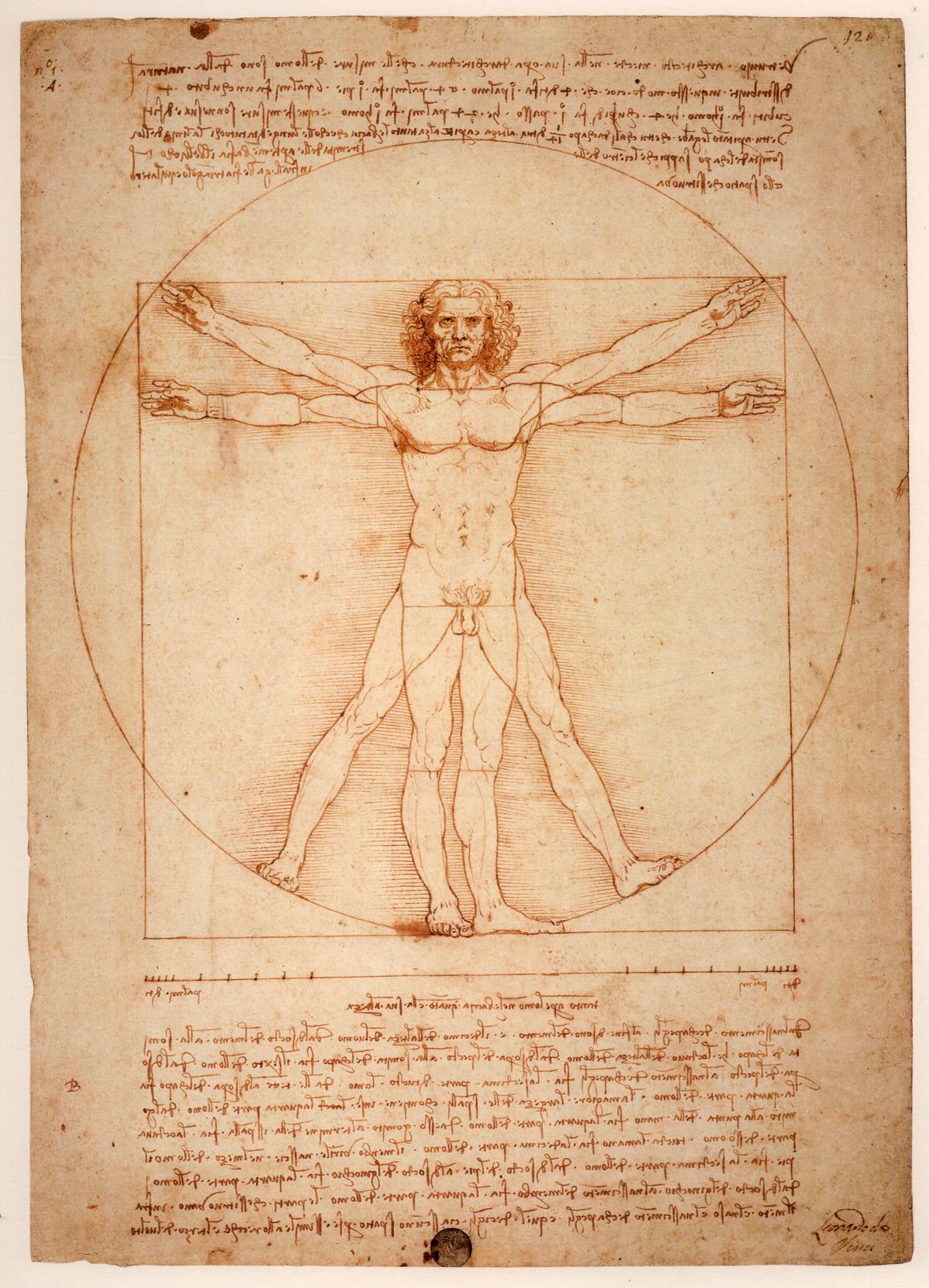
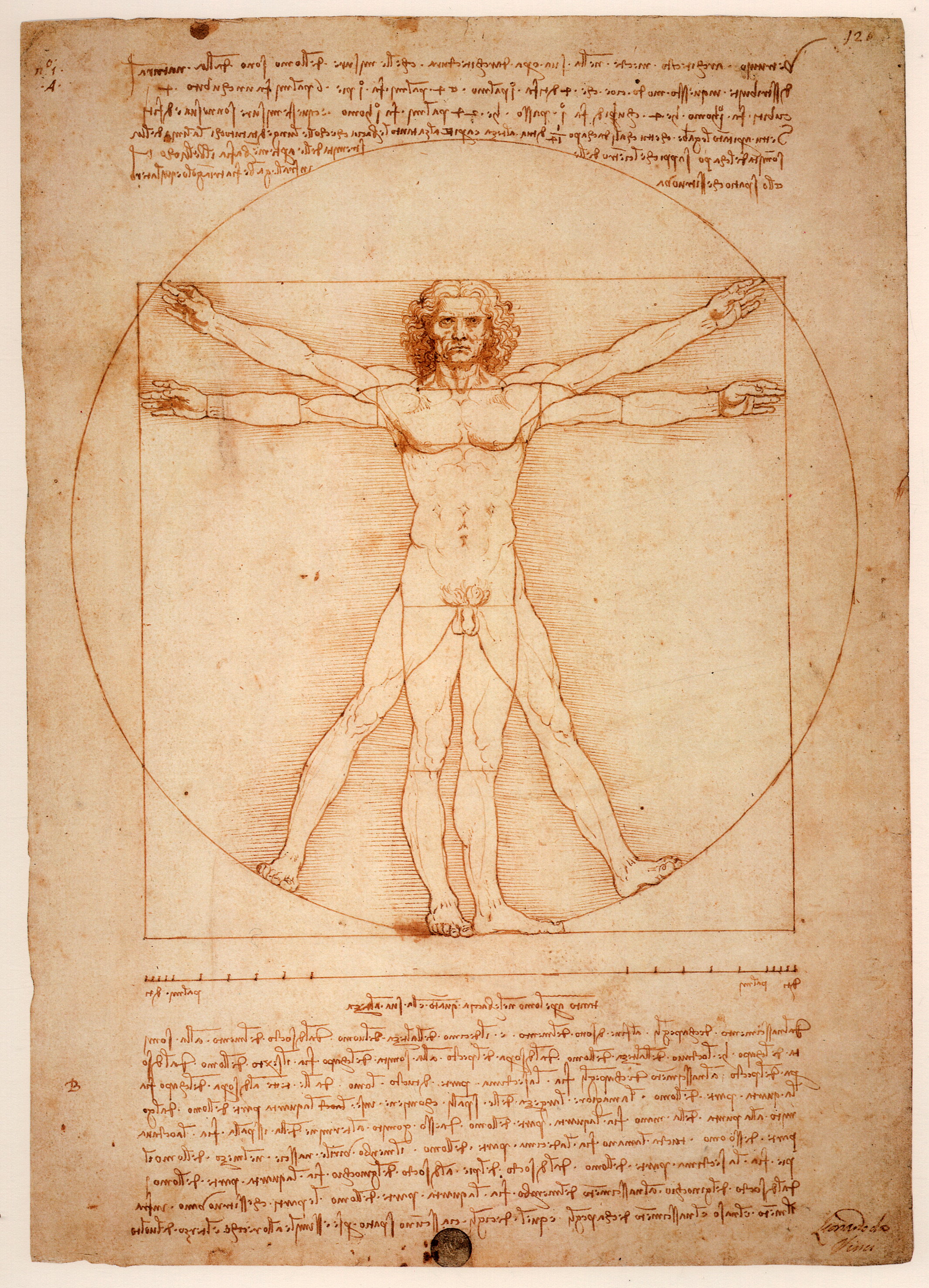
In the Vitruvian Man c. 1490, Leonardo da Vinci showed that having drawn a human figure with its arms and legs outstretched, by placing the center of a circle at the navel, the circle will perfectly surround the figure. Additionally, the distance between fingertips when the arms are held perpendicular to the body is nearly equal to the height of the human body, allowing him to draw a perfect square around such a figure. da Vinci included notes on his drawing, often referencing the sketch’s inspiration, Vitruvius’s de Architectura. The note includes specific human ratios found in de Architectura, as well as some of da Vinci’s own observations. This is why the sketch is sometimes known as Canon of Proportions or Proportions of Man.
The sketch shows ratios of the human body and its relation to geometric ideals. In Book III Chapter 1 Section 2 of de Architecture, Vitruvius outlines many such ratios. For example, the distance between the lowest tip of the chin and the highest point of the forehead and the distance from the wrist to the tip of the middle finger is equal to the a tenth of the height of the whole body, the length of the foot is a sixth, and the forearm is a fourth. Leonardo da Vinci adds many more ratios in his notes, including that the width of the shoulders is a fourth of the body. He also corrects Vitruvius suggesting that the length of the foot is a seventh of the body instead of a sixth.
Image Source: https://brunelleschi.imss.fi.it/stampa_leonardo/images/uomo_vitruviano_accademia_v.jpg
Other Sources:
Isaacson, Walter. “Chapter 8 Vitruvian Man.” Leonardo Da Vinci: The Biography, Simon & Schuster, 2018.
Vitruvius. The Ten Books on Architecture. Translated by Morris Hicky Morgan, Harvard University Press, 2014.
http://academics.triton.edu/faculty/fheitzman/Vitruvius__the_Ten_Books_on_Architecture.pdf