
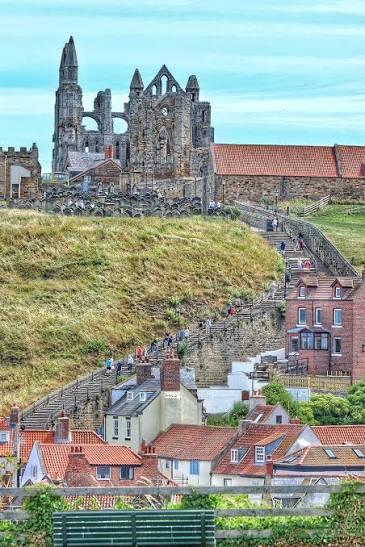
Whitby has long captured my imagination. Bram Stoker actually went there: during an 1890 holiday, he stood beneath the ruined abbey, climbed the 199 steps to St. Mary's churchyard, and folded that geography into Dracula. The town isn't just a literary setting either; the BBC's 1977 Count Dracula and the 2020 Gatiss and Moffat series both filmed there, at the actual abbey and steps, so the place has shaped the story twice over, on the page and on screen. I've visited Whitby myself, but I preferred John Welleck's Facebook image of the stairs up to the Abbey better than my own, as it captures their immense scale. I found the film connection not in a scholarly edition but on a travel blog, Third Eye Traveller's "Dracula in Whitby," written by an independent traveler, not a credentialed expert, a clean example of low barriers to entry: nobody vetted Sophie Pearce, yet her post captures details, like the disputed step count, that an institutional history might smooth over. Mapping Whitby on COVE lets one enthusiast's research sit beside official literary history, reshaping who gets to narrate a story's origins.
Bibliography
Research: https://thirdeyetraveller.com/dracula-in-whitby-fangtastic-things-to-do/
Image: https://www.facebook.com/groups/yorkenglandphotos/posts/6781489545247725/