

Unlike many men in his time, Rev. George Austen influenced his daughter Jane Austen and was a big support throughout her writing process. .When Jane Austen originally finished her first novel, First Impressions, her father tried to help her get it published by writing a formal letter to a London publisher in 1797. Although the manuscript was quickly rejected without even being read, his constant support and Jane's persistence in writing even after rejection allowed her to grow as a writer in a supportive environment. He let her use his own paper, which was very expensive at the time, and gave her a writing desk and full access to the family library, allowing her to immerse herself in as much literature as she needed to. Her father would proudly share her work with visitors and family members who would come by. He served as a valuable source of support for Jane’s writing, bolstering her confidence to keep writing even after rejection. I found that this was a beautifully refreshing example of a man in the late 18th century, and more importantly, one can see that his belief in and support for his daughter paved the way for his son Henry to support his sister's writing even after her death.
Silhouette of Rev. George Austen, by Hallie Pomerantz, 2025. Reverend George Austen, Jane Austen's father, is the focus of my silhouette. For the silhouette of Reverend George Austen, I decided to freehand the portrait with a Sharpie once the acrylic markers had thoroughly dried. As explained in my crafting section, I found that the warm colors did a great job of symbolizing the man in the portrait, as Reverand George never cared to be acknowledged himself but did everything possible for his daughter, Jane, to be known by the world.
Crafting Rev. George Austen's Silhouette, Photograph by Hallie Pomerantz, 2025. Often, a silhouette removes the extensive details about someone; it doesn't show the color of their eyes or the shades of their teeth. It instead leaves the shape of an individual and their form, much like how Reverand Austen helped in forming Jane’s writing. He never wanted or hoped to be in the spotlight; the situation itself is very fitting because he acted as a support system for Jane, always backing her up but never taking away her spotlight. Honestly, initially, I was unsure about the background colors. I came into class late and was left with a yellow and an orange acrylic marker. Yet, as I drew, I realized that the colors were quite symbolic of how Rev. Austen influenced his daughter’s life, as he stood as a very warm and comforting member on whom Jane relied. I would like to think that this object is not of an authoritative father for Jane. It is instead a truly strong-willed silhouette that proudly stands behind a glowing legacy, which happens to be his daughter Jane.
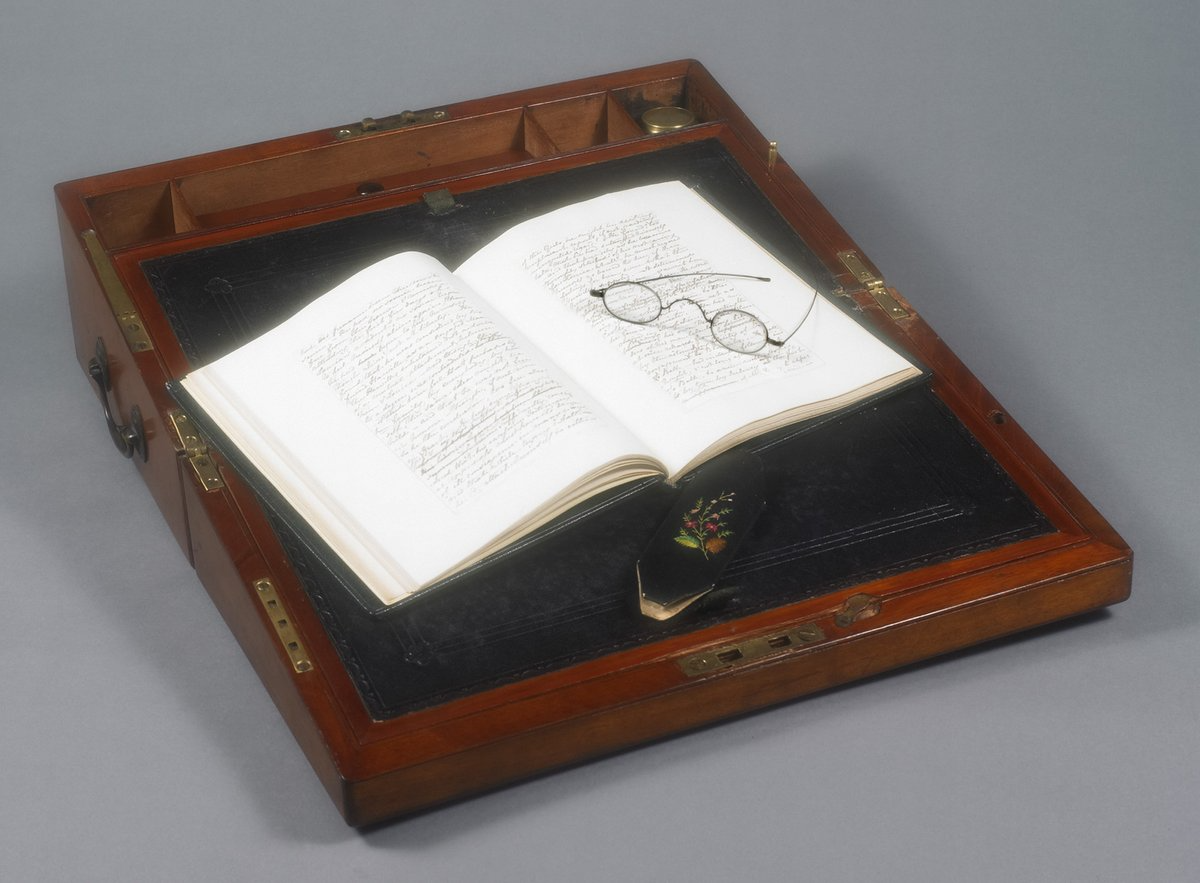
Jane Austen's Writng Table and Writing Slope, Gifted By Reverend Austen, in the 18th century (figures 3 and 4). One of the most admirable aspects that Reverend Austen did for his daughter Jane was buying her a writing slope to put atop a writing table to nurture and empower her interests in writing. By choosing such a beautiful piece of furniture, Reverend Austen did a lot more than just buy a simple desk for his daughter; he gave his daughter more than an exquisite material object and instead created a sanctuary for her to grow as a writer and a woman, where, at that time, society did not allow such a pairing. From this desk emerged some of English literature’s most enduring works, proof that brilliance and success require not pressure and negative commentary, but support, understanding, and space to grow, along with an environment that allows it.
Letter from George Austen to Thomas Cadell, 1st November 1797 (MS 279) (Reproduced by permission of the President and Fellows of St John’s College, Oxford) In 1797, Reverend George Austen wrote a letter to the popular literary figure Thomas Cadell, who was known for publishing many notable literary works during that time. This letter was written during a period in which a woman’s writing would be met with dismissal and ignorance, or would often force the woman to remain anonymous in the hope of gaining better traction and less criticism based on their gender. To get more attention from Thomas Cadell, Rev. Austen compared his daughter’s work with the notable novelist Frances Burney’s Evelina; Burney was also a woman author whom he hoped would inspire the publisher to read Jane’s manuscript. The manuscript he asked to be read was First Impressions, now known as the universally notable Pride & Prejudice; however, Thomas Cadell never read the letter nor did he even open the envelope himself, and rejected it, sending it back to Jane’s father without providing any reasonable explanation. Despite this rejection, one thing stands remarkably clear: Reverend George Austen refused to reject his daughter’s beautiful talent and constantly tried to get her work out into the world. He hoped that society could see just how talented Jane was, as her father saw through his eyes, and he was right.