
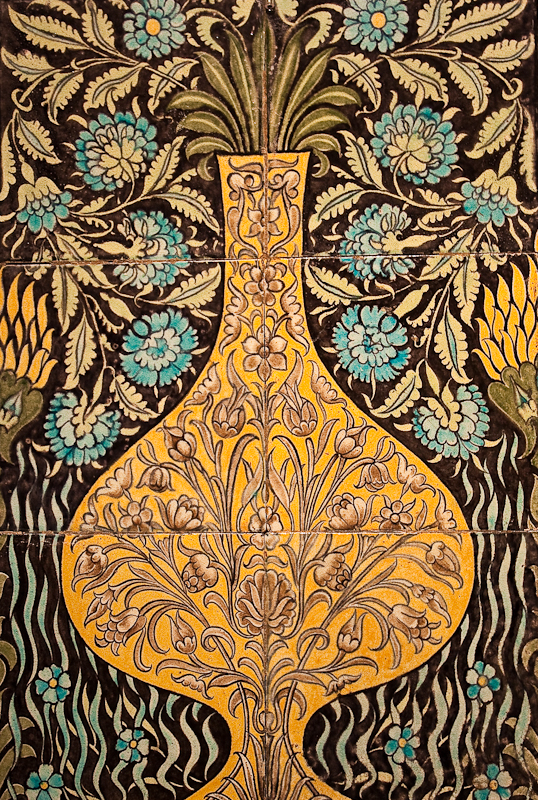
William De Morgan was a close friend of William Morris whose work was rooted in the Arts and Crafts movement, rejecting industrial methods in favor of handmade goods that were both beautiful and functional. He began his career working for Morris, Marshall, Faulkner & Co. in stained glass, and it was the iridescent quality of that work that inspired him to move into tile making. Working first at Fitzroy Square and then Chelsea, he developed intricate repeating patterns featuring flowers and animals. He was deeply influenced by Middle Eastern and Islamic design, visiting the South Kensington Museum for inspiration, and his signature style of stylized leaves and flowers in blues, greens, and turquoise became known as "Persian." His most famous commission in this vein was providing tiles for the Arab Hall at Leighton House in Kensington. In 1882 he moved his pottery to Merton Abbey, Surrey, next to Morris's own workshops, and later to Sands End in Fulham in 1888, where he produced his most ambitious work, mastering Lustre decoration, a notoriously difficult technique requiring precise pigments and firing conditions.