
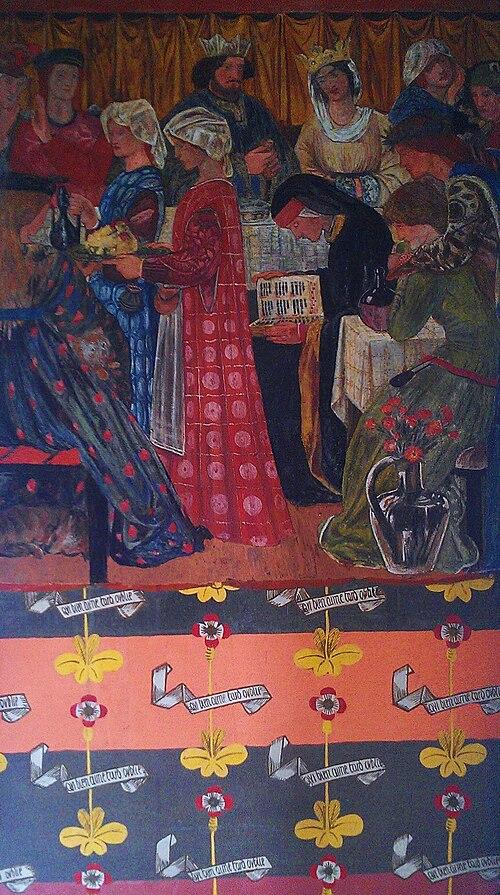
William Morris and Edward Burne-Jones developed their artistic vision through a deep shared love of medieval art and literature. John Ruskin's The Stones of Venice was a turning point for both men. Ruskin argued that Gothic art embodied a pre-capitalist world where craftsmen could express genuine creative freedom, something he saw as utterly lost under industrial capitalism. Morris and Burne-Jones took this idea to heart and built their entire aesthetic around it.
Their medieval fantasy style was never confined to painting alone. They believed beauty belonged on every surface of daily life, so their work expanded into furniture, textiles, stained glass, embroidery, and book illustration. Early collaborations, like the mural paintings at the Oxford Union on Arthurian themes, showed how naturally the group worked together across different media.
The clearest expression of this vision was the Red House, built in 1859 in Bexleyheath, Kent. Designed by architect Philip Webb in a Gothic Revival style, it became the center of the group's world. Burne-Jones painted murals in the drawing room, and the dining room was planned as a grand embroidered frieze of female figures. Morris's wife Jane Burden was deeply involved as well, collaborating on the embroidery work. The Red House was not simply a home. It was a living argument that art and everyday life should never be separated.
Timeline
Table of Events
| Date | Event | Created by |
|---|---|---|
| 1859-1861 | William Morris's and the Arts and Crafts MovementThe founding of Morris, Marshall, Faulkner & Co. in 1861 marked a turning point in which Pre-Raphaelite ideals of beauty and medieval craftsmanship were transformed into decorative goods including wallpapers, textiles, furniture, and stained glass that were distributed as commodities throughout Britain and America. Morris's wallpaper designs are a prime example, remaining so iconic that they are still copied and reproduced today. As Barringer explains, Morris paired this commercial enterprise with a deeply socialist approach to labor, insisting that the production and sale of the Firm's goods honor the dignity and creativity of the individual artisan, in direct opposition to the cheap and soulless products of industrial machine manufacturing. This philosophy became the foundation of the Arts and Crafts Movement, which spread throughout Britain, America, and Europe in the latter half of the nineteenth century. The movement took local root in many places, including New Orleans, where the Newcomb Pottery, founded in 1895, embodied the same ideals of handcrafted goods made by artisans for the sake of beauty and individual expression, standing as a direct challenge to the dominance of mass produced industrial goods. |
Md Mahmudul Hasan Robin |
| 1872-1875 | Arts and Crafts and Middle Eastern influencesWilliam De Morgan was a close friend of William Morris whose work was rooted in the Arts and Crafts movement, rejecting industrial methods in favor of handmade goods that were both beautiful and functional. He began his career working for Morris, Marshall, Faulkner & Co. in stained glass, and it was the iridescent quality of that work that inspired him to move into tile making. Working first at Fitzroy Square and then Chelsea, he developed intricate repeating patterns featuring flowers and animals. He was deeply influenced by Middle Eastern and Islamic design, visiting the South Kensington Museum for inspiration, and his signature style of stylized leaves and flowers in blues, greens, and turquoise became known as "Persian." His most famous commission in this vein was providing tiles for the Arab Hall at Leighton House in Kensington. In 1882 he moved his pottery to Merton Abbey, Surrey, next to Morris's own workshops, and later to Sands End in Fulham in 1888, where he produced his most ambitious work, mastering Lustre decoration, a notoriously difficult technique requiring precise pigments and firing conditions. |
Md Mahmudul Hasan Robin |