
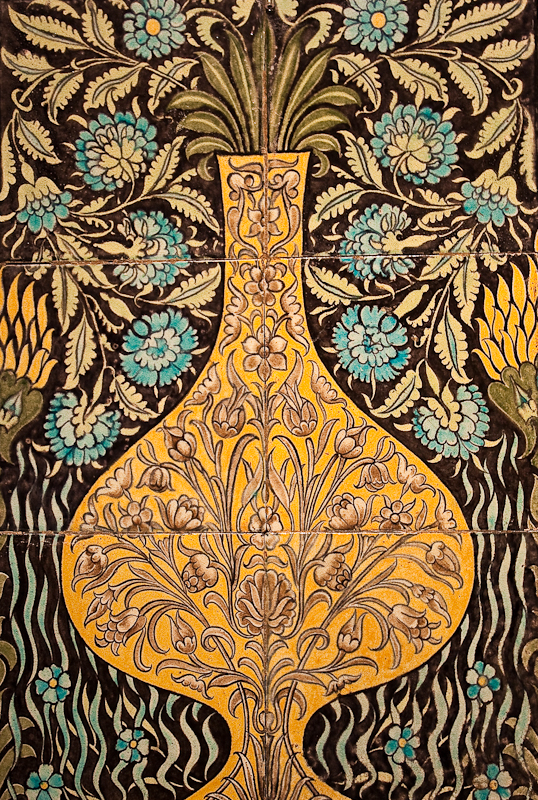
Between 1873 and 1875, William de Morgan was developing the ceramic work that would define his career. A close friend and colleague of Morris, De Morgan had originally worked for the Firm in stained glass before his fascination with the iridescent quality of silver paint on glass drew him toward tile making. Working from his studio in Chelsea, he began producing art tiles featuring floral ornament and animals, building directly on the design principles established at Morris, Marshall, Faulkner and Co.
Like other designers of his time, De Morgan drew heavily on Middle Eastern art for inspiration, visiting the collections at the South Kensington Museum to study Islamic tilework. His use of stylized leaves and flowers in blues, greens and turquoise became his signature style and was commonly referred to as Persian. This influence is most vividly seen in his work for the Arab Hall at Leighton House in Kensington, where he was commissioned to provide tiles to match 15th and 16th century originals that Lord Leighton had collected in Damascus. De Morgan's Middle Eastern influences ran throughout his entire career, extending into his later ceramic vessels and dishes and his tile schemes for ocean liners, where his Iznik inspired style evoked a sense of exotic luxury for passengers.