A study of British writers who were inspired by the visual arts, artists who adopted literary subjects, and writer/artists whose creative acts formed a composite of the two arts. This timeline tracks the progress of our class.
Timeline
Table of Events
| Date | Event | Created by |
|---|---|---|
| 1859-61 | William Morris's and the Arts and Crafts MovementThe founding of Morris, Marshall, Faulkner & Co. in 1861 marked the moment when the Pre-Raphaelite circle's passion for decorative arts became a commercial enterprise. The Firm produced wallpapers, textiles, stained glass, furniture, and ceramics — goods that were widely distributed throughout Britain and America. Among the most enduring of these products were Morris's wallpaper designs, which he truly mastered in the 1870s, producing patterns such as Larkspur, Jasmine, Willow, Marigold, and Chrysanthemum. These designs featured exuberant scrolling foliage, a degree of three-dimensionality, and closely interwoven foreground and background, requiring complex printing techniques using large numbers of individual printing blocks. They gradually found their way into the homes of the artistic middle classes and were endorsed by aristocratic patrons, eventually reaching royal commissions at St. James's Palace and Balmoral Castle. Morris's wallpaper designs are still copied and sold today. At the heart of the Firm's work was a commitment to opposing cheap, machine-made goods with handicrafts produced by skilled artisans, for the sake of beauty and individual craftsmanship. Morris brought a deeply socialist approach to labor in the production and sale of the Firm's goods — believing that meaningful, creative work was a human right. This philosophy became the foundation of the Arts and Crafts Movement, which spread throughout Britain, America, and Europe. A celebrated local example was the Newcomb Pottery in New Orleans, |
Md Mahmudul Hasan Robin |
| 1873-1875 | Arts and Crafts and Middle Eastern influencesBetween 1873 and 1875, William de Morgan was developing the ceramic work that would define his career. A close friend and colleague of Morris, De Morgan had originally worked for the Firm in stained glass before his fascination with the iridescent quality of silver paint on glass drew him toward tile making. Working from his studio in Chelsea, he began producing art tiles featuring floral ornament and animals, building directly on the design principles established at Morris, Marshall, Faulkner and Co. Like other designers of his time, De Morgan drew heavily on Middle Eastern art for inspiration, visiting the collections at the South Kensington Museum to study Islamic tilework. His use of stylized leaves and flowers in blues, greens and turquoise became his signature style and was commonly referred to as Persian. This influence is most vividly seen in his work for the Arab Hall at Leighton House in Kensington, where he was commissioned to provide tiles to match 15th and 16th century originals that Lord Leighton had collected in Damascus. De Morgan's Middle Eastern influences ran throughout his entire career, extending into his later ceramic vessels and dishes and his tile schemes for ocean liners, where his Iznik inspired style evoked a sense of exotic luxury for passengers. |
Md Mahmudul Hasan Robin |
| 1856 | Morris and Burne-Jones' first meeting with Rossetti (1856) , Formation of the GroupWilliam Morris and Edward Burne-Jones developed their artistic vision through a deep shared love of medieval art and literature. John Ruskin's The Stones of Venice was a turning point for both men. Ruskin argued that Gothic art embodied a pre-capitalist world where craftsmen could express genuine creative freedom, something he saw as utterly lost under industrial capitalism. Morris and Burne-Jones took this idea to heart and built their entire aesthetic around it. Their medieval fantasy style was never confined to painting alone. They believed beauty belonged on every surface of daily life, so their work expanded into furniture, textiles, stained glass, embroidery, and book illustration. Early collaborations, like the mural paintings at the Oxford Union on Arthurian themes, showed how naturally the group worked together across different media. The clearest expression of this vision was the Red House, built in 1859 in Bexleyheath, Kent. Designed by architect Philip Webb in a Gothic Revival style, it became the center of the group's world. Burne-Jones painted murals in the drawing room, and the dining room was planned as a grand embroidered frieze of female figures. Morris's wife Jane Burden was deeply involved as well, collaborating on the embroidery work. The Red House was not simply a home. It was a living argument that art and everyday life should never be separated. |
Md Mahmudul Hasan Robin |
| 1633 | Van Dyck, Charles I of England, a Grand Style portraitAnthony Van Dyck, Charles I (1600-1649) with M. de St Antoine (oil on canvas, 12.1 ft x 8.8 ft, 1633; Royal Collection, Windsor Castle); Wikimedia. Van Dyck (1599-1641) was a Flemish artist, whom the Stuart monarch, Charles I, appointed painter to the English court in 1632. Along with another celebrated Flemish artist of the period, Peter Paul Rubens (1577-1640), Van Dyck typified the Continental artist on whom Charles relied rather than cultivating native English artists. Among the greatest art collectors of his age, Charles instinctively turned to France, Netherlands and Flanders, Spain, and Italy to define the taste of the court. Van Dyck was especially known for the Grand Style portrait, in this example also an equestrian portrait. The huge canvas depicts Charles in military armor, astride a noble steed and riding through a triumphal arch. The architecture alludes to the triumphal arches of the ancient Roman Empire, which were erected for powerful generals and emperors returning from a great military victory. The symbolism enforces Charles's absolute power; and since he is accompanied only by his riding master, M. de St Antoine, instead of surrounded by cheering crowds, the symbolism also enforces his "Personal Rule" — referring to his decade of ruling without Parliament, an absolutist monarch justified by Divine Right. The picture was originally hung at the end of the Long Gallery in Hampton Court Palace, creating an illusion of the king entering the palace in a blaze of power (Roy Strong, Charles I on Horseback, Viking, 1972, 14, 20-25). |
David Hanson |
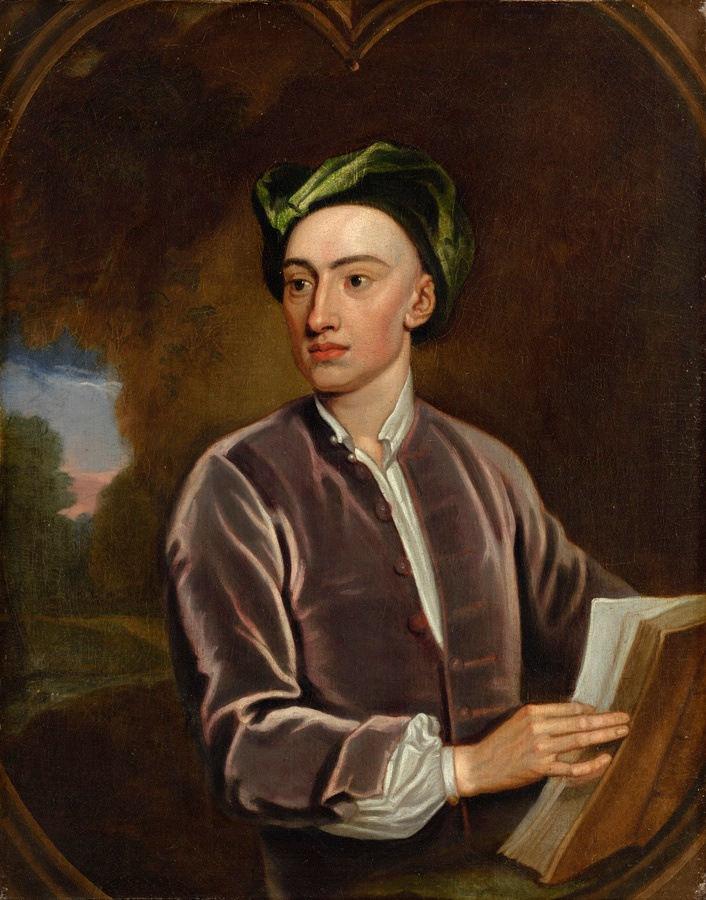
Alexander PopeIn 1711, poet Alexander Pope (1688-1744) published his first major work and entered London literary circles, including Joseph Addison's. Starting in 1715, he achieved fame and income with his translations of Homer's Iliad and Odyssey. He inherited his association with the Sister Arts from his uncle, Samuel Cooper, a painter who earned a reputation as “Van-Dyke in little.” Pope himself ventured into sketching and painting by studying in the studio of the portraitist Charles Jervas around the years 1711-1713, living in Jervas’ London studio and using the Jervas’ address up until 1726.
This friendship is memorialized in Pope's poem, "Epistle to Mr. Jervas, dated early 1719. A 1715 portrait of Pope by Jervas depicts Pope’s preoccupied and distant state of mind when starting his translation of Homer. In a (date) letter to his lifelong friend, Martha Blount (1690-1763), who is believed to be the woman in the background of his portrait, he wrote: “Fame is a thing I am much less covetous of, than your Friendship; for that I hope will last all my life, the other I cannot answer for.”
Later, Pope established other kinds of relationships with portrait painters, appropriate to his growing fame and the political and cultural controversies to which he responded as a satirical poet. While Pope sat for many portraits, he commissioned Godfrey Kneller (1646-1723), who had taught Jervas, for history paintings in 1719.
Kneller may not have had epistles written about him as Jervas had, but Pope still expressed his admiration for Kneller through his writing. Pope paid his compliments to Kneller for these paintings he had made by writing in 1719: “To Sir Godfrey Kneller, On his painting for me the Statues of Apollo, Venus, and Hercules' (1719):
What God, what Genius did the Pencil move When KNELLER painted These? Twas Friendship—warm as Phoebus, kind as Love,
And strong as Hercules.”
Portraiture has a strong hold through the 1730s, even after Kneller’s passing. At this time, Pope had moved on from translations and turned towards being a satirist. Portraits of Pope in this decade come from Jonathan Richardson Sr. (1667-1745), a painter who had literary aspirations. Richardson’s paintings were one of the distinguished collections Pope would have seen, larger than Jervas’s. Pope’s own collection was seen as not in the taste of a virtuoso—it lacked distinguished paintings done by old masters (da Vinci, Rembrandt, or even Rubens) and history paintings. His only histories were the ones he had commissioned Kneller to create for his staircase in 1719.
Pope’s years as a satirist produced works such as Moral Essays (four poems published in 1731-35), An Essay on Man (1733-34), and his masterpiece, the four books of The Dunciad (last being published in 1742). The content Pope wrote on was philosophical, ethical, and critical.
Upon his passing in 1744, it is claimed that friends surrounded him in his villa in Twickenham. |
Amelia Moran | |
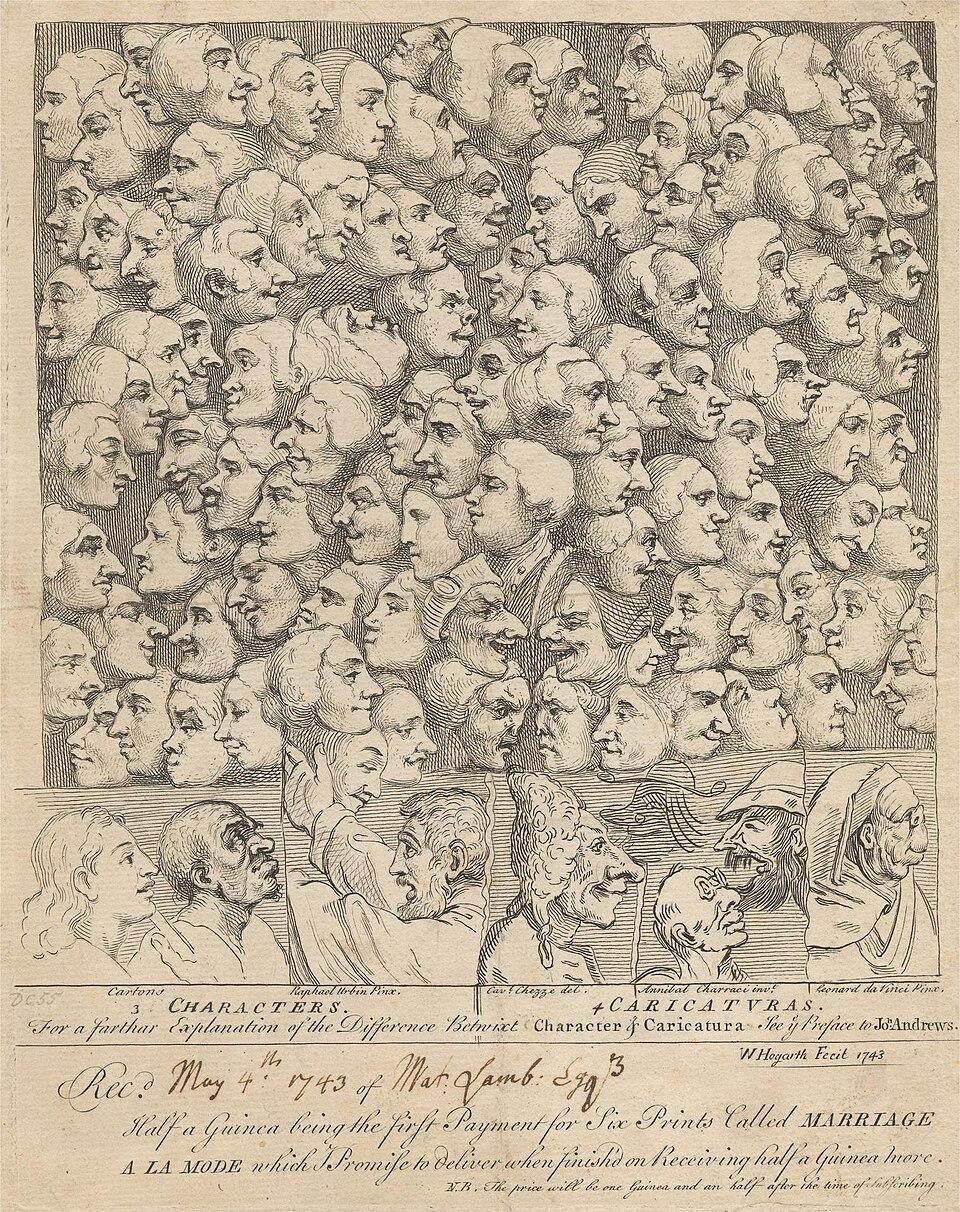
William Hogarth (1697-1764)William Hogarth (1697-1764) was an English satirist, cartoonist, and painter who was famous for his “Modern Moral Subjects,” which were series of paintings that formed a connected narrative and served as a satirical critique of English society. Hogarth reproduced the paintings as engravings for sale, and some series originated only as engravings. In the early eighteenth century, a new satirical art form became popular in England: portrait caricatures. Previously, the form had been practiced in the seventeenth century by elite circles in the Roman art world. They were first popularized by Pier Leone Ghezzi (1674-1755) and typically this type of portraiture exaggerated prominent features of a person. Ghezzi’s caricatures were done humorously rather than maliciously, and permission was granted by the sitter for the work to be done. However, caricatures were based on phrenology, the pseudo-science that asserted the physiognomic fallacy that character can be read in features, since personality traits were located in the brain and consequently the shape of the skull. Caricatures exaggerated such physical features as representations of moral attributes such as greed or voraciousness. Later on, George Townshend (1742-1807) would use caricatures to satirize English military figures. Hogarth strongly opposed Ghezzi’s work, likely because he believed it undermined the status of his own art. Rather than seeing his art as an exaggeration of history and English society, Hogarth saw his satires as works of observation. Subscription tickets for viewing his Marriage a la Mode series addresses the difference between Ghezzi’s caricatures and his paintings of “comic” history. His work, Characters and Caricatures, depicts the difference between “character” and “caricatures,” which is that “character” depends upon observation, whereas “caricatures” are created through serendipitous scribbling (essentially haphazard sketching guided by prominent features of the sitter). In the lower center of the crowd, Hogarth is believed to have inserted portraits of himself and Fielding grinning at one another.
The image above of Characters and Caricatures depicts Hogarth’s view regarding the differences between the two terms. The “character” drawings present physical features (on people) that are less dramatized than the caricature counterparts. Hogarth viewed his work as an observation and reflection on English society whereas he viewed caricatures as a form of exaggeration. |
Jacob White | |
| 1711 | Joseph Addison, "The Spectator," and Coffee House CultureThomas Rowlandson (1757-1827), The Coffee House (pencil, pen, and watercolor on paper, 1790; Aberdeen Art Gallery); Art UK. In 1711, Joseph Addison (1672-1719) and Richard Steele (1671-1729) founded the daily periodical, The Spectator, to bring "Philosophy out of Closets and Libraries, Schools and Colleges, to dwell in Clubs and Assemblies, at Tea-Tables and in Coffee Houses" (Spectator, no. 10). The two writers came together from opposing political perspectives to craft a prose of disinterested, civil observation by its fictional characters "Mr. Spectator" and fellow members of the Spectator Club. Literary historians have treated the periodical's daily installments as a progenitor of the serialized, epistolary novel (Benedict 6-7). The social context of The Spectator and other periodicals was the coffee house, which served coffee, chocolate drink, wine, brandy, and punch, and which became hubs for conversation, news, and deal-making among middle-glass gentlemen. The houses tended to host specific professions -- artists at Old Slaughter's, literati at Will's, dancers and opera singers at the Orange, and so on. During the Restoration, Charles II attempted to close them, suspecting "treasonable" conversations since people of all ranks were admitted, but his opposition was stymied by his own cronies who habituated the scene. After the Glorious Revolution, Addison idealized the coffee houses as upholding civility and learning more constantly than was likely. Nonetheless, when James Boswell -- the biographer of the essayist Samuel Johnson -- came to London from his native Scotland, he loved to frequent the coffee houses and imagine himself as "Mr. Spectator" himself (Brewer 35-40). Benedict, Barbara M. "Joseph Addison." The Oxford Encyclopedia of British Literature, edited by David Scott Kastan, Oxford UP, 2006, vol. 1, 6-10. Brewer, John. The Pleasures of the Imagination: English Culture in the Eighteenth Century, Farrar Straus Giroux, 1997. |
David Hanson |
| 1750 | Conversation PaintingThe “Conversation” Portrait entered mainstream English circles in the 1720s, originated as an offshoot of French rococo art, wherein artists began communicating through their work the complexities of human relationship, specifically those found within a social setting. It was brought on by a softening of artistic conventions in the French court following the death of Louis XIV (1638-1715). Early English artists in this form, such as William Hogarth (1697-1764) and Philip Mercier (1689-1760), used the Conversation piece as a vehicle for examining and satirizing the seedier side of British society. Hogarth’s A Modern Midnight Conversation, which he split between a Before and an After, portrayed a salacious woodland rendezvous between a young man and a young woman. In the first illustration, the young man is seen pleading with the young woman, who is herself portrayed as behaving modestly, casually denying his advances. In the second illustration the roles are reversed, as now it is the woman who clings to the man, and the man who appears disinterested. The content of the Conversation portrait evolved a great deal in subsequent years. Young and ambitious artists began using the form as a way to introduce themselves to the broader artisan scene. The genre began hyper-focusing on sociability—illustrating the means through which social gatherings might facilitate personal association. By the latter half of the 1730s, the Conversation portrait began to fall out of favor. Artists started reshaping the form, moving away from its earlier iterations to depict moments of quiet intimacy between their subjects. A chief example of this is Joseph Highmore’s (1692-1780) Mr Oldham and his Guests, which was believed to have been an affable response to Hogarth’s Modern Midnight Conversations. The portrait is a subdued one, its red-faced subjects only slightly tipsy and behaving in a mellow manner as they wait for their companion, the titular Mr. Oldham, to return home. Unlike the earlier Conversation pieces, where the subjects were often presented far from the viewer, and framed in a remote way, the subjects here are framed closer, as if to make the setting and scene feel more intimate and personal. Thomas Gainsborough (1727-1788), in his piece The Painter’s Daughters Chasing a Butterfly, similarly favored intimacy over scale, framing the tandem subjects in much the same way as Highmore. By the 1760s, with the ascension of Charles III, a new variation of the Conversation portrait began taking shape. Actor-manager David Garrick (1716-1779) commissioned the German-born artist Johann Zoffany (1733-1810) to illustrate a piece for Garrick’s forthcoming play, The Farmer’s Return. This piece, and others like it, acted as a way to promote theatrical productions and puff up the social stature of the performer who had them commission. Beyond that, through its construction, it blurred the boundary between theatrical performance and painted genre scene, creating a new form of the Conversation piece altogether. |
Wilkins Dowdy |
| 1758 | Gavin HamiltonGavin Hamilton (1723-1798) was a Scottish painter, dealer, and archaeologist who took a systemic study of classical antiques during the 1750s and 1760s. In 1748, he arrived in Rome to study portrait painting. While in Rome two architects James Scott and Nicolas Revette encouraged him to visit Herculaneum and view the recently discovered site of Pompeii. These freshly discovered ruins in Athens, Naples, Palmyra, and Dalmatian coast were disseminated throughout Europe in treatises with detailed descriptions, picturesque landscape views, reproduction of frescoes, and attributes the great, beautiful, strange imagination in the middle of sense. In 1751 Scotland, he painted a full length portrait of Elizabeth Gunning Duchess of Hamilton in a conventional style from Van Dyck. Whilst then choosing to return to Rome and stay there for life in 1752. During his stay, he encouraged and got to know all British artists in Rome during the second half of the 18th century. In 1755, Hamilton met Raphael Mengs and Johann Winckelmann who were the leading theorists on Neoclassicism. Neoclassicism was the effort to revive the glories of lost civilizations. Winckelmann's book on Neoclassicism in the 1740's was about moving the model of classicism from Rome to Greek. The neoclassical movement was intensified for Hamilton after his discoveries of Greek Civilization artifacts during his time as a dealer and belief that 'the ancients have surpassed the moderns, both in painting and sculpture.' With Winckelmann's influence, his push for a newer thought of classical nobility made trouble for political parties as it sent a message to the oligarchs and challenged their rulings. |
Lacy Coleman |
James Thomson (1700-1748) and "The Seasons" (by Brady)James Thomson (1700-1748) was a Scottish poet and playwright best known for his 1730 poem “The Seasons” Where he wrote about the different seasons of the year and the important roles they play in nature. Thomson was born in the town of Ednam and grew up in Scotland. At the age of 15 he began attending Edinburgh University in Scotland where he joined “The Grotesques” a school club based on literature. By the time he was 20 years old he had written many different Verse poems and even had some published in the local paper. When he turned 25 he quit Edinburgh and he had moved to London to go on and tutor many noble figures such as Thomas Hamilton, Lord Binning and Charles Talbot Jr. He began working on “The Seasons” one poem at a time starting with “Winter” and finished it by 1726. Due to the poems success, he began writing the other seasons in chronological order from Spring to Autumn between 1727 and 1730, with the help of publisher John Millan. He was recognized for the way he wrote about serious subjects. He was known to make amusing descriptions of beautiful, sublime objects with a sense of imagination. He was inspired by Addison’s Spectator which believed in the idea of primary pleasures of observing nature firsthand and secondary pleasures from poems written about nature and how they played off of each other. His descriptions of nature really resonated with the readers with the descriptions of landscapes and animals. He believed the natural world was external and objective and took inspiration from poets such as Virgil. Throughout the various revisions he made of “The Seasons” he would incorporate material from ancient poets like him as well as more modern poets from the time and worked them into his style. He also combined the studies of Husbandry, history, hydropathy, optics, theology, and meteorology. He knew how to take simple concepts and make something powerful out of them. One notable example of this is in the “Spring” poem when he is discussing ploughing and he goes into detail humanizing the oxen, describing the ploughman’s joy with the soft breeze, and singing birds and describes the Earth, man, beast, and soil all being as one in harmony, comparing it to how Virgil would write about the Romans and their fieldwork of days past. “The Seasons’ was revised multiple times throughout Thomsons lifetime with the last one being two years before his death in 1748. The following picture was made by artist William Kent for the original 1730 edition of “The Seasons” with all four seasons compiled together. Each painting’s upper half represents the allegorical process of the seasons transitioning with the opening lines while the lower half shows the more naturalized process with individual scenes. This particular painting represents Springtime as we see angels moving the clouds from the rainy winter and forming beautiful sunny skies and rainbows for the people down below. |
Wilkins Dowdy | |
| 1742 | Henry Fielding and Joseph Andrews 1742Henry Fielding (1717-54) wrote The History of the Adventures of Joseph Andrews and of His Friend Mr. Abraham Adams, which could be considered as one of the first English novels. In the preface to this work, Fielding compared his novel to pictures by his friend William Hogarth (1697-1764), a satirist and painter who invented a comic narrative art in pictorial form that he called a “modern moral progress.”Fielding and Hogarth both expose the realities of their time through the usage of satire, Fielding in a new form of comic prose and Hogarth in a new form of narrative pictures. They wanted their audiences to take seriously the realities they exposed, so Fielding argues in his preface that, like Hogarth, his characters are not exaggerated caricatures but believable.
Fielding called his new kind of work a “comic epic in prose.” Like Alexander Pope (1688-1744), he compared his to an epic, just as Pope called his poem, The Rape of the Locke (1730), a “mock epic.” Pope satirizes characters’ moments of triviality or smallness by using lofty language to conceptualize the frivolous nature of his society. For example, he caricatures the petty vanity of his epic heroine, Belinda, by comparing her stolen lock of hair to the abduction of Helen of Troy (Canto II). That Fielding shared an appreciation of Pope’s classical form of mock-epic satire is shown through his first success Tom Thumb (1717). Yet, while Fielding displays the same bright and brittle language displayed in The Rape of the Lock, he softens the tone, making his narration sociable and playful.
Having understood the value of both enlightenment and entertainment according to the classical apology for literature, Fielding used his new form of fiction to uphold ethical purposes. Fielding teaches readers to be skeptical and question their social world. According to William Warner’s work on “Henry Fielding,” his work after his death was placed as “the most valuable English model for novel writing during the 17th century, increasing the value of novels in their current market world” (Warner 317). |
Lacy Coleman |
| 1716-1783 | Lancelot 'Capability' Brown (1716-1783)Lancelot ‘Capability’ Brown (1716-1783) was an English landscape architect known for his seamless fusion of honoring nature’s capabilities with human manipulation (hence the nickname). Brown’s garden landscapes were strategically designed to enhance (or imitate) the natural world, while still signaling the desired hierarchies of English society.
Brown’s landscape career began at Kirkharle Hall, where he worked as an apprentice to the head gardener until the age of twenty-three. After this apprenticeship, Brown went south—first to Lincolnshire, then to Kiddington Hall in Oxfordshire. Brown received his first landscape commission, and his career continued to flourish, ultimately leading to his addition to the gardening team at Stowe in Buckinghamshire. At Stowe, Brown worked under the direction of William Kent (another popular landscape architect known for his Palladian style). By age twenty-six, Brown had worked his way up to head gardener, allowing himself to hone in on his signature style. This style was highly sought after, especially after the members of high society saw his Grecian Valley at Stowe.
Brown’s landscapes were known for their simplicity (in contrast to the formal gardens of the 17th century) and elegance. Many of Brown’s clients were involved in the world of high politics. As such, these politicians advertised their success through fashionable houses and gardens—embracing the signature style of Brown and the ‘Capability’ Men. These designs often featured serpentine lakes, ha-has, stone bridges, clumps of trees, woodland belts, and sweeping drives. All design choices were strategically made to enhance the existing landscape and leverage its capabilities.
After a successful career, Brown died in 1783 at age sixty-seven. It is estimated that he worked on over two hundred gardens, many of which can still be seen today. Some of the estate landscapes that Brown designed include Croome Court, Warwick Castle, Blenheim Palace, Stowe Gardens, Chatsworth House, and Hampton Court. |
Kaleigh Wood |
William Blake (by Brady)The way that William Blake did his printing was a very new and influential way for his time back in the late 18th century. Blake wanted to combine poetry and artwork into illuminated books with etchings so that the literature and visuals would balance each other out in a lovely package. First he used copper plates as paper sheets, then he would use a stopped out varnish with the quill pen or brush that he was usually using while making the books. He began practicing writing and drawing with a mirror, essentially making the reversal of what he wanted to put in the books. After the varnish dried out he would make what is called a “wax dike” around the plates and bathe it in nitric acid that would quickly corrode. The reason for this was so he could etch out every area except for the stopped out varnish. He then would stir the nitric acid with a feather to induce relief etching. By the time this was finished, the raised surfaces around the etchings would be properly inked. For whichever color he wanted to use, he relied on various pigments that he would mix together. He would then mix the pigments with linseed/nut oil to form a paste. Blake would then use an ink dabber and gently dabbed the relief surfaces so that the ink would not smudge the areas that were shallow and etched. Usually, there would still end up being at least a couple of smudges, which he would do his best to wipe them out, sometimes it was the longest part of the process for him. Depending on the sizes of the plates they would finish printing anywhere between half an hour to 2 hours. The bigger the plates were the longer it took to dry. By the time the process is finished, the words will have been printed on the top layer surface while the pictures would be printed from the bottom layer surface, which he would then put in a rolling press and manually roll it through, leading to the final product. Below is an example of his work with a page from his poem “Echoing Green” in the book “Songs of Innocence” One can see the beautiful artwork of the people and the branches surrounding the beautifully crafted writings of the poet and they mesh together in a lovely combination. Thanks to this process he would be able to make lovely works of art that were 100 percent all his own work. |
Wilkins Dowdy | |
| 1788 | Humphry Repton, and The Red BookHumphry Repton (1752-1818) was among the foremost—and last—great designers of the classical tradition in English landscape gardening. Repton was educated at a grammar school in Bury St Edmunds and Norwich, and, anticipating a career in mercantilism, was sent abroad to the Netherlands to continue his schooling. It was the connections he made while abroad that taught him the finer points of mixing with high society. Repton famously tried his hand at various careers before turning to landscape gardening—including trade, farming, and even journalism, all of which were said to have contributed a great deal to his later successes. Working during a transitional moment in taste, he balanced the naturalistic style of the earlier Georgian landscape with emerging picturesque and more formal revival elements. Despite early success and a wide clientele among Britain’s landed elite, financial difficulties and declining health marked his later years. Nonetheless he remains one of the most influential figures in the history of English landscape design.
Unlike some of his well-regarded predecessors, Repton didn’t involve himself with executing the plans he mapped out, but rather worked exclusively as a designer. He would carefully document his proposals in illustrated presentation books known as Red Books—so-called for having been expertly bound in distinctive red morocco leather—which combined practical plans with watercolor overlays to show before-and-after views of estates. While Repton claims to have made roughly four hundred Red Books, only about one hundred still extant.
Two of these Red Books are housed at The Morgan Library, in New York City. They are the Red Book of Ferney Hall and of Hatchlands in Surrey. Repton's process consisted mostly of him visiting a specific client, touring the grounds of the estate, interacting with the client and discussing expectations the client might have, and then compiling all his cumulated notes and drawings together into a single proposal. The proposals were often pretty elaborate, and would include expectations Repton had, different views of the property and the surrounding country, and a conclusion, in which Repton would praise the client's excellent taste and, at the same time, urge them to spend a large amount of capital in improving the appearance of their estate.
Regarding the Ferney Hall estate, Repton was commissioned by Samuel Phipps, a prosperous attorney, who in 1787 sought to improve the state of his newly acquired home. This was an early endeavor of Repton’s, and as such he was still perfecting the format of the Red Book. Repton focused primarily on establishing his practical expertise, picturesque sensibilities, and cultivated taste, traits which would no doubt impress an individual as elite as Phipps.
Repton died at the age of 65, and his body currently resides in the graveyard of the Church of St Michael, Aylsham, Norfolk.
Below is an example of an overlay picture as seen in the Red Book of Ferney Hall. The left image is with the overlay up, and the right is with the overlay down. The following link will connect you with a video on the Morgan Library site where they discuss, in detail, the history of the Red Book. https://www.themorgan.org/videos/humphrey-reptons-red-books
|
Wilkins Dowdy |
William Wordsworth and "Lyrical Ballads" (by Brady)Lyrical Ballads is an experimental poetry collaboration project from 1798 that was coauthored by William Woodsworth and Samuel Taylor Coleridge. Woodsworth began developing poetry in a way that would reflect the livelihoods of people in rustic environments. He was very interested in the idea of ballads which were poetry that told stories about people with messages. The most common example of this in modern day is music as ballads play a big role in music writing. This also goes back to the era of medieval times and religious mythology as ballads told stories of many well-known figures such as Jesus Christ and Robin Hood. Their goal was also to have a language that mimicked the way these people communicated as to compared to the more modern poetic styles at the time compared to the elegant and posh way that the upper class would speak. Woodsworth believed that there were extraordinary aspects in ordinary life and wanted to show this in his writing. Coleridge essentially was the reverse of this and wrote about ordinary aspects of extraordinary life. Their most well known pieces in the collection “The Idiot Boy” (The story of a mentally disabled boy and the story his life tells which is genuine and relatable in the real world) and “Rime of the Ancient Mariner” (A ghost sea adventure story that eventually inspired a song by English metal band Iron Maiden) respectively both highlight how well they represent these ideas. The writers believed that both of these styles would balance each other out and make people think deeper about poetry and realize there is more power to it than meets the eye. There was also the idea that at the time the poems were written in support of the French government during the Revolution but at this point in time it is more speculation if anything. The most important aspect was that the two writers worked hard to help bring poetry to a more public audience of average everyday nonfiction and combine it with the whimsical and adventurous side of fiction and without them poetry possibly might not be as impactful to the literary world as it is today. Despite negative reviews building up to the release of the full collection, it has since gone on to be considered important pieces of literary history and for good reason. |
Wilkins Dowdy | |
| 1798 | William Wordsworth and the Wye TourWilliam Wordsworth (1770-1850) was an English poet, art critic, and landscape gardener, and served as one of the chief pioneers of the Romantic Movement in England. Born in England’s Lake District—the immense and varied landscapes of which deeply shaped his poetry and lifelong love of nature—Wordsworth was described as having been a precocious child, diligently pursuing a literary education despite countless financial difficulties experienced by his family. He studied at the University of Cambridge, and spent a large portion of his young adult life in France. He wrote poetry that focused on nature, memory, and human emotion, often celebrating the spiritual power of the natural world. His most renowned work is generally considered to be The Prelude, a semi-autobiographical poem of his early years that he religiously revised and expanded throughout his life. In 1843 he was appointed Poet Laureate of the United Kingdom, a role he held until his death in 1850.
One of Wordsworth’s poems detailed the sights and sounds of the Wye Tour, which was a popular late-18th-century picturesque journey along the River Wye between Ross-on-Wye and Chepstow. The poem, “Lines Written a Few Miles Above Tintern Abbey,” is said to be a delicately constructed piece, focused primarily on the pastoral beauty afforded by the riverboat journey.
The river scenery, which was the main attraction of the Wye Tour, offered a very specific kind of picturesque pleasures. The boat passage was smooth and easy, allowing the guests the opportunity to focus on the sights unfolding around them. William Gilpin, an 18th century artist who is believed to have originated the term “picturesque,” and whose guidebook many of the sightseers used to accentuate the tour, divided the trip into “four grand parts”: the area, which was the river itself; the two-side-screens, which are the dueling banks of the river, and so mark the perspective; and the front-screen, which traces the winding path of the river itself. Gilpin went on to say that the chief delight of the tour, while being composed of simple parts, is that the view is “infinitely varied.”
The first major spectacle on the journey was the ruins of Goodrich Castle, situated approximately three miles below Ross. Gilpin’s description of this early chapter of the tour highlights “the reach of the river,” which “forms a noble bay….The bank, on the right, is steep, and covered with wood; beyond which a bold promontory shoots out, crowned with a castle, rising among the trees.”
Continuing on, as the gorge of the Wye deepens, the river scenery becomes increasingly more magnificent. There are half-sheltered cottages dotting the countryside, long chains of orchards softening the distant grades, and a belt of apple-trees of various sizes and shapes. The banks of the river are particularly noted for being intensely steep and wild. Eventually the tour comes upon one of its chief sites: the ruins of Tintern Abbey. It's renowned for its gaunt, melancholic splendor—nearly overwhelmed by the natural scenery which surrounds it.
The tour eventually concludes at the imposing Chepstow Castle—some two-hundred kilometers from the journey’s beginning at Ross. Arthur Young, an English agricultural writer, described the boat's approach towards the Castle and the town which surrounds it: “The town and castle of Chepstow appear from one part of the bench, rising from the romantic steps of wood, in a manner too beautiful to express.” |
Wilkins Dowdy |
| 1819,1848 | "Isabella, or The Pot of Basil" by John Keats (1819) and "Isabella" by John Everett Millais (1848)Millais, in his painting “Isabella,” shows the moment in John Keats’s narrative poem, Isabella, or the Post of Basil (1818), in which Isabella’s brothers figure out that she and Lorenzo are in love. In the image, Lorenzo is intensely staring at Isabella as he offers her citrus fruit. Two men in the image, her brothers, appear to witness this interaction, with the male in the black hat appearing to bite his fingernails while pretending to study the clarity of his wine but stealthily staring at the couple. The brother in the foreground reacts more violently, kicking the dog that is leaning on Isabella’s leg. The action shows both his ruthless character and also a pose that that an academic traditionalist would not exhibit. Somewhat similar to the organization of figures in Cimabue’s Majesta, Millais’s figures at the table are lined up in a straight row. The perspective constructed by the painting creates a flat appearance for each of the members sitting at the table. Unlike the paintings Bolton Abbey in the Olden Time by Edwin Landseer and The Champion by Charles Eastlake, Millais’s figures cover one another in the triangular arrangement. In the other images, each figure is mostly visible with minimal obstruction of view from our perspective. Stanza 18 presents the moment when the men notice Lorenzo’s gaze. This coincides with the moment that is described in Millais’ painting. The men discover their love and “find out in Lorenzo’s eye / A straying from his toil” (Keats 140) and the brothers are depicted as “covetous and sly” when seeing this (Keats 141). The scene in which the brothers “find out in Lorenzo’s eye” is depicted by Millais’ painting where Lorenzo is staring intensely at Isabella. This could symbolize his desire for her and also her ignorance as to what her brothers are planning. Isabella is told, by her brothers, that Lorenzo fled by ship when he goes missing. She learns of the true nature of his death when his spirit visits her in a dream. She becomes extremely sad and appears detached completely after his death, becoming focused on the basil plant pot that contains Lorenzo’s head. Millais’s presentation of Isabella not looking towards Lorenzo’s gaze in the image could be seen as representing her future emotional detachment caused by his death: “To-day thou wilt not see him, nor to-morrow, / And the next day will be a day of sorrow” (Keats 231-232). It could also symbolize the disconnect between the couple when he goes missing. Initially, she is told by her brothers that Lorenzo had abandoned her. Though the art piece and poem mirror the same scene, Millais presents additional details that the poem does not offer. His painting places stanza 18 in the context of a dinner scene, constructing a difference from the text. Placing both the brothers and Lorenzo so closely together in a dinner scene could be a way of Millais creating tension as any move Lorenzo makes could be observed by many eyes. It also grounds the moment of the brother’s discovery to a specific moment. The painting allows us to visualize, not just imagine, his intense eye contact with Isabella that gave away his love, and also the reaction of the brothers. Keats’ story is condensed into one scene constructed by Millais’ painting. The specific setting of the dining room is not in Keats’ work. This construction grounds the scene in a more specific moment rather than just describing the brothers finding out about their love. |
Jacob White |
| 1850 | The Germ, thoughts towards nature in art and literature (1850)The Germ, a periodical, was created by the pre-Raphaelite circle of Dante Gabriel Rosetti, William Holman Hunt, Thomas Woolner, James Collinson, Frederick George Stephens. The periodical’s goal was to disseminate the pre-Raphaelite ideas of the group. Only four issues were published in the year 1850 before the journal was discontinued due to financial failure. The first edition of the periodical was published with an etching at its beginning which signified the focus for that specific journal. The first edition of The Germ began with an etching by William Holman Hunt. There are two separate image boxes in this etching, with the top one relating to “My Beautiful Lady” and the other relating to “Of My Lady in Death,” with both poems being written by Thomas Woolner. The top image depicts a man holding a woman’s hand while she picks weeds from a brook. And the bottom image depicts the same man weeping over a dirt mount, presumably his dead lady. In the first poem of the periodical, “My Beautiful Lady”, lines 56-60 depict the lady pulling weeds in a brook and carrying them home. The stanza constructs a pre-Raphaelite pose for the lady as it presents her as in motion, allowing Hunt to construct an image showing the lady acting without facing the viewer. Her pose is similar to that of the lady in Elizabeth Siddal’s The Lady of Shalott drawing which presents her body and face pointing towards opposite areas of the composition, avoiding direct eye contact with the viewer. The image presents non-historical figures participating in mundane, repeatable actions. And the images have a medieval quality to it. that avoids the graceful, feminine form associated with Raphael and his followers. Going against the tradition of Sir Joshua Reynolds, the images of Hunt and Siddal present non-historical figures that are not idealized. The image created for “My Beautiful Lady’ ties to the Gothic rather than to that of a historical figure. Additionally, Siddal’s painting ties to the “The Lady of Shalott” poem rather than Greek or Roman literature. Thomas Woolner’s poem “ Of my Lady in Death” presents an auditory experience which creates its mournful tone. Woolner’s poem compares silence starting in space and a bell’s harsh toll ringing for the lady’s soul. Silence starting in space can be compared to the silence of losing a loved one. Once the lady dies, he notices the silence that fills the space she no longer occupies. By doing this, Woolner presents a dramatic construction of the man’s grief. Additionally, the narrator (presumably the man), describes the bell’s harsh toll ringing for the lady’s soul. This harsh ringing for the soul is personification as it depicts the bell doing a human-like action. The bell’s noise can even be seen as a stand-in for the man yelling or crying out. Hunt’s bottom etching depicts the man as mourning over the woman’s grave, with the figure covering his head and laying directly over her resting spot. The image directly correlates with the description that Woolner gives of the man lying in a dead swoon for a long time. It follows the same style as Hunt’s previous image, which utilizes sharp edges over rounded features. |
Jacob White |
John William Inchbold, “A Study, in March” (1855)John William Inchbold (1830-1888), a Yorkshireman, began his artistic career in lithography and watercolor before turning toward a Wordsworthian-influenced Pre-Raphaelite style. His landscapes carry forward the Romantic heritage established by Wordsworth, presenting nature with both meticulous observation and poetic expression that can be observed throughout his work. Inchbold's A Study, in March (1855) exemplifies how Wordsworth's poetic lines of emotional responsiveness to nature were adapted to fit Pre-Raphaelite realism.
Inchbold's composition addresses a key challenge faced by Pre-Raphaelite landscapists: their dedication to rendering every detail of the natural scene with microscopic detail makes it difficult to use traditional aerial perspective, as distant objects cannot be shown with the same level of precision. Inchbold overcomes this by lowering the viewpoint, so the viewer gazes upward at a steep bank, keeping distant views to a minimum. The foreground-dominant composition allows Inchbold to maintain Pre-Raphaelite precision while showcasing emotionally-charged, Wordsworthian elements of early spring. Among scholars, it is generally agreed that Inchbold's A Study, in March (1855) was inspired by lines from Wordsworth's The Excursion (Book I): "When the primrose flower peeped forth to give an earnest of the spring." Inchbold's fusion of Pre-Raphaelite microscopic detail with the tender Romanticism of Wordsworth showcases the intersection of precision and introspective, poetic nature.
Although Inchbold's later career did not bring him significant public success, his work was recognized by both Ruskin and Millais as exhibiting considerable talent. |
Kaleigh Wood | |
John Brett, “The Glacier of Rosenlaui” (1856)John Brett (1831-1902), British artist and devotee of Ruskin, was inspired by the work of Inchbold and the Pre-Raphaelite movement, having written that he was “going fast towards Preraphaelitism—Millais and Hunt are fine fellows.” He was so captivated by the movement that he abandoned the traditional disciplines of the Royal Academy Schools, following Ruskin’s advice, and vowed to paint all he could see from then on. More than this, Brett committed to precision on all levels—employing scientific, accurately observed nature in his Pre-Raphaelite landscapes. Brett’s The Glacier of Rosenlaui (1856) exhibits the scientific precision introduced into the movement’s landscapes, starting with the unusual dating: 23 August 1856. By including the day, month, and year, Brett establishes that no detail was too small to record.
Brett’s composition also differs from traditional norms, as it is meticulously geologically detailed. Each pebble depicted is clearly defined, departing from the “slosh” often praised in academia. Like Inchbold, Brett faced a challenge posed by Pre-Raphaelite landscapes: conveying space and distance amid such detail. Brett’s challenge differed from Inchbold’s in that he refused any compositional concessions on account of Ruskin loyalty.
Throughout our unit on landscapes, we have seen how the construction hinges on friendship—both in the literal and artistic depiction sense. Lancelot ‘Capability’ Brown benefited from homosocial friendships for the architectural construction of his landscapes. The Pre-Raphaelites relied on these relationships, specifically between Ruskin and his painters, to foster intimacy in the detailed movement. Here, Brett missed the mark of Ruskin’s instruction, focusing so much on scientific detail that he missed crucial imagination.
|
Kaleigh Wood | |
| 1857 | The Pre-Raphaelites and the Poems of Alfred TennysonTennyson's conflict with the Pre-Raphaelites stems from the Pre-Raphaelites insistence on taking Tennyson’s work and interpreting it in ways that didn’t represent his viewpoints at all. In Edward Moxon’s 1857 edition of Poems, it featured illustrations by major Pre-Raphaelite artists. John Everett Millais, William Holman Hunt, and Dante Gabriel Rossetti, all artists with distinct styles, were commissioned to create illustrations for Tennyson’s work following the text, but they had other plans. Tennyson expected all images to convey the meaning of his words and no more, but when it comes to strictly mirroring a text, failure is bound to happen among artists of different styles. This pending failure of course happened, and Tennyson had some complaints. Still, Ruskin defended the Pre-Raphaelites creativity, writing that, ‘they are always another poem, subordinate but wholly different from the poet’s conception, and serve chiefly to show the reader how variously the same verses may affect various minds.’ It must be understood that the Pre-Raphaelites were fans of the Gothic, and, coincidentally, Tennyson’s “Lady of Shalott” was one of the most Gothic pieces that caught their attention. Tennyson’s writing was evocative and full of sensory details that were practically begging for the Pre-Raphaelites' attention. It wasn’t that the artists were against him; they just wanted to bring those visuals to life, while Tennyson wanted the viewers to use their imagination. While it is important to try to maintain the true meaning of texts and depict them as they were intended to be viewed, Illustrators have the right as artists to respond to the emotion of the text itself. “The Lady of Shalott” allowed the Pre-Raphaelites to convey an even more Gothic atmosphere and Wordsworthian intensity. Nonetheless, the artist's individual style did cause problems in the publication process. After all, as George Somes Layard in the text says, "Millais realized, Hunt idealized, and Rossetti transcendentalized the subject.” This made it difficult to get anything done. Millais made the greatest contribution to the collection of poems for Tennyson, providing 18 images. His contribution as an illustrator was so grand that Author Trollope said that it was “the best I have seen in any novel in any language.” Rossetti, on the other hand, was a perfectionist, which greatly delayed publication and strained Moxon’s budget. In fact, Rossetti only contributed 5 out of the 7 promised drawings, refusing to “sacrifice the exuberant detail of his drawings to the exigencies of printmaking.” Ultimately, the book turned out to be a major financial failure due to mixed reviews and competition.
|
Lacy Coleman |