
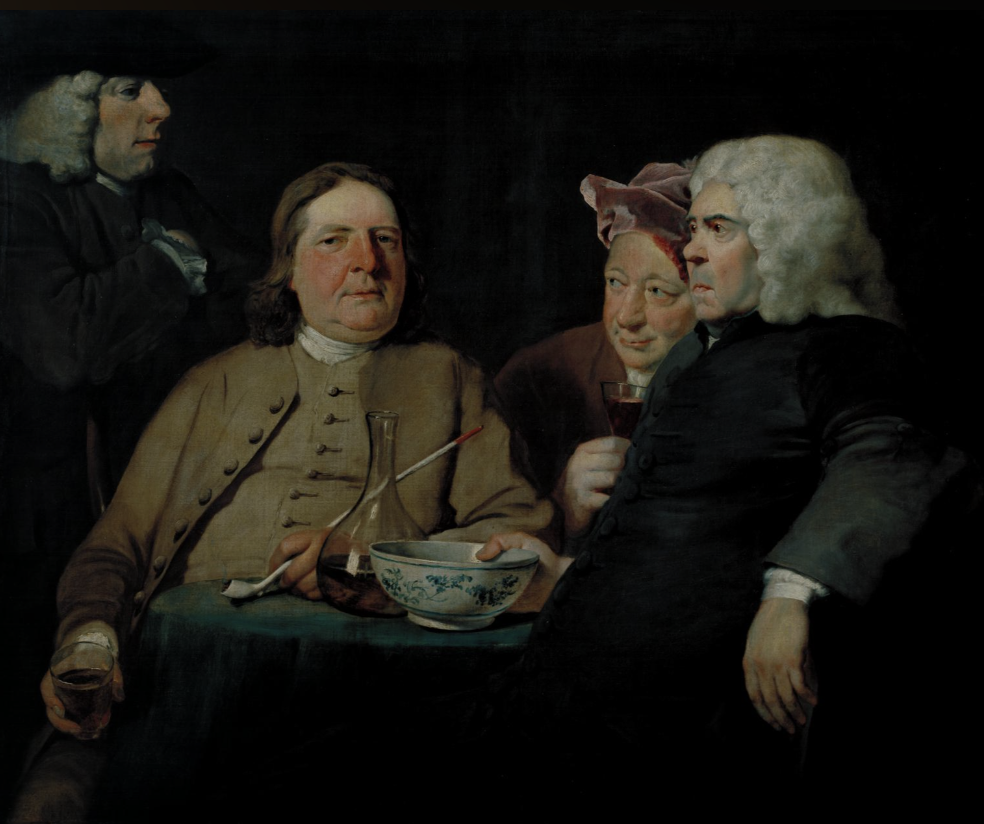
The “Conversation” Portrait entered mainstream English circles in the 1720s, originated as an offshoot of French rococo art, wherein artists began communicating through their work the complexities of human relationship, specifically those found within a social setting. It was brought on by a softening of artistic conventions in the French court following the death of Louis XIV (1638-1715). Early English artists in this form, such as William Hogarth (1697-1764) and Philip Mercier (1689-1760), used the Conversation piece as a vehicle for examining and satirizing the seedier side of British society. Hogarth’s A Modern Midnight Conversation, which he split between a Before and an After, portrayed a salacious woodland rendezvous between a young man and a young woman. In the first illustration, the young man is seen pleading with the young woman, who is herself portrayed as behaving modestly, casually denying his advances. In the second illustration the roles are reversed, as now it is the woman who clings to the man, and the man who appears disinterested.
The content of the Conversation portrait evolved a great deal in subsequent years. Young and ambitious artists began using the form as a way to introduce themselves to the broader artisan scene. The genre began hyper-focusing on sociability—illustrating the means through which social gatherings might facilitate personal association.
By the latter half of the 1730s, the Conversation portrait began to fall out of favor. Artists started reshaping the form, moving away from its earlier iterations to depict moments of quiet intimacy between their subjects. A chief example of this is Joseph Highmore’s (1692-1780) Mr Oldham and his Guests, which was believed to have been an affable response to Hogarth’s Modern Midnight Conversations. The portrait is a subdued one, its red-faced subjects only slightly tipsy and behaving in a mellow manner as they wait for their companion, the titular Mr. Oldham, to return home. Unlike the earlier Conversation pieces, where the subjects were often presented far from the viewer, and framed in a remote way, the subjects here are framed closer, as if to make the setting and scene feel more intimate and personal. Thomas Gainsborough (1727-1788), in his piece The Painter’s Daughters Chasing a Butterfly, similarly favored intimacy over scale, framing the tandem subjects in much the same way as Highmore.
By the 1760s, with the ascension of Charles III, a new variation of the Conversation portrait began taking shape. Actor-manager David Garrick (1716-1779) commissioned the German-born artist Johann Zoffany (1733-1810) to illustrate a piece for Garrick’s forthcoming play, The Farmer’s Return. This piece, and others like it, acted as a way to promote theatrical productions and puff up the social stature of the performer who had them commission. Beyond that, through its construction, it blurred the boundary between theatrical performance and painted genre scene, creating a new form of the Conversation piece altogether.