
The Germ, a periodical, was created by the pre-Raphaelite circle of Dante Gabriel Rosetti, William Holman Hunt, Thomas Woolner, James Collinson, Frederick George Stephens. The periodical’s goal was to disseminate the pre-Raphaelite ideas of the group. Only four issues were published in the year 1850 before the journal was discontinued due to financial failure.
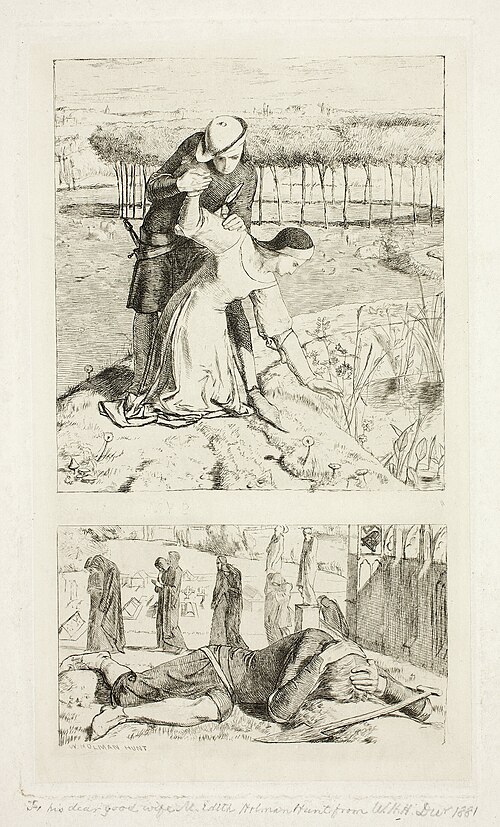
The first edition of the periodical was published with an etching at its beginning which signified the focus for that specific journal. The first edition of The Germ began with an etching by William Holman Hunt. There are two separate image boxes in this etching, with the top one relating to “My Beautiful Lady” and the other relating to “Of My Lady in Death,” with both poems being written by Thomas Woolner. The top image depicts a man holding a woman’s hand while she picks weeds from a brook. And the bottom image depicts the same man weeping over a dirt mount, presumably his dead lady.
In the first poem of the periodical, “My Beautiful Lady”, lines 56-60 depict the lady pulling weeds in a brook and carrying them home. The stanza constructs a pre-Raphaelite pose for the lady as it presents her as in motion, allowing Hunt to construct an image showing the lady acting without facing the viewer. Her pose is similar to that of the lady in Elizabeth Siddal’s The Lady of Shalott drawing which presents her body and face pointing towards opposite areas of the composition, avoiding direct eye contact with the viewer. The image presents non-historical figures participating in mundane, repeatable actions. And the images have a medieval quality to it. that avoids the graceful, feminine form associated with Raphael and his followers.
Going against the tradition of Sir Joshua Reynolds, the images of Hunt and Siddal present non-historical figures that are not idealized. The image created for “My Beautiful Lady’ ties to the Gothic rather than to that of a historical figure. Additionally, Siddal’s painting ties to the “The Lady of Shalott” poem rather than Greek or Roman literature.
Thomas Woolner’s poem “ Of my Lady in Death” presents an auditory experience which creates its mournful tone. Woolner’s poem compares silence starting in space and a bell’s harsh toll ringing for the lady’s soul. Silence starting in space can be compared to the silence of losing a loved one. Once the lady dies, he notices the silence that fills the space she no longer occupies. By doing this, Woolner presents a dramatic construction of the man’s grief. Additionally, the narrator (presumably the man), describes the bell’s harsh toll ringing for the lady’s soul. This harsh ringing for the soul is personification as it depicts the bell doing a human-like action. The bell’s noise can even be seen as a stand-in for the man yelling or crying out.
Hunt’s bottom etching depicts the man as mourning over the woman’s grave, with the figure covering his head and laying directly over her resting spot. The image directly correlates with the description that Woolner gives of the man lying in a dead swoon for a long time. It follows the same style as Hunt’s previous image, which utilizes sharp edges over rounded features.