
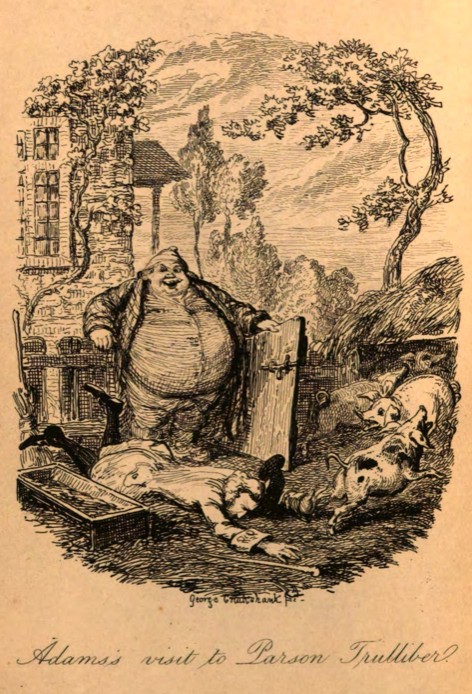
Henry Fielding (1717-54) wrote The History of the Adventures of Joseph Andrews and of His Friend Mr. Abraham Adams, which could be considered as one of the first English novels. In the preface to this work, Fielding compared his novel to pictures by his friend William Hogarth (1697-1764), a satirist and painter who invented a comic narrative art in pictorial form that he called a “modern moral progress.”Fielding and Hogarth both expose the realities of their time through the usage of satire, Fielding in a new form of comic prose and Hogarth in a new form of narrative pictures. They wanted their audiences to take seriously the realities they exposed, so Fielding argues in his preface that, like Hogarth, his characters are not exaggerated caricatures but believable.
Fielding called his new kind of work a “comic epic in prose.” Like Alexander Pope (1688-1744), he compared his to an epic, just as Pope called his poem, The Rape of the Locke (1730), a “mock epic.” Pope satirizes characters’ moments of triviality or smallness by using lofty language to conceptualize the frivolous nature of his society. For example, he caricatures the petty vanity of his epic heroine, Belinda, by comparing her stolen lock of hair to the abduction of Helen of Troy (Canto II). That Fielding shared an appreciation of Pope’s classical form of mock-epic satire is shown through his first success Tom Thumb (1717). Yet, while Fielding displays the same bright and brittle language displayed in The Rape of the Lock, he softens the tone, making his narration sociable and playful.
Having understood the value of both enlightenment and entertainment according to the classical apology for literature, Fielding used his new form of fiction to uphold ethical purposes. Fielding teaches readers to be skeptical and question their social world. According to William Warner’s work on “Henry Fielding,” his work after his death was placed as “the most valuable English model for novel writing during the 17th century, increasing the value of novels in their current market world” (Warner 317).