
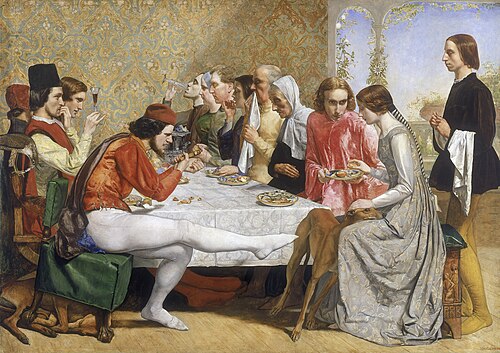
Millais, in his painting “Isabella,” shows the moment in John Keats’s narrative poem, Isabella, or the Post of Basil (1818), in which Isabella’s brothers figure out that she and Lorenzo are in love. In the image, Lorenzo is intensely staring at Isabella as he offers her citrus fruit. Two men in the image, her brothers, appear to witness this interaction, with the male in the black hat appearing to bite his fingernails while pretending to study the clarity of his wine but stealthily staring at the couple. The brother in the foreground reacts more violently, kicking the dog that is leaning on Isabella’s leg. The action shows both his ruthless character and also a pose that that an academic traditionalist would not exhibit.
Somewhat similar to the organization of figures in Cimabue’s Majesta, Millais’s figures at the table are lined up in a straight row. The perspective constructed by the painting creates a flat appearance for each of the members sitting at the table. Unlike the paintings Bolton Abbey in the Olden Time by Edwin Landseer and The Champion by Charles Eastlake, Millais’s figures cover one another in the triangular arrangement. In the other images, each figure is mostly visible with minimal obstruction of view from our perspective.
Stanza 18 presents the moment when the men notice Lorenzo’s gaze. This coincides with the moment that is described in Millais’ painting. The men discover their love and “find out in Lorenzo’s eye / A straying from his toil” (Keats 140) and the brothers are depicted as “covetous and sly” when seeing this (Keats 141). The scene in which the brothers “find out in Lorenzo’s eye” is depicted by Millais’ painting where Lorenzo is staring intensely at Isabella. This could symbolize his desire for her and also her ignorance as to what her brothers are planning. Isabella is told, by her brothers, that Lorenzo fled by ship when he goes missing. She learns of the true nature of his death when his spirit visits her in a dream. She becomes extremely sad and appears detached completely after his death, becoming focused on the basil plant pot that contains Lorenzo’s head. Millais’s presentation of Isabella not looking towards Lorenzo’s gaze in the image could be seen as representing her future emotional detachment caused by his death: “To-day thou wilt not see him, nor to-morrow, / And the next day will be a day of sorrow” (Keats 231-232). It could also symbolize the disconnect between the couple when he goes missing. Initially, she is told by her brothers that Lorenzo had abandoned her.
Though the art piece and poem mirror the same scene, Millais presents additional details that the poem does not offer. His painting places stanza 18 in the context of a dinner scene, constructing a difference from the text. Placing both the brothers and Lorenzo so closely together in a dinner scene could be a way of Millais creating tension as any move Lorenzo makes could be observed by many eyes. It also grounds the moment of the brother’s discovery to a specific moment. The painting allows us to visualize, not just imagine, his intense eye contact with Isabella that gave away his love, and also the reaction of the brothers.
Keats’ story is condensed into one scene constructed by Millais’ painting. The specific setting of the dining room is not in Keats’ work. This construction grounds the scene in a more specific moment rather than just describing the brothers finding out about their love.