
James Thomson (1700-1748) was a Scottish poet and playwright best known for his 1730 poem “The Seasons” Where he wrote about the different seasons of the year and the important roles they play in nature. Thomson was born in the town of Ednam and grew up in Scotland. At the age of 15 he began attending Edinburgh University in Scotland where he joined “The Grotesques” a school club based on literature. By the time he was 20 years old he had written many different Verse poems and even had some published in the local paper. When he turned 25 he quit Edinburgh and he had moved to London to go on and tutor many noble figures such as Thomas Hamilton, Lord Binning and Charles Talbot Jr. He began working on “The Seasons” one poem at a time starting with “Winter” and finished it by 1726. Due to the poems success, he began writing the other seasons in chronological order from Spring to Autumn between 1727 and 1730, with the help of publisher John Millan. He was recognized for the way he wrote about serious subjects. He was known to make amusing descriptions of beautiful, sublime objects with a sense of imagination. He was inspired by Addison’s Spectator which believed in the idea of primary pleasures of observing nature firsthand and secondary pleasures from poems written about nature and how they played off of each other. His descriptions of nature really resonated with the readers with the descriptions of landscapes and animals. He believed the natural world was external and objective and took inspiration from poets such as Virgil. Throughout the various revisions he made of “The Seasons” he would incorporate material from ancient poets like him as well as more modern poets from the time and worked them into his style. He also combined the studies of Husbandry, history, hydropathy, optics, theology, and meteorology. He knew how to take simple concepts and make something powerful out of them. One notable example of this is in the “Spring” poem when he is discussing ploughing and he goes into detail humanizing the oxen, describing the ploughman’s joy with the soft breeze, and singing birds and describes the Earth, man, beast, and soil all being as one in harmony, comparing it to how Virgil would write about the Romans and their fieldwork of days past. “The Seasons’ was revised multiple times throughout Thomsons lifetime with the last one being two years before his death in 1748.
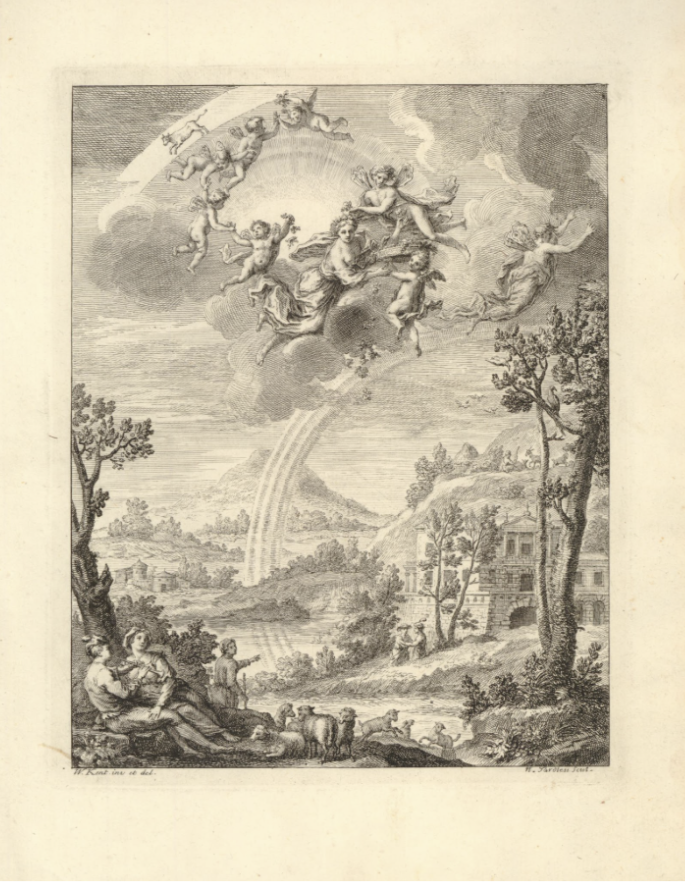
The following picture was made by artist William Kent for the original 1730 edition of “The Seasons” with all four seasons compiled together. Each painting’s upper half represents the allegorical process of the seasons transitioning with the opening lines while the lower half shows the more naturalized process with individual scenes. This particular painting represents Springtime as we see angels moving the clouds from the rainy winter and forming beautiful sunny skies and rainbows for the people down below.