
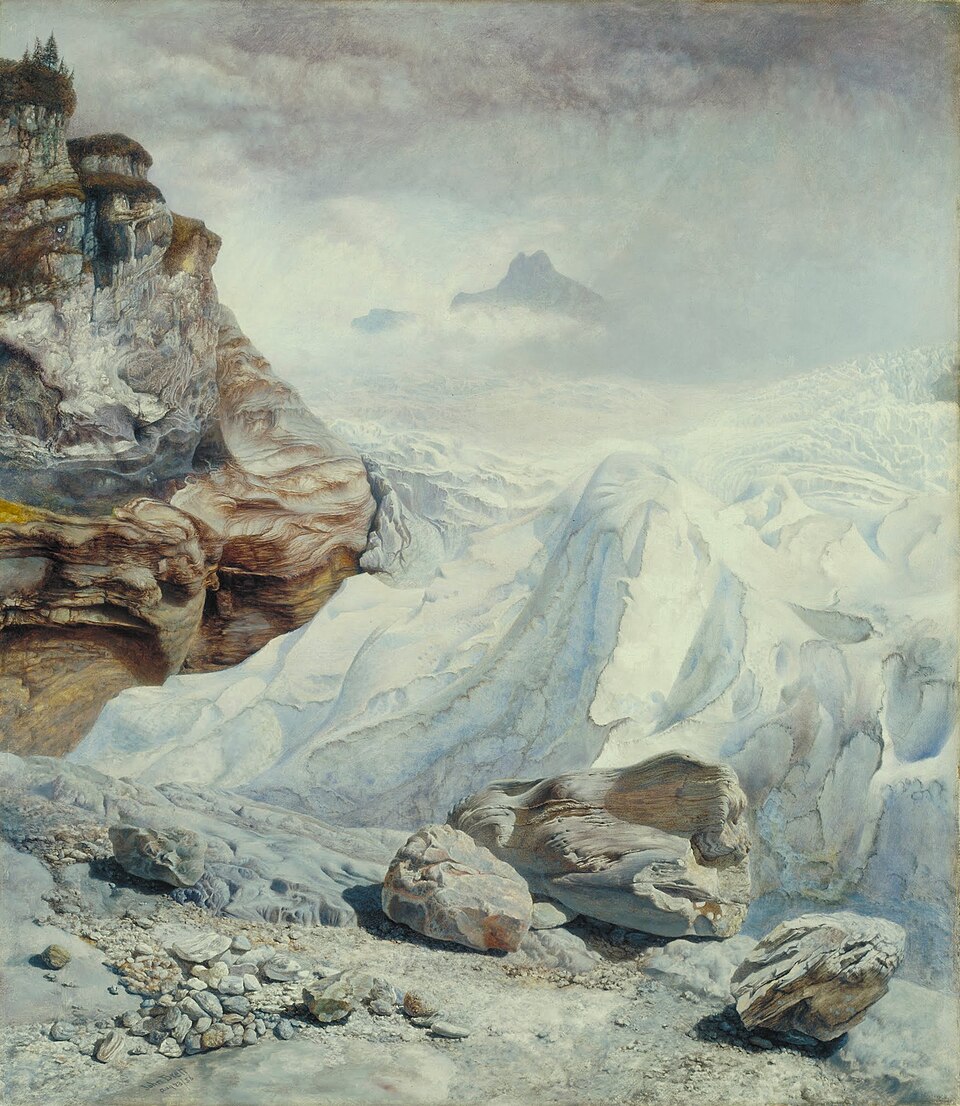
John Brett (1831-1902), British artist and devotee of Ruskin, was inspired by the work of Inchbold and the Pre-Raphaelite movement, having written that he was “going fast towards Preraphaelitism—Millais and Hunt are fine fellows.” He was so captivated by the movement that he abandoned the traditional disciplines of the Royal Academy Schools, following Ruskin’s advice, and vowed to paint all he could see from then on. More than this, Brett committed to precision on all levels—employing scientific, accurately observed nature in his Pre-Raphaelite landscapes. Brett’s The Glacier of Rosenlaui (1856) exhibits the scientific precision introduced into the movement’s landscapes, starting with the unusual dating: 23 August 1856. By including the day, month, and year, Brett establishes that no detail was too small to record.
Brett’s composition also differs from traditional norms, as it is meticulously geologically detailed. Each pebble depicted is clearly defined, departing from the “slosh” often praised in academia. Like Inchbold, Brett faced a challenge posed by Pre-Raphaelite landscapes: conveying space and distance amid such detail. Brett’s challenge differed from Inchbold’s in that he refused any compositional concessions on account of Ruskin loyalty.
Throughout our unit on landscapes, we have seen how the construction hinges on friendship—both in the literal and artistic depiction sense. Lancelot ‘Capability’ Brown benefited from homosocial friendships for the architectural construction of his landscapes. The Pre-Raphaelites relied on these relationships, specifically between Ruskin and his painters, to foster intimacy in the detailed movement. Here, Brett missed the mark of Ruskin’s instruction, focusing so much on scientific detail that he missed crucial imagination.