
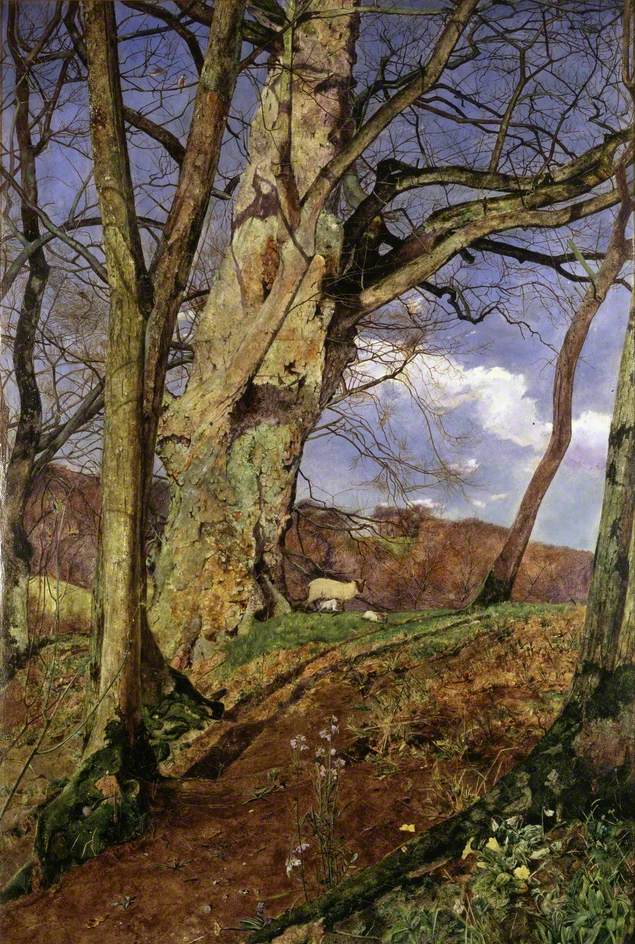
John William Inchbold (1830-1888), a Yorkshireman, began his artistic career in lithography and watercolor before turning toward a Wordsworthian-influenced Pre-Raphaelite style. His landscapes carry forward the Romantic heritage established by Wordsworth, presenting nature with both meticulous observation and poetic expression that can be observed throughout his work. Inchbold's A Study, in March (1855) exemplifies how Wordsworth's poetic lines of emotional responsiveness to nature were adapted to fit Pre-Raphaelite realism.
Inchbold's composition addresses a key challenge faced by Pre-Raphaelite landscapists: their dedication to rendering every detail of the natural scene with microscopic detail makes it difficult to use traditional aerial perspective, as distant objects cannot be shown with the same level of precision. Inchbold overcomes this by lowering the viewpoint, so the viewer gazes upward at a steep bank, keeping distant views to a minimum. The foreground-dominant composition allows Inchbold to maintain Pre-Raphaelite precision while showcasing emotionally-charged, Wordsworthian elements of early spring. Among scholars, it is generally agreed that Inchbold's A Study, in March (1855) was inspired by lines from Wordsworth's The Excursion (Book I): "When the primrose flower peeped forth to give an earnest of the spring." Inchbold's fusion of Pre-Raphaelite microscopic detail with the tender Romanticism of Wordsworth showcases the intersection of precision and introspective, poetic nature.
Although Inchbold's later career did not bring him significant public success, his work was recognized by both Ruskin and Millais as exhibiting considerable talent.