
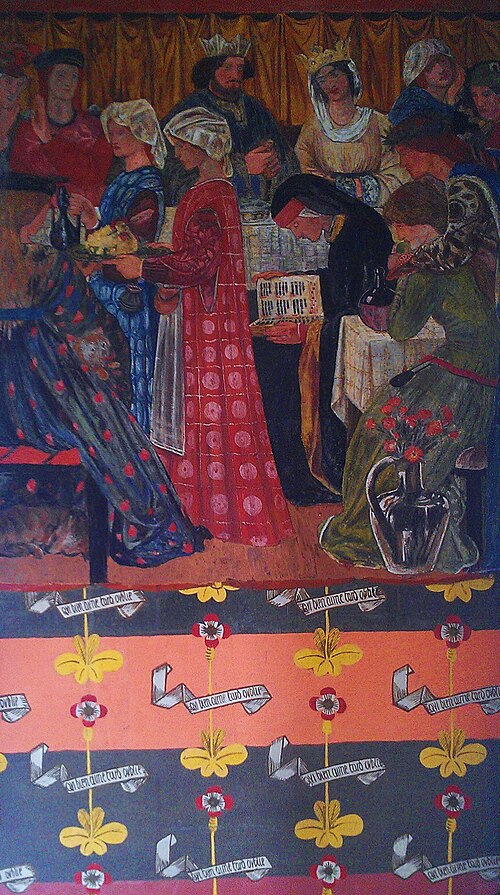
William Morris and Edward Burne-Jones developed their artistic vision through a deep shared love of medieval art and literature. John Ruskin's The Stones of Venice was a turning point for both men. Ruskin argued that Gothic art embodied a pre-capitalist world where craftsmen could express genuine creative freedom, something he saw as utterly lost under industrial capitalism. Morris and Burne-Jones took this idea to heart and built their entire aesthetic around it.
Their medieval fantasy style was never confined to painting alone. They believed beauty belonged on every surface of daily life, so their work expanded into furniture, textiles, stained glass, embroidery, and book illustration. Early collaborations, like the mural paintings at the Oxford Union on Arthurian themes, showed how naturally the group worked together across different media.
The clearest expression of this vision was the Red House, built in 1859 in Bexleyheath, Kent. Designed by architect Philip Webb in a Gothic Revival style, it became the center of the group's world. Burne-Jones painted murals in the drawing room, and the dining room was planned as a grand embroidered frieze of female figures. Morris's wife Jane Burden was deeply involved as well, collaborating on the embroidery work. The Red House was not simply a home. It was a living argument that art and everyday life should never be separated.