
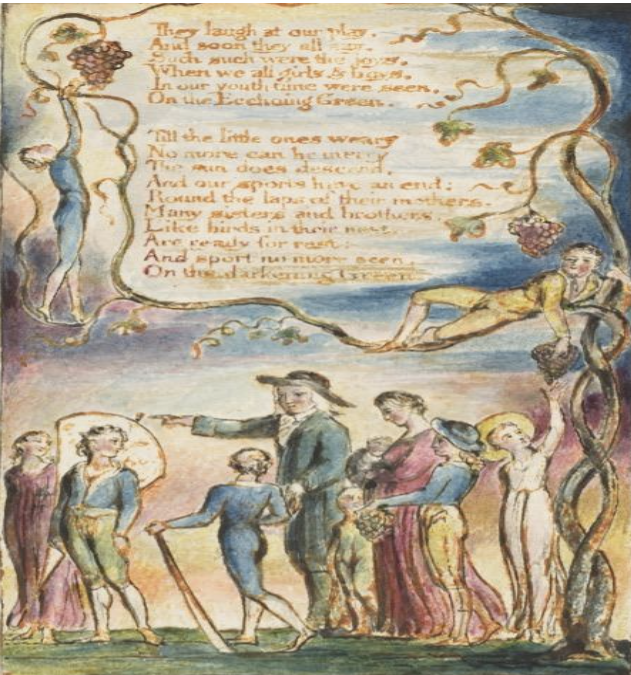
The way that William Blake did his printing was a very new and influential way for his time back in the late 18th century. Blake wanted to combine poetry and artwork into illuminated books with etchings so that the literature and visuals would balance each other out in a lovely package. First he used copper plates as paper sheets, then he would use a stopped out varnish with the quill pen or brush that he was usually using while making the books. He began practicing writing and drawing with a mirror, essentially making the reversal of what he wanted to put in the books. After the varnish dried out he would make what is called a “wax dike” around the plates and bathe it in nitric acid that would quickly corrode. The reason for this was so he could etch out every area except for the stopped out varnish. He then would stir the nitric acid with a feather to induce relief etching. By the time this was finished, the raised surfaces around the etchings would be properly inked. For whichever color he wanted to use, he relied on various pigments that he would mix together. He would then mix the pigments with linseed/nut oil to form a paste. Blake would then use an ink dabber and gently dabbed the relief surfaces so that the ink would not smudge the areas that were shallow and etched. Usually, there would still end up being at least a couple of smudges, which he would do his best to wipe them out, sometimes it was the longest part of the process for him. Depending on the sizes of the plates they would finish printing anywhere between half an hour to 2 hours. The bigger the plates were the longer it took to dry. By the time the process is finished, the words will have been printed on the top layer surface while the pictures would be printed from the bottom layer surface, which he would then put in a rolling press and manually roll it through, leading to the final product. Below is an example of his work with a page from his poem “Echoing Green” in the book “Songs of Innocence” One can see the beautiful artwork of the people and the branches surrounding the beautifully crafted writings of the poet and they mesh together in a lovely combination. Thanks to this process he would be able to make lovely works of art that were 100 percent all his own work.