
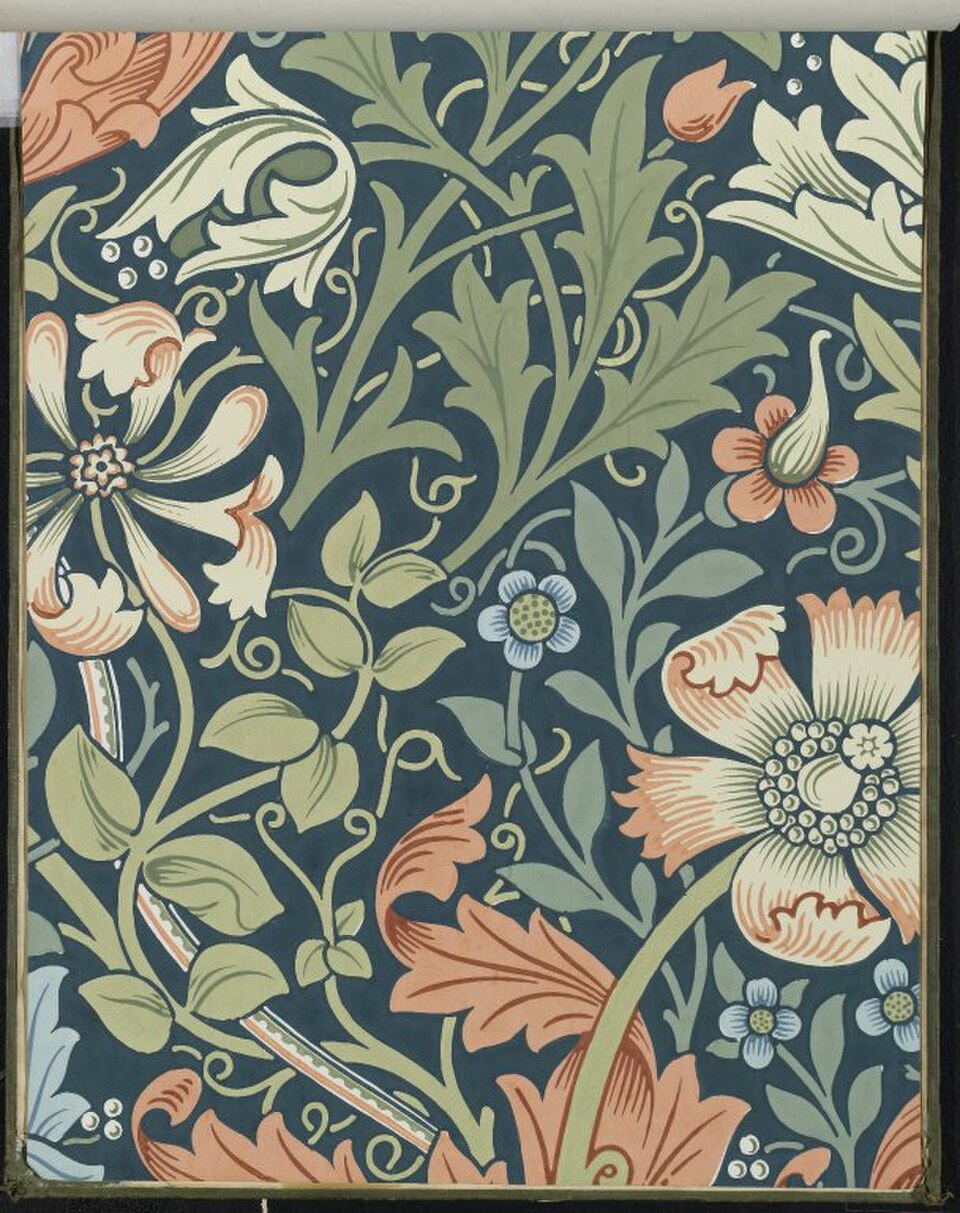
The founding of Morris, Marshall, Faulkner & Co. in 1861 marked the moment when the Pre-Raphaelite circle's passion for decorative arts became a commercial enterprise. The Firm produced wallpapers, textiles, stained glass, furniture, and ceramics — goods that were widely distributed throughout Britain and America. Among the most enduring of these products were Morris's wallpaper designs, which he truly mastered in the 1870s, producing patterns such as Larkspur, Jasmine, Willow, Marigold, and Chrysanthemum. These designs featured exuberant scrolling foliage, a degree of three-dimensionality, and closely interwoven foreground and background, requiring complex printing techniques using large numbers of individual printing blocks. They gradually found their way into the homes of the artistic middle classes and were endorsed by aristocratic patrons, eventually reaching royal commissions at St. James's Palace and Balmoral Castle. Morris's wallpaper designs are still copied and sold today.
At the heart of the Firm's work was a commitment to opposing cheap, machine-made goods with handicrafts produced by skilled artisans, for the sake of beauty and individual craftsmanship. Morris brought a deeply socialist approach to labor in the production and sale of the Firm's goods — believing that meaningful, creative work was a human right. This philosophy became the foundation of the Arts and Crafts Movement, which spread throughout Britain, America, and Europe. A celebrated local example was the Newcomb Pottery in New Orleans,