
William Wordsworth (1770-1850) was an English poet, art critic, and landscape gardener, and served as one of the chief pioneers of the Romantic Movement in England. Born in England’s Lake District—the immense and varied landscapes of which deeply shaped his poetry and lifelong love of nature—Wordsworth was described as having been a precocious child, diligently pursuing a literary education despite countless financial difficulties experienced by his family. He studied at the University of Cambridge, and spent a large portion of his young adult life in France. He wrote poetry that focused on nature, memory, and human emotion, often celebrating the spiritual power of the natural world. His most renowned work is generally considered to be The Prelude, a semi-autobiographical poem of his early years that he religiously revised and expanded throughout his life. In 1843 he was appointed Poet Laureate of the United Kingdom, a role he held until his death in 1850.
One of Wordsworth’s poems detailed the sights and sounds of the Wye Tour, which was a popular late-18th-century picturesque journey along the River Wye between Ross-on-Wye and Chepstow. The poem, “Lines Written a Few Miles Above Tintern Abbey,” is said to be a delicately constructed piece, focused primarily on the pastoral beauty afforded by the riverboat journey.
The river scenery, which was the main attraction of the Wye Tour, offered a very specific kind of picturesque pleasures. The boat passage was smooth and easy, allowing the guests the opportunity to focus on the sights unfolding around them. William Gilpin, an 18th century artist who is believed to have originated the term “picturesque,” and whose guidebook many of the sightseers used to accentuate the tour, divided the trip into “four grand parts”: the area, which was the river itself; the two-side-screens, which are the dueling banks of the river, and so mark the perspective; and the front-screen, which traces the winding path of the river itself. Gilpin went on to say that the chief delight of the tour, while being composed of simple parts, is that the view is “infinitely varied.”
The first major spectacle on the journey was the ruins of Goodrich Castle, situated approximately three miles below Ross. Gilpin’s description of this early chapter of the tour highlights “the reach of the river,” which “forms a noble bay….The bank, on the right, is steep, and covered with wood; beyond which a bold promontory shoots out, crowned with a castle, rising among the trees.”
Continuing on, as the gorge of the Wye deepens, the river scenery becomes increasingly more magnificent. There are half-sheltered cottages dotting the countryside, long chains of orchards softening the distant grades, and a belt of apple-trees of various sizes and shapes. The banks of the river are particularly noted for being intensely steep and wild. Eventually the tour comes upon one of its chief sites: the ruins of Tintern Abbey. It's renowned for its gaunt, melancholic splendor—nearly overwhelmed by the natural scenery which surrounds it.
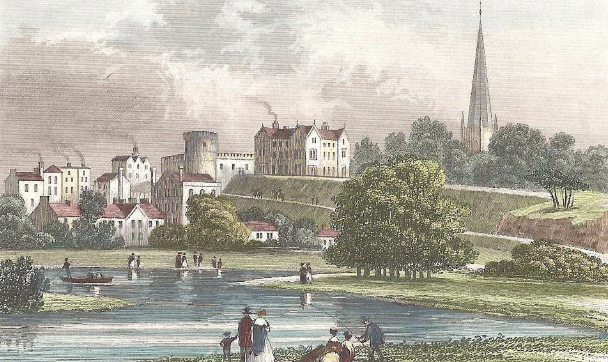
The tour eventually concludes at the imposing Chepstow Castle—some two-hundred kilometers from the journey’s beginning at Ross. Arthur Young, an English agricultural writer, described the boat's approach towards the Castle and the town which surrounds it: “The town and castle of Chepstow appear from one part of the bench, rising from the romantic steps of wood, in a manner too beautiful to express.”