
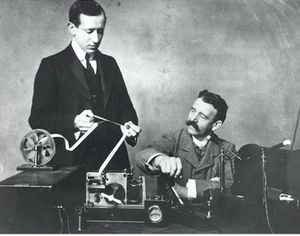
It was once believed to be impossible to send a transmission about as far as 200 miles due to the curvature of the Earth. This assumption didn’t stop Guglielmo Marconi from trying, though. Guglielmo Marconi was an Italian inventor and engineer, born in Bologna, Italy. Growing up, Guglielmo had a very good education due to his family’s wealth. He had multiple tutors growing up and then went on to further his education at the Livorno Technical Institute and the University of Bologna.
Guglielmo had a strong interest in electromagnetic waves. He began to build his own wave generating equipment, but no one of importance was interested in what he had to offer, so Guglielmo moved to London. At first, he was only able to send transmission up to one mile away, but after a year's worth of work after moving to London, he had built it up to 12 miles away. There were many people in London who were interested in supporting Guglielmo’s work, including the British Post Office and eventually, Queen Victoria. A year later, Guglielmo had been able to send transmissions across the English Channel. After this, he had quickly begun to gain popularity around the globe.
Guglielmo wanted to continue improving his work. At the time, “many physicists argued that radio waves traveled in straight lines, making it impossible for signals to be broadcast beyond the horizon, but Marconi believed they would follow the planet’s curvature” (History.com, Editors). After failing to go at too far of a distance right off the bat, Guglielmo tried a shorter distance, from Cornwall to Marconi. Just barely, they were able to successfully send the transmission; they received the message a faint three-dot message, the letter “s”. This transmission was approximately 2,100 miles away and sent sparks flying in the process. This moment was a monumental step in history, but there was still a long way to go to completely understand electromagnetic waves, so Guglielmo continued to improve his work for the next 30 years. In 1909, he was awarded a Nobel prize in physics for his work alongside Ferdinand Braun. Not only did his work help the evolution of the radio, but it save multiple lives. “His company’s Marconi radios ended the isolation of ocean travel and saved hundreds of lives, including all of the surviving passengers from the sinking Titanic” (History.com, Editors).
Works Cited
History.com Editors. (2009, December 02). Guglielmo Marconi. Retrieved December 08,
2020, from https://www.history.com/topics/inventions/guglielmo-marconi
Editors. (2010, February 09). First radio transmission sent across the Atlantic Ocean.
Retrieved December 08, 2020, from
https://www.history.com/this-day-in-history/marconi-sends-first-atlanti…