
Display Explanation
A display for these three pieces would be as a walkthrough exhibit in a museum. What I mean by this is that the display area would be made that you must enter to see the paintings. This would be achieved through a trapezoidal wall setup with the short top being the buildings structural wall, two forty-five-degree walls protruding left and right, then a longer base that leaves room on the left and right corners for patrons to enter and then exit the exhibit. The pieces will be on display separately on the top of the trapezoidal setup facing the viewer. The doorways for this display will include hanging “vines” that must be parted to enter and exit the display. Inside the installation between the paintings will be various false plant life displayed. The lighting will be darker save for the paintings themselves. This will give the viewer an immersion not unlike a theater of not only seeing the paintings but being involved in them. As you enter, there is a pronounced button below the center painting that will begin a narration that explains to the goers the context of the paintings, comparing and contrasting, and further invoking the museum goers to come to their own conclusions about the pieces themselves. As the narrator covers each painting individually, the lights will dim for the remaining two so that the viewer is easily guided throughout. If the viewer does not wish to pus the button however, there are also individual placards beneath each painting giving a brief history and context so that they may enjoy each painting as they wish.
Installation Note
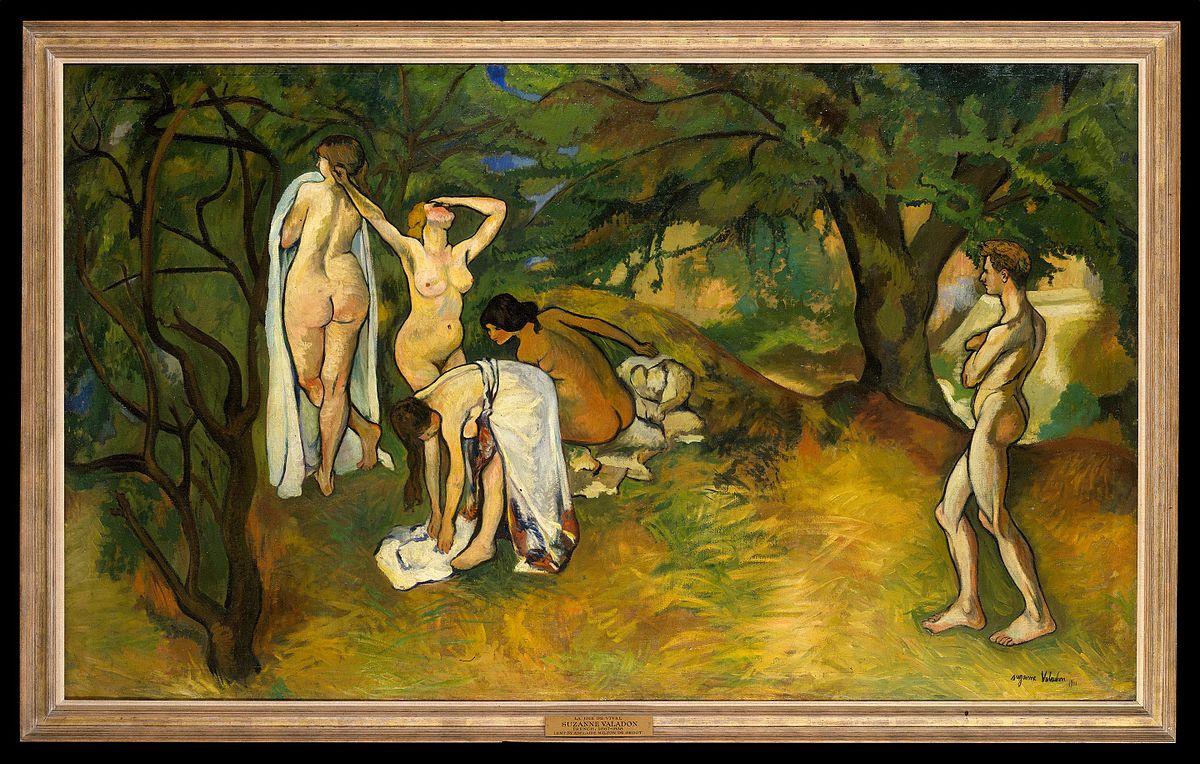
At the onset of looking at these images, aesthetically you may see them all as basically the same without much difference. The first of these paintings is called Joy of Life. It depicts nude women and a nude man in a remote nature area. The next piece is called Luncheon on the Grass. It depicts a few nude and semi-nude women bathing and having a picnic with fully clothed men. The final piece is called The Awakening of Adonis. The depiction is of the Greek goddess Aphrodite mourning the loss of her lover Adonis. The context behind these paintings is that they were all painted during a time in art history where the use of nudity in art was taking a shift. The older and more accepted style of art in traditional circles was more the like of the Awakening painting. It depicted nudity in a conservative sense and in a context of a Greek myth. These two factors made this piece a readily accepted piece at this time period. The depiction of children nudity and female nudity to only include her breasts was seen as proper for the day as well as depicting within a myth. It was considered proper and historical. In stark contrast, Joy of Life and Luncheon on the Grass both depict what would’ve been considered risqué at this time period. The former depicting full frontal and rear nudity to include pubic hair. A stylistic choice that was quite daring for the time. Also, the depiction of a man being naked with them. This could be interpreted in a few ways, including that the viewer is the man or possibly that men and women being naked together is a natural occurrence even outside the sanctity of marriage. A very bold theme indeed. In the latter, we have Luncheon on the Grass, a painting that shows a similar theme of women nudity in the presence of men. The striking direction of this image however is the way in which two of the portrayed figures, both a man and a woman, are staring directly at the viewer. This was highly irregular for the times as well. Most depictions were more so that we are a fly on the wall. In this painting we are acknowledged in part. The interpretation could be that it evokes a certain judging and uncomfortable feeling for the viewer. Another could be that again we have a theme of challenging public perception that woman being naked with a man in a setting outside of a marriage bed is a more casual occurrence or should be. Invoking instead a more “join us” feeling in the eyes of a viewer. This time period began a large exploration of the defining of women’s sexuality in art. The shift coming as part of the idea to lessen the stigma of women as objects and instead people with a sexuality all their own.
Valadon, Suzanne. Joy of Life. 1911.
https://commons.wikimedia.org/wiki/File:Joy_of_Life_MET_DT356454.jpg
Accessed 08 Feb. 2022.
Manet, Edouard. Luncheon on the Grass. 1863
Accessed 08. Feb. 2022
Waterhouse, John. The Awakening of Adonis. 1899.
Accessed 08. Feb. 2022.