
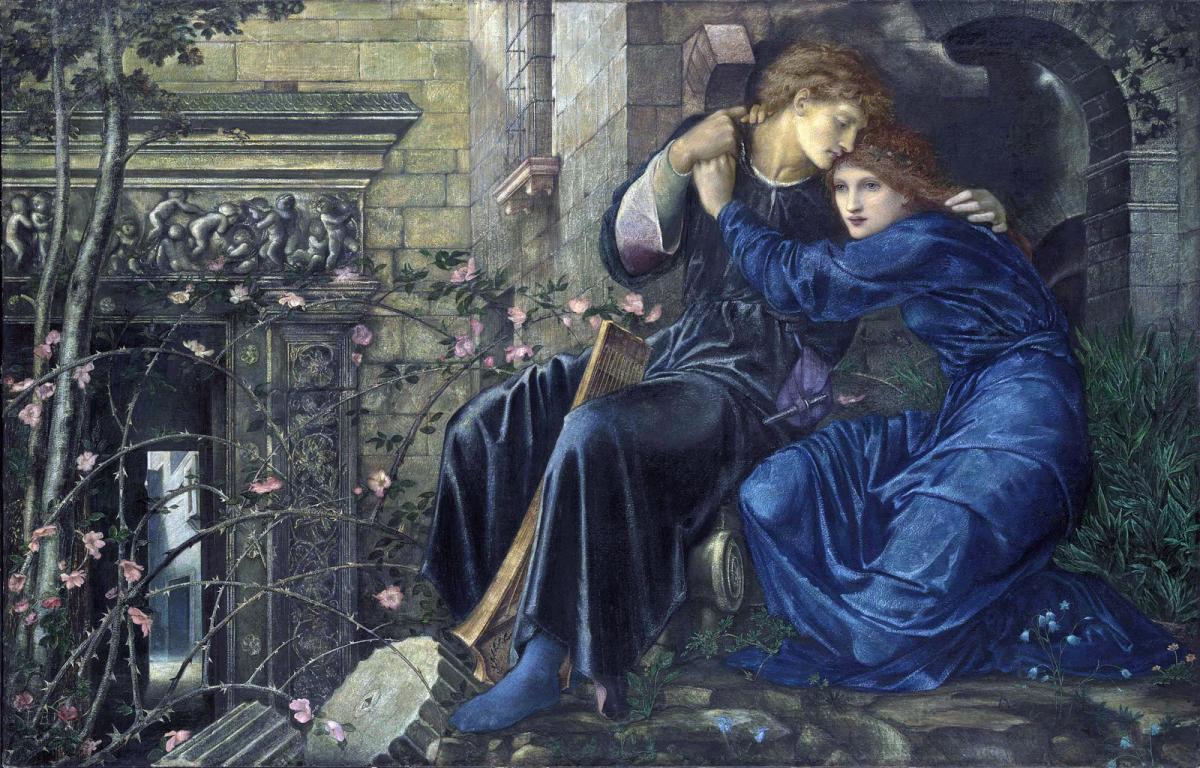



The room is completely white and rectangular, about a yard long. The three paintings are spaced out throughout the length of the corridor, with dates on the wall that show the passing of time from the 1800s to the 1920s. Significant events regarding women's rights and the history of the paintings lead the viewer through the exhibit. large, painted black cracks follow the corridor, growing until they cover the end of the room completely in black, floors and all. The final painting, Head of a Woman, is surrounded by this black void created by the wall, popping out as it has lighter colors than it's surroundings. The lights are fleurescent white, giving the entire exhibit a stark, minimalist vibe.
Installation Note:
The focus of this installation is to examine how women have been viewed and portrayed throughout the history of art. The first piece, titled "Love Among the Ruins", shows a very idealized version of a woman; here she sits with a man, clinging to him for protection it would seem. While the woman is not sexualized or portrayed in an objectified manner, there is still a sense of ownership; the man is clearly more dominant in the picture, and gives off the sense of ownership in the way one would own an object. The second piece, V kavarne, falls under a similar vein. The woman is posed in a relaxed manner, though she sits in the presence of a man, as if he is in charge of her. Her posture is almost childlike, and the lighter colors of her dress and skin make her stand out in the otherwise dark canvas. Like in the previous piece, the way she is framed makes it look as if she is the property of the man, an object so to speak. This creates a sense of ownership, and coupled with the time periods of the pieces, one can see how views on women changed, though not much, in the timespan between them. The final piece, Head of a Woman, is starkly different than the previous pieces. The first and most obvious difference is the art style used, as the piece is very abstract. Second, the piece portrays women in a much different manner. The woman in this piece is up close to the viewer, making the piece much more intimate. Her face is the subject, however she is not portrayed in a conventionally attractive manner; her features are intentionally abstracted to draw attention to her expression and the nature of humans rather than the aesthetic exterior. Head of a Woman, in contrast to the other paintingss in this display, rejects the preestblished manner of portrayels of women throughout the history of art, and instead attempts to look past the idealized form in search of the true nature of humans.