
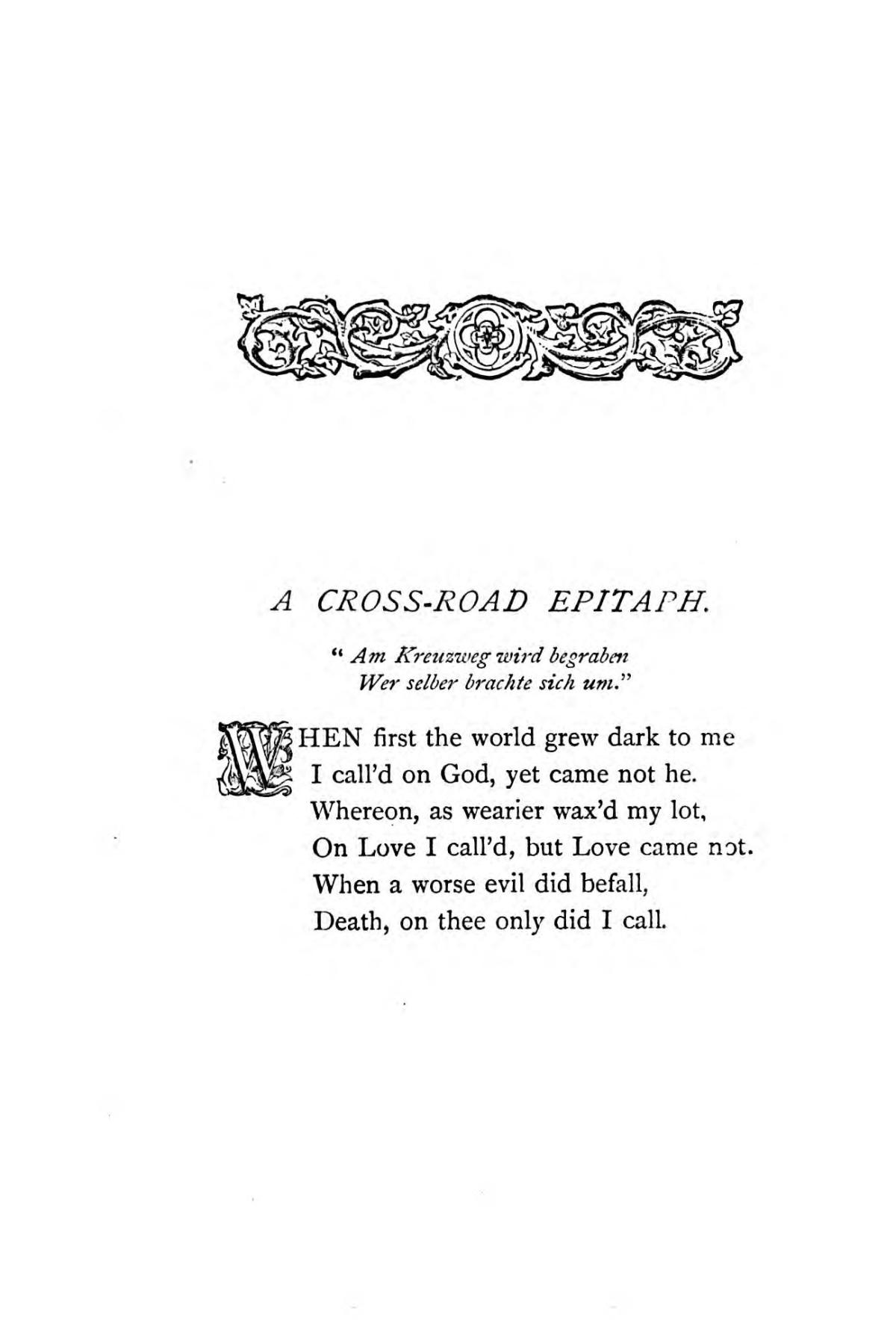
I was organizing some old keepsakes I found from the shop when I came across this copy of A Cross-Road Epitaph by Amy Levy. This poem holds a very special place in my heart, and it probably always will. I remember the day I picked up the paper and saw that my fiancé’s regiment in Africa had been slaughtered and realized that I’d have to come to terms with the fact that I might never see my husband-to-be again. I’m not one to make a big show of my emotions like Fanny, but as you can imagine these times were some of the hardest I had ever experienced in my life. Just after hearing news of the British troops, I was also faced with the reality that my youngest sister had passed on as well, only compounding the grief I already felt. I always admired Gerty’s cleverness and passion for writing, so in order to deal with the pain I was feeling, I turned to works of poetry to help make sense of my emotions. I was drawn to the works of Amy Levy because of her ability to so eloquently convey feelings of mourning and sorrow through her work, and I was hoping to find some sort of comfort in having the emotions that I felt so strongly written on paper before me. This poem in particular perfectly depicted how I felt at this season of life, how hopeless and weary, it seemed like even God had abandoned me. That is, until a glimmer of hope shined once again at the news that my dear Frank had been found alive, and I once again found happiness and looked forward to my life to come. However, I’ll never forget the impact Levy’s words had on me at my lowest point and how powerful her work is on the minds of her readers.
Editorial Commentary: Lucy’s outlook regarding her own emotions and the type of poetry she was drawn to during this time reflect the values she likely held as a Victorian woman. Marriage wasn’t an option for most women in the Victorian era, it was a necessity to lead a comfortable life because of the limited opportunities they had to make a living on their own. It would be logical to assume that any woman would be distraught at the news that her husband had died, but the additional societal pressure put on Lucy makes her ability to cope with her emotions impressive. Displaying emotions was seen as a feminine quality and looked down upon as weak by much of Victorian society. Unlike her description of her sister Fanny, Lucy is depicted as one who keeps her emotions to herself, and it makes sense that she would need an outlet to go to alone in order to cope with the traumatic events occurring in her life. With an older sister like Gerty who had a passion for writing, whom she respects and looks up to, it’s reasonable to think she would consider poetry as this outlet. The type of poetry and authors Lucy was interested in reflects the attitude she had regarding the expectations of women in the Victorian era. Amy Levy was a leading feminist author in the Victorian era who depicted an image of the New Woman. The New Woman challenged the boundaries set for women during this time and symbolized the change people like Levy hoped to see in society. By supporting authors like Amy Levy, Lucy conveys her own views regarding women like herself during this period.
Citation:
Levy, Amy, 1861-1889. A Minor Poet And Other Verse. London: T. Fisher Unwin, 1884.