
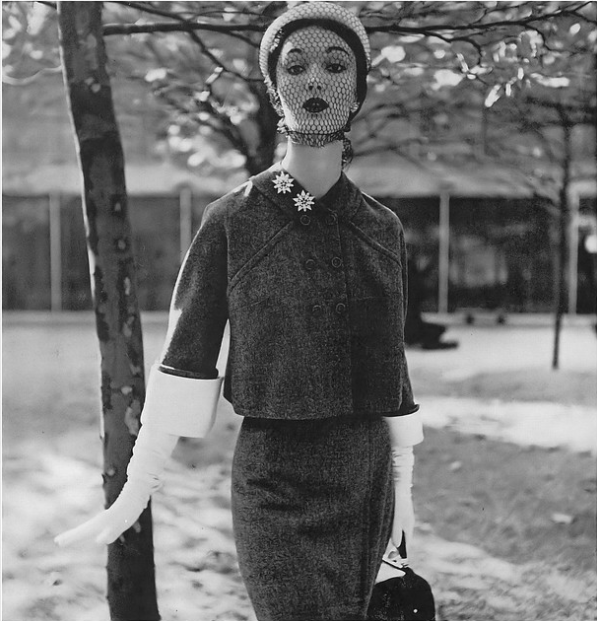
The photographer Diane Arbus didn’t start as a solo photographer. Originally, she ran a fashion photography business with her husband Allan (later of television fame). They had married in 1941 as soon as she had turned 18, and they shared an interest in photography. Early on, they converted their bathroom into a darkroom, and Allan later served as a military photographer in the Second World War. After the war, Allan and Diane had a successful commercial photography business. They quickly became photographers for the top magazines and advertising agencies. While Allan was the one taking the pictures, Diane was the one coming up with the ideas while taking care of their kids.
Despite the success, both Allan and Diane became frustrated with fashion work and the limitations it imposed. Diane felt that fashion photography was artificial and she wanted to expose the truth. Their marriage was strained due to the conflicts arising from the fashion business. Diane wanted to be more than a stylist, and Allan wanted to be more than a photographer. So, amid all the stress and mental health issues, Diane quit the business to pursue her own photography. Allan continued to use the Diane & Allan Arbus name while entering the theater.
Before marrying Allan, Diane was a proficient art student. Her family was wealthy and encouraged her creativity, but she quit since she was tired of being good at it. The freedom she had in 1956, away from the restrictive fashion photography world, allowed her to explore her photography. She eventually settled on street photography, but didn’t know exactly who her subject would be. When she took a class with photographer Lisette Model, she asked her for help with her photography. Model asked her what she wanted to take photos of, and Diane discovered that she wanted to photograph the forbidden, dangerous, frightening, and ugly. For the Cold War era, that would include many groups, such as the disabled, poor, and the queer community. Her photography, Two female impersonators backstage, N.Y.C., 1962, was early in her career.
Arbus, Diane and Allan Arbus. Evelyn Tripp in box-jacket suit of Botany worsted flannel by Connie Adams, white piqué hat by Suzy U.S.A.. Vogue. January 1, 1950. https://www.flickr.com/photos/skorver1/36077888480/in/album-72157624790…. Accessed 2 April 2023.
DeCarlo, Tessa. “A Fresh Look at Diane Arbus.” Smithsonian Magazine. https://www.smithsonianmag.com/arts-culture/a-fresh-look-at-diane-arbus…. Accessed 18 March 2023.
Lubow, Arthur. “How Diane Arbus Became ‘Arbus.’” The New York Times. https://www.nytimes.com/2016/05/29/arts/design/how-diane-arbus-became-a…. Accessed 2 April 2023.