
This timeline provides a sociohistorical context for Diane Arbus's 1962 Two female impersonators backstage, N.Y.C.. 1962.
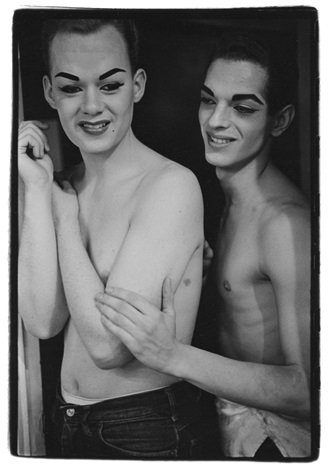
Arbus, Diane. Two Female Impersonators Backstage, N.Y.C.. 1962. http://www.artnet.com/artists/diane-arbus/two-female-impersonators-back….
Timeline
Table of Events
| Date | Event | Created by |
|---|---|---|
| 1953 | Club 82 opens under the ownership of the Genovese familyThe two subjects of Two female impersonators backstage, though never explicitly stated, are likely to be Terry Noel and Ronnie Morales. The two were members of the traveling Jewel Box Revue, a racially inclusive and queer owned female impersonator revue. Little is readily known about Ronnie Morales, but Terry Noel was a female impersonator who transitioned in the 1960s. The two female impersonators were photographed backstage in Club 82, a popular bar in lower Manhattan. While the location had been a club of some sort since 1929, its opening as Club 82 (or the 82 Club) under the ownership of the Genovese family saw it reach its most famous stage. While the club was a key part of gay nightlife that allowed queer culture in the city to grow, Club 82 was not for gay patrons. This club was to entertain heterosexual, and predominantly white, audiences with elaborate and "exotic" performances, mainly drag performers. Many famous figures are reported to have attended shows at Club 82. Terry Noel recalled seeing the likes of Judy Garland, Liza Minelli, and Frankie Valli, among others, including queer icons. Advertisements for the club’s performances highlight the illusion of the performers. Audiences would be treated to an exciting performance on stage with female impersonators, and they would be served by male impersonators in suits. Patrons could buy a postcard featuring the performers or could get a souvenir picture taken in the club with a performer, such as the undated picture of the two straight couples. The Genovese family, including famous Mafia boss Vito Genovese, would come to own many gay bars in Greenwich Village. Crossdressing was still illegal, mainly through the use of unrelated laws by the police to harass queer people, so the Mafia was able to capitalize on this. They would be able to make money on the queer community while keeping the establishment running despite the acts inside. Using their connections, the Mafia would pay off the police to ignore what their establishment was doing. This was a common occurrence, as many gay bars in the city were owned by the Mafia. In Club 82’s case, they would be able to use this risqué factor to their advantage. Thus, while hosting queer performers and fostering queer community in the area, the Mafia also drew in curious heterosexual people to see an extravagant show performed by people commonly deemed as a danger to society.
Noel, Terry. Interview with Morgan Stevens. https://queermusicheritage.com/fem-terrynoel.html. Accessed 2 April 2023. Straight Patrons at the Club 82. https://www.messynessychic.com/2020/08/25/remembering-nycs-secret-82-dr…. Accessed 3 April 2023. "Welcome to 82 Club: The Naughty Story of a Legendary New York Drag Institution." New-York Historical Society. August 1, 2019. https://www.nyhistory.org/blogs/82-club-legendary-new-york-drag-institu…. Accessed 18 March 2023. |
Kathryn Maille |
| 1956 | Diane Arbus leaves the fashion photography business
The photographer Diane Arbus didn’t start as a solo photographer. Originally, she ran a fashion photography business with her husband Allan (later of television fame). They had married in 1941 as soon as she had turned 18, and they shared an interest in photography. Early on, they converted their bathroom into a darkroom, and Allan later served as a military photographer in the Second World War. After the war, Allan and Diane had a successful commercial photography business. They quickly became photographers for the top magazines and advertising agencies. While Allan was the one taking the pictures, Diane was the one coming up with the ideas while taking care of their kids. Despite the success, both Allan and Diane became frustrated with fashion work and the limitations it imposed. Diane felt that fashion photography was artificial and she wanted to expose the truth. Their marriage was strained due to the conflicts arising from the fashion business. Diane wanted to be more than a stylist, and Allan wanted to be more than a photographer. So, amid all the stress and mental health issues, Diane quit the business to pursue her own photography. Allan continued to use the Diane & Allan Arbus name while entering the theater. Before marrying Allan, Diane was a proficient art student. Her family was wealthy and encouraged her creativity, but she quit since she was tired of being good at it. The freedom she had in 1956, away from the restrictive fashion photography world, allowed her to explore her photography. She eventually settled on street photography, but didn’t know exactly who her subject would be. When she took a class with photographer Lisette Model, she asked her for help with her photography. Model asked her what she wanted to take photos of, and Diane discovered that she wanted to photograph the forbidden, dangerous, frightening, and ugly. For the Cold War era, that would include many groups, such as the disabled, poor, and the queer community. Her photography, Two female impersonators backstage, N.Y.C., 1962, was early in her career. Arbus, Diane and Allan Arbus. Evelyn Tripp in box-jacket suit of Botany worsted flannel by Connie Adams, white piqué hat by Suzy U.S.A.. Vogue. January 1, 1950. https://www.flickr.com/photos/skorver1/36077888480/in/album-72157624790…. Accessed 2 April 2023. DeCarlo, Tessa. “A Fresh Look at Diane Arbus.” Smithsonian Magazine. https://www.smithsonianmag.com/arts-culture/a-fresh-look-at-diane-arbus…. Accessed 18 March 2023. Lubow, Arthur. “How Diane Arbus Became ‘Arbus.’” The New York Times. https://www.nytimes.com/2016/05/29/arts/design/how-diane-arbus-became-a…. Accessed 2 April 2023. |
Kathryn Maille |
| 1957 | Frank Kameny is fired from his job with the Army
Much like the Red Scare of the same period, McCarthy’s Lavender Scare claimed that the government was under threat from another group of deviants. However, the Lavender Scare was concerned that homosexuals had infiltrated the government and posed a threat to national security. Cold War fears of possible threats to Western civilization made communism the equal to the “perversion” of homosexuality. Homosexuality’s role in the colorful scares of the Cold War was that, officially, their sexuality made them susceptible to blackmail, but queer people were feared to be plotting to take over the world for communists. “Perverts” were seen as one of the biggest threats of the country and the American way of life, and politicians often discussed these “dangers.” After “othering” queer people, the U.S. State Department fired 91 employees in 1950 due to suspicion of homosexuality. Astronomer Frank Kameny was no different, as in 1957 he became one of the hundreds of federal employees fired for being gay. He was questioned by officials about his sexuality and later fired by the Army Map Service. After he was fired, he couldn’t find any work since he lost his security clearance, required for almost all astronomy jobs of the time. So, he sued the Civil Service Commission on the basis that civil rights could not be denied due to sexual orientation. He lost twice, despite working with organizations that advocated for gay rights. The Supreme Court refused to hear Kameny’s statements, so he became a full-time campaigner for gay rights. On July 4, 1965, Frank Kameny led a protest in front of Independence Hall in Philadelphia with forty people. That protest was the largest demonstration for queer rights until that point in world history. His campaigning often involved this, as well as his presidency of the Mattachine Society of Washington, the same organization that helped him with his lawsuits. He testified before Congress, wrote to politicians, picketed, became a member of the ACLU, and helped others fired from their federal jobs. Inspired by the Black Power “Black is beautiful” slogan, Kameny came up with “Gay is good,” often seen in his famous signs. Crain, Caleb. “Frank Kameny’s Orderly, Square Gay-Rights Activism.” The New Yorker. https://www.newyorker.com/magazine/2020/06/29/frank-kamenys-orderly-squ…. Accessed 18 March 2023. Frank Kameny Picketing. July 4, 1965. https://www.thelavenderscare.com/epk. Accessed 2 April 2023. Wills, Matthew. "The Lavender Scare." JSTOR Daily. https://daily.jstor.org/the-lavender-scare/. Accessed 18 March 2023.
The reason that I offered that background concerning those three events is because it helps me to explain what Two female impersonators backstage, N.Y.C., 1962 was doing culturally and politically when Diane Arbus created it. Knowing the background of Club 82 provides context for the attitudes toward the subjects in the era. The fascination and exoticization of the performers and staff for straight white audiences lets us know how the two subjects of the photo fit into Arbus’s subject of the “freaks.” The distant and bittersweet look in their faces lets us into their world for a moment. Their lives were deemed perverse and illegal, yet they performed for the same people who often hated them otherwise. They constantly faced threats of violence in their lives for being who they felt most comfortable as, but they found safety with each other. So, Arbus’s photograph of these two individuals is daring for the time, exposing the truth behind the act in Club 82. Frank Kameny’s story of becoming a gay rights activist perfectly describes the atmosphere of Cold War America. Much like today, queer people were seen as indecent, perverts, liabilities, dangerous, and more. The government did not care for them, as seen in Kameny’s legal battles. People would lose their livelihoods because they were gay or simply suspected of being gay. Thus, we know why Arbus wanted to photograph those within the community. They were “forbidden.” The atmosphere, however, was changing by the time Arbus captured her photograph. There were campaigns for gay rights starting in the country, and Kameny was part of the reason for that. Furthermore, we would not truly understand the purpose of Arbus’s photography if we did not know the background she came from. She disliked the restrictive and artificial nature of fashion photography, and she wanted to explore her own craft. If she had never quit the business she ran with her husband, she would have never discovered her subject for her own photography. If it weren’t for her time in the fashion industry, she would have never had a drive to capture what society turns away from. Her subjects were quite literally the antithesis of what she had done before with her husband. Her art came from a newfound sense of freedom, and the purpose of this piece is only understood properly when understanding that.
"There's a quality of legend about freaks. Like a person in a fairy tale who stops you and demands that you answer a riddle. Most people go through life dreading they'll have a traumatic experience. Freaks were born with their trauma. They've already passed their test in life. They're aristocrats." - Diane Arbus |
Kathryn Maille |