
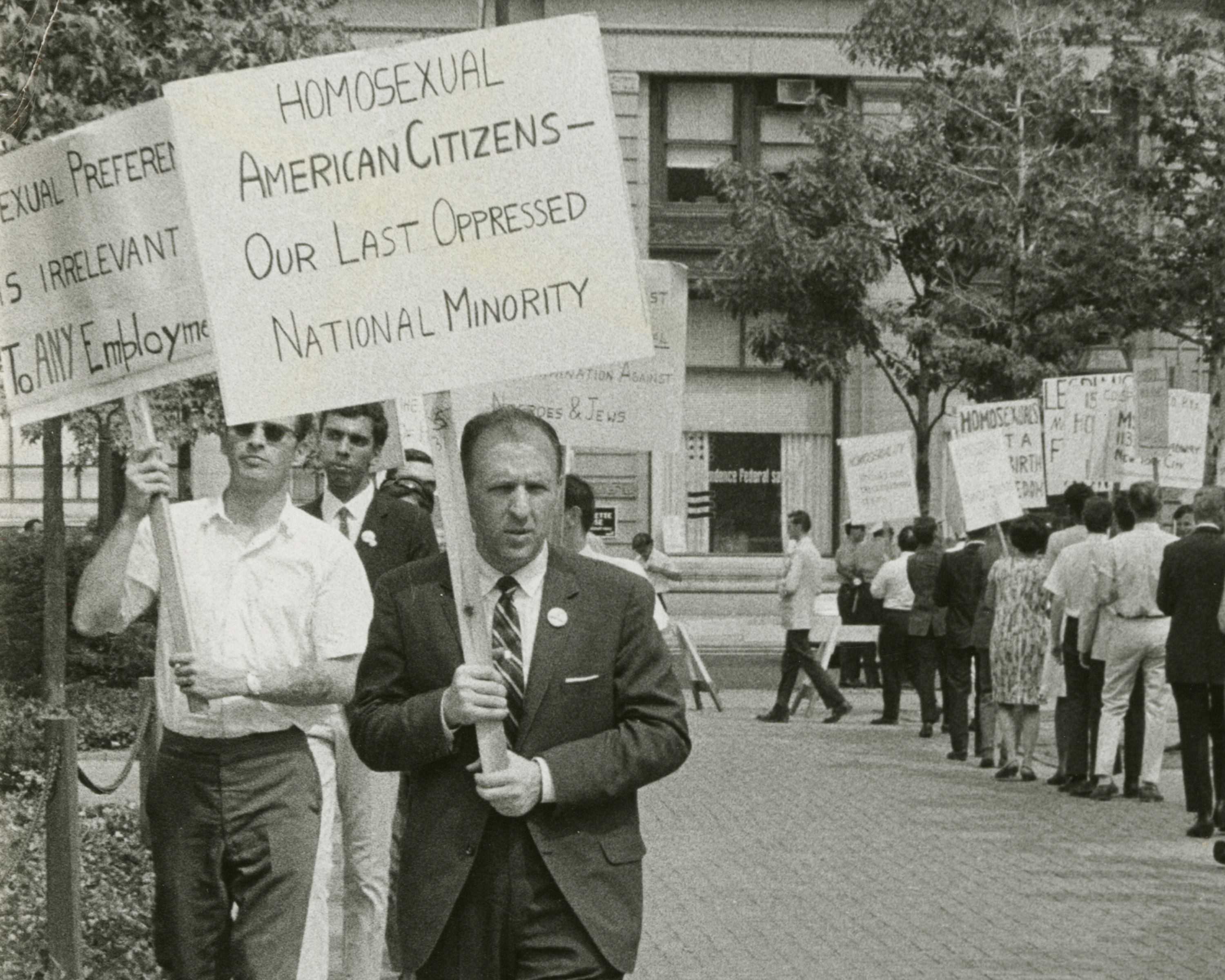
Much like the Red Scare of the same period, McCarthy’s Lavender Scare claimed that the government was under threat from another group of deviants. However, the Lavender Scare was concerned that homosexuals had infiltrated the government and posed a threat to national security. Cold War fears of possible threats to Western civilization made communism the equal to the “perversion” of homosexuality. Homosexuality’s role in the colorful scares of the Cold War was that, officially, their sexuality made them susceptible to blackmail, but queer people were feared to be plotting to take over the world for communists. “Perverts” were seen as one of the biggest threats of the country and the American way of life, and politicians often discussed these “dangers.” After “othering” queer people, the U.S. State Department fired 91 employees in 1950 due to suspicion of homosexuality.
Astronomer Frank Kameny was no different, as in 1957 he became one of the hundreds of federal employees fired for being gay. He was questioned by officials about his sexuality and later fired by the Army Map Service. After he was fired, he couldn’t find any work since he lost his security clearance, required for almost all astronomy jobs of the time. So, he sued the Civil Service Commission on the basis that civil rights could not be denied due to sexual orientation. He lost twice, despite working with organizations that advocated for gay rights. The Supreme Court refused to hear Kameny’s statements, so he became a full-time campaigner for gay rights.
On July 4, 1965, Frank Kameny led a protest in front of Independence Hall in Philadelphia with forty people. That protest was the largest demonstration for queer rights until that point in world history. His campaigning often involved this, as well as his presidency of the Mattachine Society of Washington, the same organization that helped him with his lawsuits. He testified before Congress, wrote to politicians, picketed, became a member of the ACLU, and helped others fired from their federal jobs. Inspired by the Black Power “Black is beautiful” slogan, Kameny came up with “Gay is good,” often seen in his famous signs.
Crain, Caleb. “Frank Kameny’s Orderly, Square Gay-Rights Activism.” The New Yorker. https://www.newyorker.com/magazine/2020/06/29/frank-kamenys-orderly-squ…. Accessed 18 March 2023.
Frank Kameny Picketing. July 4, 1965. https://www.thelavenderscare.com/epk. Accessed 2 April 2023.
Wills, Matthew. "The Lavender Scare." JSTOR Daily. https://daily.jstor.org/the-lavender-scare/. Accessed 18 March 2023.
The reason that I offered that background concerning those three events is because it helps me to explain what Two female impersonators backstage, N.Y.C., 1962 was doing culturally and politically when Diane Arbus created it. Knowing the background of Club 82 provides context for the attitudes toward the subjects in the era. The fascination and exoticization of the performers and staff for straight white audiences lets us know how the two subjects of the photo fit into Arbus’s subject of the “freaks.” The distant and bittersweet look in their faces lets us into their world for a moment. Their lives were deemed perverse and illegal, yet they performed for the same people who often hated them otherwise. They constantly faced threats of violence in their lives for being who they felt most comfortable as, but they found safety with each other. So, Arbus’s photograph of these two individuals is daring for the time, exposing the truth behind the act in Club 82.
Frank Kameny’s story of becoming a gay rights activist perfectly describes the atmosphere of Cold War America. Much like today, queer people were seen as indecent, perverts, liabilities, dangerous, and more. The government did not care for them, as seen in Kameny’s legal battles. People would lose their livelihoods because they were gay or simply suspected of being gay. Thus, we know why Arbus wanted to photograph those within the community. They were “forbidden.” The atmosphere, however, was changing by the time Arbus captured her photograph. There were campaigns for gay rights starting in the country, and Kameny was part of the reason for that.
Furthermore, we would not truly understand the purpose of Arbus’s photography if we did not know the background she came from. She disliked the restrictive and artificial nature of fashion photography, and she wanted to explore her own craft. If she had never quit the business she ran with her husband, she would have never discovered her subject for her own photography. If it weren’t for her time in the fashion industry, she would have never had a drive to capture what society turns away from. Her subjects were quite literally the antithesis of what she had done before with her husband. Her art came from a newfound sense of freedom, and the purpose of this piece is only understood properly when understanding that.
This photograph breaks the cultural and political rules of the time, exposing and humanizing the queer community with honesty unfamiliar at the time. Knowing the context behind the subjects, atmosphere, and artist allow us to understand the honesty Arbus was exposing in her art. All the events lead into each other, and these intersections in the context of the piece allow us to understand what Arbus wanted to create with her art, and the message within this piece.
"There's a quality of legend about freaks. Like a person in a fairy tale who stops you and demands that you answer a riddle. Most people go through life dreading they'll have a traumatic experience. Freaks were born with their trauma. They've already passed their test in life. They're aristocrats." - Diane Arbus