
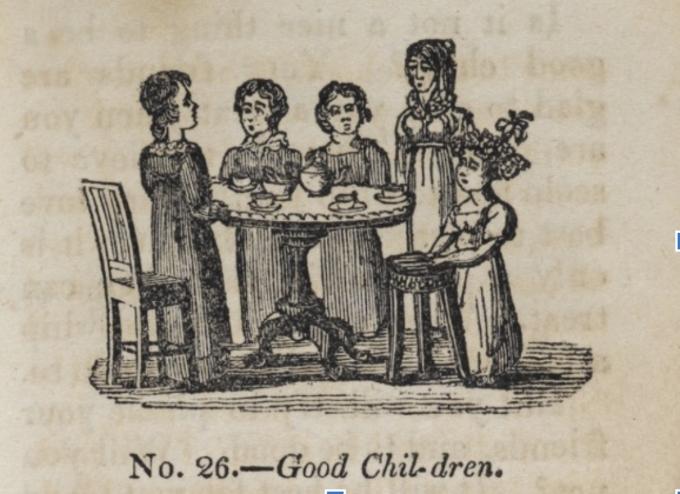
- A stand-out primary source for us was Child’s First Tales, a children’s book written by William Carus Wilson -- the headmaster of a school that all four of the Bronte sisters attended. It contains many stories depicting various events involving children, all of which emphasize the expectations that children had to live up to in order to please adults such as Wilson. The extreme implications of their ability (or lack thereof) to meet these expectations stunted the growth of the typical Victorian child.
- Notably, Charlotte Bronte based the character of Brocklehurst on Wilson himself, which makes a lot of sense in context with many of these stories.
- For instance, story no. 26 (titled Good Children) opens by describing a group of children who are making tea -- “one makes the tea… one puts in the sugar… one pours out the milk… and oh! They are all so happy” (Wilson). This doesn’t seem so extreme at first, similarly to the progression of many of the book’s stories. However, what soon becomes clear are the severe implications resulting from whether or not children abide to the obedient norm implicit in that earlier scene; “Is it not a nice thing to be a good child? Your friends are glad to give you a treat when you are good… But then it is only a good child that they can treat. They must scold and whip a bad one. God tells them to do so” (Wilson, my emphasis). This is taken to the next level in story no. 80, in which a little girl was “in such a rage, that all at once God struck her dead,” and she ends up in Hell to top it off (Wilson).
- This book’s stories represent the unforgiving lens through which children were viewed during the 1800’s. According to Wilson, and likely most of the adults who subscribed to an ideology similar to his, children were rightfully subject to extreme consequences for common everyday failures, such as not properly helping with tea-making or being “in a rage.” Instilling that cause-and-effect in the minds of children, while strikingly using God as a basis for its justification, must have been harmful to Victorian childrens’ coming-of-age. In fear of facing harsh consequences like the ones handed down to “bad children” in stories like this one, Victorian children needed to suppress their truest selves in favor of strictly conforming to the Victorian ideal.
- Overall, this source was very insightful to our knowledge of the rigidity and conformity that Victorian adults required of their children, which was explicitly depicted in both Jane Eyre (through the harshness with which Jane is punished for acting out by her peers at Gateshead-- especially Mrs. Reed) and Ruth Hall (through the demands of Mrs. Hall to Katy during her stay there).
Featured in Exhibit
Copyright
©
Vetted?
No