
Display Explanation:
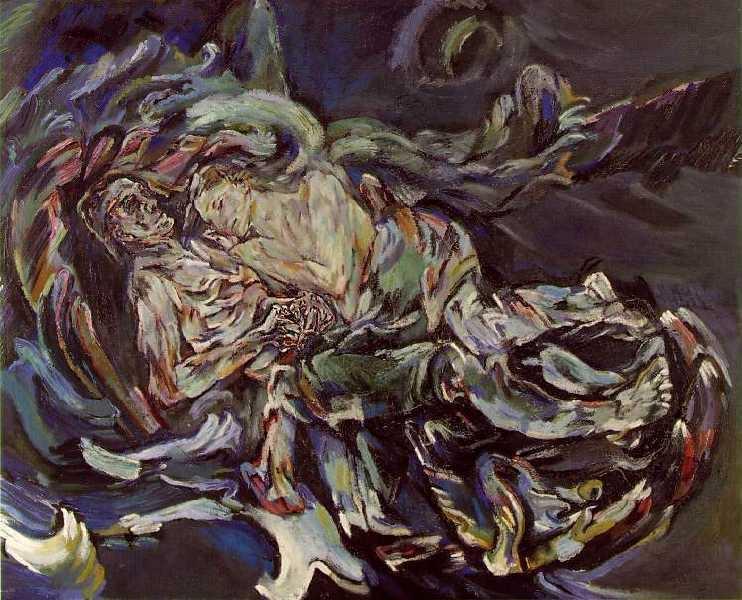
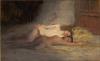
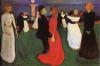
As guests walk in through two wide red doors, they are welcomed into an almost dome-like room. Three walls are painted with a warm tan color, each has its painting, adjacent walls are open space. The paintings are suspended fifteen feet above the audience, hanging by strings. The artwork is all framed in simplistic black frames. This allows the attention to be directed to the paintings. The art angles slightly downwards onto the viewers. The paintings are displayed at an acute angle. The audience looks up to observe the paintings. The first one their attention is directed to is “The Bride of the Wind,” by Oskar Kokoschka. There is sort of a “gloomy” environment surrounding the painting: thunder, wind, and rain sounds. There are occasional flashes of light, like lightning. Although the weather (environment) is tumultuous, the two depicted in the painting hold each other close. On the next wall, we see the next painting, “Victory of Faith,” by George Hare. It depicts another couple. The light around this painting is warmer, compared to the cool lighting of the first painting. There are more nature sounds, with a slight undertone of growling due to the beasts in the piece. As the audience moves to the final piece, “The Dance of Life,” by Edvard Munch they are presented with music— a genre of folk. There is also subtle chatter around this painting, like at a cafe. There is a slight red hue of light to the painting, not like the other two. The audience exits out of a yellow door. There is ample space between the paintings, allowing for the sounds not to overlap and become overwhelming to the viewer.
Installation Note:
The three paintings within my installation are on a spectrum. “The Bride of the World,” by Oskar Kokoschka has a blue and cool-toned color palette. The couple almost blends into each other, the viewer cannot tell where they are two separate people or one person. This elicits a sense of togetherness and unity. The “Victory of Faith,” by George Hare, is a much warmer image. The women (could be interpreted as a couple) are close together resting. Behind them, are lions referred to as “beasts.” Although the impending danger there is still a sense of comfort. “Dance of Life”, by Edvard Munch showcases another couple dancing. This painting is a little different from the others because there is more going on. There are other couples in the background dancing, and then a woman on each side. The woman in the white dress resembles purity, maybe she was “good” for the man. The woman in the black gives off an authorial stance, she could also be perceived as “good” for the man.
The color red normally carries a negative connotation, the woman in red could be representing aggressions or toxicity. These things are “bad” for the man, yet he chooses them over other options. This painting has the same central tone of being in harmony with your partner as the other paintings do. All the people in the paintings are almost oblivious to their surroundings, just focusing on each other. Overall, the paintings all display their version of sexuality. Whether it is two people intertwined, two women, or a couple.
MLA entries:
Kokoschka, Oskar. The Bride of the Wind.
,_1913.jpg)
Accessed 8 Feb. 2022.
Hare, George. Victory of Faith.
https://commons.wikimedia.org/wiki/File:George_Hare_-_Victory_of_Faith.jpg

Accessed 29 Jan. 2022.
Munch, Edvard. The Dance of Life
https://www.edvardmunch.org/the-dance-of-life.jsp
Accessed 8 Feb. 2022.